
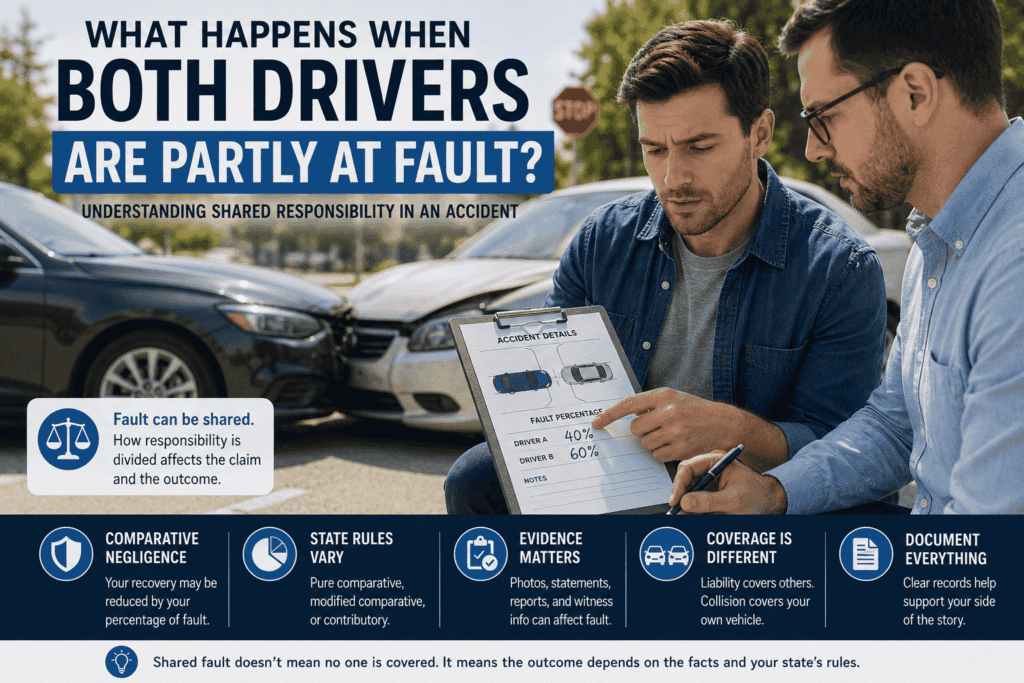
When both drivers are partly at fault for a car accident, the insurance outcome can depend on each driver’s share of responsibility, the available coverage, the evidence, and the negligence rules that apply in the state. There is no single national formula for every shared-fault accident.
Insurance companies evaluate the facts of the crash when making claim decisions, while courts can ultimately decide legal responsibility if a dispute becomes litigation. For the broader process after an accident, start with our guide to the car insurance claims process.
Quick Summary
- Both drivers can share responsibility for the same accident.
- Comparative negligence can reduce a person’s recovery based on that person’s share of fault.
- Modified comparative negligence uses a state-specific threshold that can affect whether recovery is available.
- Contributory negligence is a stricter approach used in a limited number of jurisdictions.
- Insurance coverage and legal fault are related but are not the same question.
- Shared-fault rules vary by state, so one state’s outcome should not be treated as a national rule.
Can Both Drivers Be Partly at Fault?
Yes. Some accidents involve actions by both drivers that contribute to the collision. One driver might make an unsafe lane change while the other follows too closely. A driver turning across traffic might misjudge the available space while another vehicle is traveling faster than expected.
The California Department of Insurance explains that both drivers may share fault in an accident and describes comparative negligence as each driver’s share of responsibility. California is one state example; the rules used elsewhere can be different.
Our guide to how insurance determines fault explains the types of evidence insurers may review when deciding responsibility for a claim.
What Evidence Can Affect a Shared-Fault Decision?
Insurers may review driver statements, vehicle damage, photos, video, witnesses, road markings, traffic signals, and police reports. A police report can be useful, but it does not automatically determine the insurer’s liability decision or a court’s legal conclusion.
What Is Comparative Negligence?
Cornell Law School’s Legal Information Institute explains comparative negligence as a legal principle that reduces a person’s recovery according to that person’s share of responsibility for the incident.
For a simplified example, imagine one party has $10,000 in damages and is assigned 30% of the responsibility. Under a pure comparative negligence approach, that person’s potential recovery from the other side could be reduced by 30%. The example illustrates the concept only; actual claim outcomes depend on state law, evidence, damages, coverage, and other factors.
Pure vs. Modified Comparative Negligence
Not every comparative-negligence state uses the same system. Cornell LII explains two broad approaches: pure comparative negligence and modified comparative negligence.
Pure comparative negligence
Under the pure approach, a person’s recovery can generally be reduced according to that person’s percentage of fault even when the percentage is high.
Modified comparative negligence
Modified systems use a threshold. Cornell explains that some use a 50% bar while others use a 51% bar. Reaching the applicable threshold can prevent recovery from the other party. Because that distinction is state-specific, do not assume a percentage rule found online applies where your accident occurred.
What Is Contributory Negligence?
Cornell LII describes contributory negligence as a stricter rule under which a claimant’s own negligence can prevent recovery from another negligent party. Most jurisdictions have moved away from this approach, but it remains relevant in a limited number of jurisdictions.
This is one reason shared-fault questions can become legally significant. This article explains general insurance concepts and is not legal advice. A real dispute involving injuries, litigation, or significant losses may require state-specific professional guidance.
How Can Shared Fault Affect an Insurance Claim?
Shared responsibility can affect how much one insurer is willing or required to pay another party. The effect depends on the state’s negligence rules and the facts of the accident.
It also helps to separate liability from coverage for your own vehicle. The National Association of Insurance Commissioners explains that liability coverage addresses injuries or property damage caused to others, while collision coverage addresses physical damage to your own vehicle from a collision, subject to the policy.
If you carry collision coverage, you may be able to use your own policy for covered vehicle damage even while responsibility between the drivers is disputed. Your deductible can apply according to your policy. The insurer may later consider whether recovery from another responsible party is possible.
Our guide to liability vs. full coverage explains why responsibility for another driver’s damage is different from having physical damage coverage for your own vehicle.
What If the Insurers Disagree About Fault?
Different insurers may initially reach different conclusions from the same accident. One may believe its driver was 20% responsible while the other assigns a different percentage. That does not necessarily mean either decision is final.
If you disagree with a liability decision, ask the insurer to explain what evidence it considered and what facts led to its conclusion. Then identify factual errors or provide additional evidence instead of responding only that the percentage feels unfair.
Documentation such as clear photographs, video, witness information, traffic-control evidence, or corrected information about the sequence of events may be more useful than repeating the same version of the accident.
What Should You Do When Both Drivers May Share Fault?
- Report the accident promptly. Give your insurer an accurate factual description.
- Preserve evidence. Save photos, videos, witness information, and police report details.
- Describe facts instead of guessing about legal responsibility. Explain what each vehicle did and what you observed.
- Ask for the liability decision in writing. Find out what evidence supported the insurer’s conclusion.
- Correct factual mistakes. Provide documents or evidence supporting the correction.
- Check your own coverage. Collision or other coverage may affect how your vehicle damage can be handled while liability remains disputed.
Conclusion
When both drivers are partly at fault, the insurance result depends on evidence, available coverage, each driver’s share of responsibility, and the negligence rules that apply in the state. Pure comparative negligence, modified comparative negligence, and contributory negligence can produce different results.
For a practical claim, focus first on documentation. Ask how the insurer reached its liability decision, correct factual errors with evidence, and avoid treating a rule from another state as if it automatically controls your claim.
Related
Frequently Asked Questions
Can both drivers be found partly at fault?
Yes. Depending on the accident and applicable state rules, responsibility can be shared between drivers rather than assigned entirely to one person.
Does shared fault mean no one gets paid?
Not necessarily. The result depends on the state’s negligence system, the assigned percentages, damages, available coverage, and the facts of the claim.
Does a police report decide who is at fault?
A police report can be important evidence, but insurers conduct their own claim investigations, and courts can ultimately determine legal responsibility if a dispute becomes litigation.
Are shared-fault rules the same in every state?
No. States use different negligence systems and thresholds, so the effect of the same fault percentage can vary by jurisdiction.