
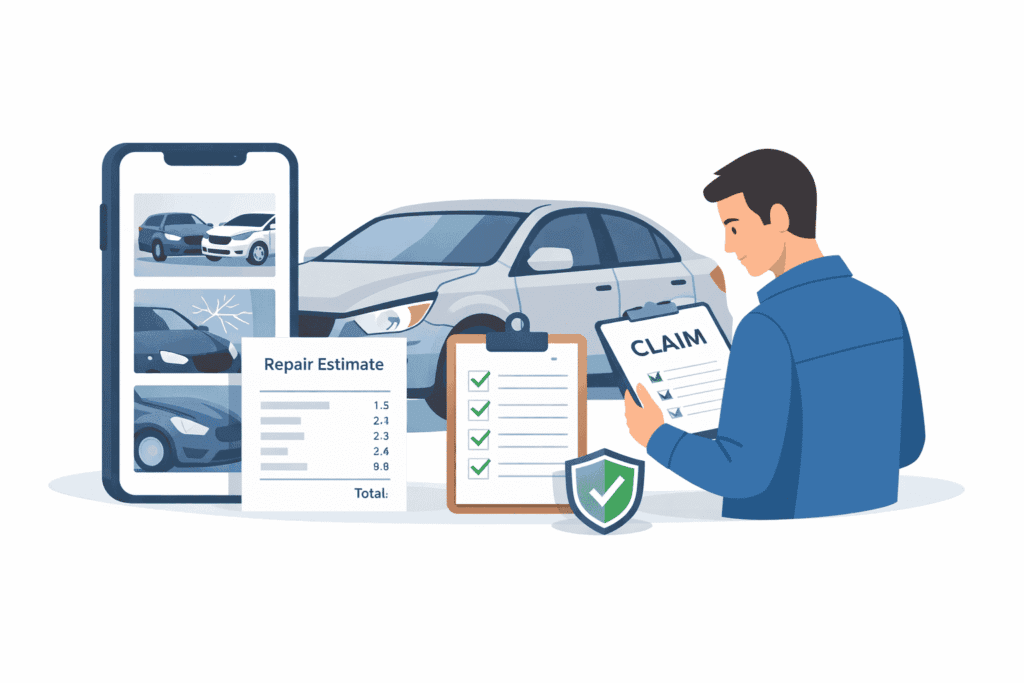
The car insurance claims process usually starts when a driver is already stressed. A crash, theft, hailstorm, vandalism problem, or sudden repair estimate can turn into a long list of questions almost immediately. Who should you call first? What documents matter most? How does the insurer decide what is covered? And why do some claims move quickly while others drag on?
For related context, see rental reimbursement vs rental car coverage.
For related context, see rights after a car accident.
In practice, most claims follow a predictable structure. The insurer opens a file, reviews the policy, checks the facts, evaluates the damage, applies deductibles or limits, and then decides whether the claim should be approved, partly approved, or denied. The details can vary by claim type, policy language, and state rules, but the overall path is often similar.
This guide explains how the process usually works in real life, what each step is trying to answer, what often slows things down, how payment is usually handled, and what to review before you assume a loss will be paid. Before getting too deep into claim steps, it helps to check your car insurance declarations page, because that is often the fastest way to confirm your active coverages, deductibles, limits, vehicles, and listed drivers.
Quick Summary
- The car insurance claims process is how an insurer reviews a reported loss to decide whether it is covered and how much the policy should pay.
- Most claims follow the same general flow: report the loss, verify coverage, investigate facts, evaluate damage, apply policy rules, and make a decision.
- Delays often come from missing documents, disputed facts, repair supplements, policy questions, or multiple parties being involved.
- Approval does not always mean one direct payment to the driver.
- The most important things to check are coverage type, deductible, limits, exclusions, and what evidence supports the claim.
What the Car Insurance Claims Process Actually Means
The car insurance claims process is the step-by-step review an insurance company uses after a loss is reported. At its core, the insurer is usually trying to answer two questions: does the policy cover this event, and if it does, how much should be paid after the policy rules are applied?
That sounds simple, but the answer depends on more than the fact that damage happened. The insurer may need to confirm whether the policy was active on the date of loss, whether the driver was covered, which coverage section applies, whether the damage matches the reported event, whether a deductible applies, and whether any exclusion changes the result.
Many misunderstandings happen because drivers think filing a claim and proving a covered loss are the same thing. They are not. Filing starts the review. Coverage still has to be confirmed. If you are only trying to understand your policy before reporting a specific loss, see whether you can ask your insurer a question without opening a claim. If you later decide not to continue with a claim, see whether you can withdraw a car insurance claim after filing. If you want a cleaner foundation before looking at claims, read What Is Car Insurance and How Does It Work? first, then come back to this guide.
How the Car Insurance Claims Process Works in 9 Steps
Below are the 9 steps that really happen in many claims. Some simple files move fast. Others take longer because they involve injuries, multiple vehicles, unclear fault, hidden damage, or questions about whether the policy applies the way the driver expected.
- The loss happens and you document what you can.
Take photos, note the time and location, save names and contact details, and keep any early records tied to the incident. If there are injuries, safety and medical care come first. - You report the claim.
You contact your insurer, or sometimes another insurer involved in the event, and explain the basic facts: what happened, when it happened, where it happened, and who was involved. The National Association of Insurance Commissioners also recommends reporting the loss promptly and keeping claim information organized. See its consumer guidance on filing an auto insurance claim. - A claim file is opened.
You usually receive a claim number, and a claims representative or adjuster becomes the main contact for the file. - Coverage is reviewed.
The insurer checks whether the policy was active and which coverage might apply, such as liability, collision, comprehensive, PIP, MedPay, or uninsured motorist protection. - The facts are investigated.
For simple damage, photos and a short statement may be enough. For more complex losses, the insurer may review police reports, witness details, recorded statements, prior damage questions, repair history, or scene evidence. Claim-history information may also be relevant in some situations, which is why it can help to understand what a CLUE report shows and how insurers may use it. - Damage or loss value is evaluated.
The insurer reviews estimates, photos, inspections, or valuation data. This may be done through photo estimating, a shop estimate, a field inspection, or a total-loss valuation process. If repairs have not started yet, see how a car inspection before repairs may work and what to document before permanent work begins. - Deductibles, limits, and exclusions are applied.
Even when a loss appears covered, the policy rules still matter. A deductible may reduce payment. A limit may cap it. An exclusion may remove coverage for a specific situation. - A decision is made.
The insurer may approve the claim, approve only part of it, or deny it based on the policy language and the facts reviewed. - Payment and repairs are handled.
If the claim is approved, payment may go to you, a repair facility, a medical provider, another party, or more than one recipient. If hidden damage appears during repairs, a supplemental estimate may be submitted for review.
Most confusion happens in steps 4 through 8 because that is where coverage language, evidence, deductible rules, and damage calculations matter most. That is also why a claim can feel simple at first and then slow down later. For a deeper look at timing, see how long a car insurance claim can take.
How the Process Changes Depending on the Type of Claim
The basic structure stays similar, but the details change based on the kind of loss being reported.
Liability claims
A liability claim usually focuses on damage or injuries you allegedly caused to someone else. These claims often require more discussion about fault, statements, and supporting evidence. Payment may not go to you at all, because the claim may involve the other driver, a repair shop, or medical providers.
Collision claims
A collision claim usually involves damage to your own vehicle after impact with another vehicle or object. These claims often move through estimate review, deductible handling, repair approval, and sometimes a supplemental review after teardown reveals hidden damage. The repair estimate may also specify OEM, aftermarket, recycled, or other replacement parts; CPA’s guide to whether car insurance can require aftermarket parts explains how policy language and state rules can affect that decision. If another driver caused the crash, see whether you may still have to pay a deductible when someone hits you. If the other driver leaves the scene, CPA’s guide to whether collision insurance covers hit-and-run damage explains how collision and uninsured motorist property damage may come into play.
Towing after a crash may be included in the broader claim or handled under a separate emergency-service benefit, depending on the policy and circumstances. Review how roadside assistance coverage may handle towing and related service limits.
Comprehensive claims
Comprehensive claims usually involve non-collision losses such as theft, vandalism, hail, fire, falling objects, flood damage, or animal-related damage. These claims can sometimes require different documents than a normal crash claim. For example, if a parked vehicle has chewed wiring or other signs of animal activity, CPA’s guide to whether car insurance covers rodent damage explains what evidence can help document the cause of loss. Some files also raise immediate questions about whether a police report was required. That is where a claim denied without a police report becomes a real concern.
Animal-strike claims may also involve immediate safety decisions, towing, photographs, and damage that is not fully visible at the roadside. Review what to do after hitting a deer for insurance purposes before repairs or cleanup remove useful evidence.
Injury-related claims
Injury claims usually require more paperwork than vehicle-only claims. Medical bills, treatment records, timing, fault rules, and state-specific systems may all matter. Even when the accident facts are clear, the claim may stay open longer because more treatment or documentation is still coming in.
Total loss claims
A total loss claim happens when repairing the vehicle no longer makes practical sense under the policy and the applicable threshold. At that point, the file shifts away from a normal repair workflow and into valuation, deductible handling, settlement review, and lender or lease payoff questions. That is why this topic naturally connects to Total Loss in Car Insurance: How It’s Decided and Paid. If you are reviewing the final offer, CPA’s guide to whether a total-loss settlement includes sales tax and fees explains how taxes, title, registration, and transfer-related amounts may vary by state. Weather losses can reach the same stage, including situations where hail damage results in a total-loss review.
What Usually Slows a Claim Down
Some claims are resolved quickly because the facts are clear and the documentation is complete. Others slow down for reasons that have nothing to do with bad faith or bad intentions.
- Missing information: incomplete photos, unclear timelines, missing receipts, or incomplete contact details.
- Coverage questions: uncertainty about who was driving, whether the policy was active, or what use of the vehicle was involved.
- Disputed facts: conflicting statements, no witnesses, unclear fault, or damage that does not match the reported event.
- Repair issues: shop backlog, parts shortages, hidden damage, or disagreement about estimate scope.
- Injury complications: continuing treatment, multiple providers, or incomplete medical records.
- Ownership issues: lender, lease, or title problems that affect payment handling.
One practical habit helps almost every claim: keep a simple file with photos, estimates, receipts, emails, letters, report numbers, and notes from calls. For a practical checklist, review which documents help support a car insurance claim.
How Payments Usually Work After Approval
Many drivers assume that once a claim is approved, the insurer simply sends one check and the matter is over. In reality, payment handling can vary a lot depending on the claim type and the vehicle’s ownership details. If the payment is issued directly to you, see whether you can cash an insurance check without repairing your car and what lender, lease, safety, and future-claim issues may still matter.
- Repair claims: payment may go directly to the shop, to you, or jointly to multiple parties.
- Liability claims: payment may go to the damaged third party, their shop, or medical providers.
- Total loss claims: payment is usually based on vehicle value, then adjusted by deductible and other policy terms.
- Supplemental repairs: if more damage is found after work begins, the shop may submit an additional estimate.
- Lender or lease interests: a bank or leasing company may need to be included in the payment process.
That is why an approved claim does not always mean money goes straight to the driver in one fast payment. Approval answers the coverage question. Payment still follows the repair path, valuation process, and ownership details tied to that file.
What to Do If You Disagree With the Decision
If you think the insurer missed something, the most useful first step is to ask for the explanation in writing. That helps you compare the decision to the actual policy language and figure out whether the disagreement is about facts, repair scope, valuation, documentation, or coverage interpretation.
- Ask which policy section the insurer relied on.
- Request clarification on anything excluded, reduced, or partially denied.
- Provide missing photos, receipts, estimates, or timeline details if they were not reviewed.
- Keep your communication organized and specific.
- Compare the reason given to common denial patterns, including Can an Insurance Company Deny a Claim?.
If the disagreement cannot be resolved directly, consumers can identify and contact their state insurance department through the NAIC state insurance department directory. If you are ready to escalate the issue, see how to file a complaint against a car insurance company, including what documents to prepare and what a state regulator may review.
Not every disagreement means the claim was handled incorrectly. Sometimes the issue is simply that the policy never covered that kind of loss. Other times, better documentation changes how part of the file is evaluated.
Common Questions Drivers Ask During a Claim
“If I file a claim, will I automatically be paid?”
No. Filing starts the review. Coverage, deductibles, limits, exclusions, and supporting evidence still affect the outcome.
“Does an adjuster asking more questions mean something is wrong?”
Not necessarily. It often means the insurer is trying to match the reported facts to the policy and avoid paying the wrong amount or the wrong party.
“If part of the estimate is not paid, was the whole claim denied?”
No. A claim can be partially approved. Some repair items may be covered while others are excluded, unrelated, unsupported, or outside a policy limit.
“Do all claims move at the same speed?”
No. A simple glass, hail, or parked-car damage claim can move very differently from a multi-vehicle injury claim with disputed facts.
“What should I check first before I argue with the insurer?”
Start with the declarations page, the specific policy section involved, your deductible, your limits, and the written reason for the insurer’s position.
What to Check Before You Assume a Claim Will Be Simple
Use this checklist when you want a calmer, more organized claim experience:
- Confirm what coverage you actually have before discussing payment expectations.
- Document the loss clearly with photos and basic notes.
- Keep names, dates, claim numbers, and repair paperwork organized.
- Respond to document requests quickly and completely.
- Ask for written explanations when something is delayed, reduced, or denied.
- Separate what feels unfair from what the policy actually says.
Most claim stress comes from uncertainty, not only from the damage itself. The clearer your records are, the easier it becomes to understand what is happening and why.
For official context, California DOI describes claim documentation, OPIC advises keeping estimates and receipts, and NAIC explains consumer complaint options.
Conclusion
The car insurance claims process is not random, even when it feels messy. In most cases, the loss is reported, a file is opened, coverage is reviewed, facts are checked, damage is evaluated, policy rules are applied, and a decision is made about payment, repairs, or denial.
The biggest misunderstandings usually come from skipped details: not checking the policy first, assuming filing means approval, or not realizing how much deductibles, limits, exclusions, and documentation shape the final result. Once you understand the 9 steps and what each one is trying to answer, the whole process becomes easier to follow.
Related
- How Long Does a Car Insurance Claim Take?
- Can a Claim Be Denied Without a Police Report?
- Total Loss in Car Insurance: How It’s Decided and Paid
FAQ
How long does the car insurance claims process usually take?
It depends on the claim type, the available documents, repair complexity, and whether fault or coverage is disputed. Simple claims may move quickly, while injury or multi-party claims often take longer.
Can a claim be approved for some damage but denied for other parts?
Yes. A claim can be partially approved. Some items may be covered while others are excluded, unrelated to the reported loss, unsupported, or limited by policy terms.
Will the insurer always inspect the vehicle in person?
No. Some claims are handled through photos and digital estimates, while others require a shop review, field inspection, or total-loss valuation process.