
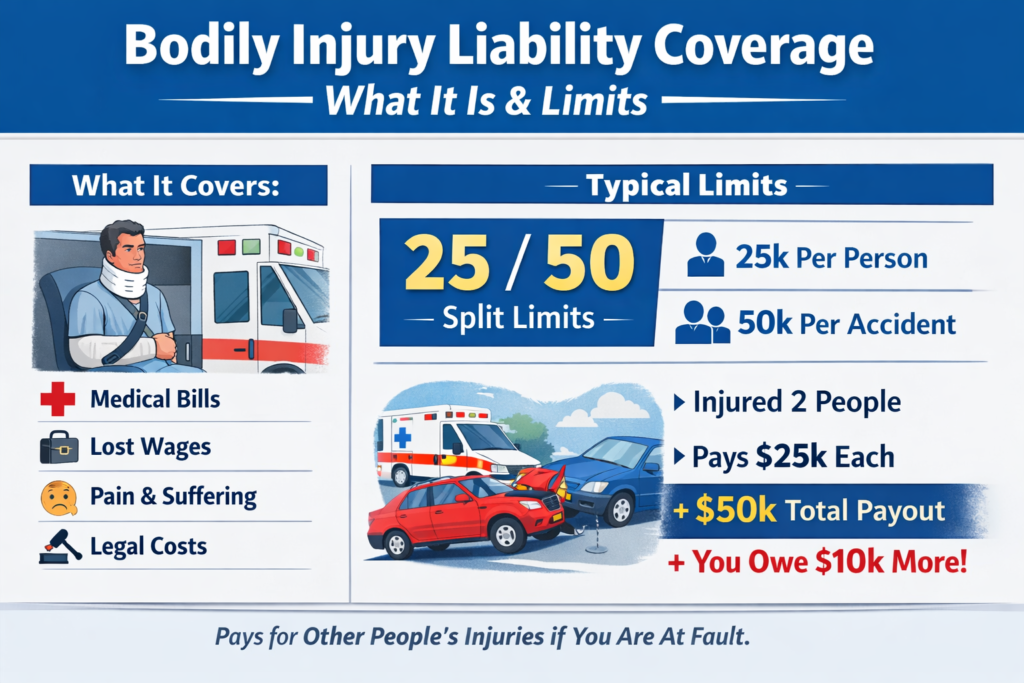
Bodily injury liability coverage helps pay for injuries to other people when you cause a car accident. It can apply to medical bills, lost wages, and legal claims after an at-fault crash.
For official context, NAIC describes bodily injury liability as part of common auto liability coverage.
For related context, see car insurance accident coverage.
Many drivers see this coverage on the declarations page without knowing what it pays for or how its limits work. That matters because bodily injury liability is often required by state law and may protect you from major injury-related costs.
For the broader coverage picture, start with What Does Car Insurance Cover?. This guide explains what bodily injury liability may pay for, what it usually excludes, how limits work, and where to find the coverage on your policy.
Quick Summary
- Bodily injury liability coverage helps pay for injuries to other people when you cause an accident.
- It may cover medical bills, lost wages, legal defense, and some injury-related claims.
- It usually does not pay for your own injuries or damage to your own car.
- Limits matter because serious injury claims can exceed low coverage amounts.
- Your declarations page is usually the fastest place to confirm whether this coverage is listed and what limits apply.
What is bodily injury liability coverage?
Bodily injury liability coverage is the part of your auto insurance policy that may help pay for injury-related costs suffered by other people when you are legally responsible for a crash. That can include the other driver, passengers in another vehicle, pedestrians, bicyclists, or, in some situations, passengers riding with you.
It is important to separate this from other types of coverage. Bodily injury liability is about other people’s injuries when you are at fault. It is not mainly designed to pay for your own medical treatment. It is also different from property damage liability, which focuses on damage to cars, fences, buildings, and other property rather than physical injuries.
The National Association of Insurance Commissioners explains that auto liability insurance generally includes bodily injury and property damage protection, while requirements and minimum limits vary by state. See its overview of auto insurance coverages.
What bodily injury liability coverage may pay for
When it applies, bodily injury liability coverage may help pay for several injury-related costs tied to a covered at-fault accident. These may include:
- Emergency medical care and hospital bills
- Follow-up treatment, rehabilitation, or physical therapy
- Lost wages if the injured person cannot work
- Some pain and suffering claims, depending on the facts and state rules
- Legal defense costs if you are sued over a covered accident
What gets paid depends on the policy language, the injuries, the claim investigation, and applicable state rules.
What bodily injury liability coverage usually does not pay for
This is where many misunderstandings happen. Bodily injury liability coverage is usually for other people’s injuries, not your own. It typically does not pay for:
- Your own injuries after a crash
- Damage to your own vehicle
- Damage to someone else’s vehicle or property
- Intentional harm or excluded situations under the policy
Your own injuries may instead fall under other coverages, such as PIP or MedPay where available, or under the other driver’s liability coverage if that driver caused the crash. Damage to your own car is usually handled by collision, while damage to someone else’s vehicle is usually tied to property damage liability.
How bodily injury liability limits work
Your policy does not provide unlimited protection. Bodily injury liability coverage comes with limits, which are the maximum amounts the insurer may pay for covered injury claims. These limits are often shown in split format, such as 25/50 or as part of a broader liability format like 25/50/25.
In simple terms, bodily injury liability often works with:
- A per person limit — the maximum paid for one injured person
- A per accident limit — the maximum paid for all injured people combined in one accident
For example, if your bodily injury liability limits are 25/50 and you cause an accident that injures two people, the policy may pay up to $25,000 for one person and no more than $50,000 total for the accident, assuming the claim is covered. If the total injuries and settlement costs go above that amount, you may be personally responsible for the rest.
If those number formats look confusing, this guide on car insurance policy limits breaks them down in a more practical way.
When bodily injury liability coverage usually applies
Bodily injury liability coverage usually applies when three basic things are true:
- You are found legally responsible for the accident
- Another person is injured and makes a claim
- The situation is not excluded by your policy terms
That may sound straightforward, but real claims are not always simple. Fault can be disputed. Injuries may take time to evaluate. A claim may involve passengers, pedestrians, or multiple vehicles. And in some states, no-fault rules can affect how some medical costs are handled before bodily injury liability becomes the main issue.
Where to find bodily injury liability coverage on your policy
The fastest place to look is usually your car insurance declarations page, often called the dec page. Look for wording such as Bodily Injury Liability or BI Liability, followed by the limits.
If you are not sure how to read that page, this guide on the car insurance declarations page shows what to look for and how policy details are usually organized.
Conclusion
Bodily injury liability coverage helps protect you financially when you cause an accident that injures other people. It may help pay for medical bills, lost wages, legal defense, and other injury-related claims, but it usually does not pay for your own injuries or damage to your own vehicle.
The most important things to understand are what this coverage is for, what the limits mean, and where to verify it on your declarations page. A low limit may satisfy a legal requirement, but it may still feel small in a serious injury claim. That is one reason this part of the policy deserves a closer look before an accident happens.
Related
FAQ
Is bodily injury liability coverage required?
In most states, some form of bodily injury liability coverage is part of the minimum liability insurance required to drive legally. The exact rules and limits vary by state.
Does bodily injury liability pay for my own injuries?
Usually no. This coverage is mainly for injuries to other people when you are at fault. Your own injuries may fall under other coverages, depending on your policy and state rules.
Does bodily injury liability cover passengers in my car?
It can in some situations, but the exact result depends on who was injured, who was at fault, and how your state handles injury claims. The policy and claim facts both matter.