
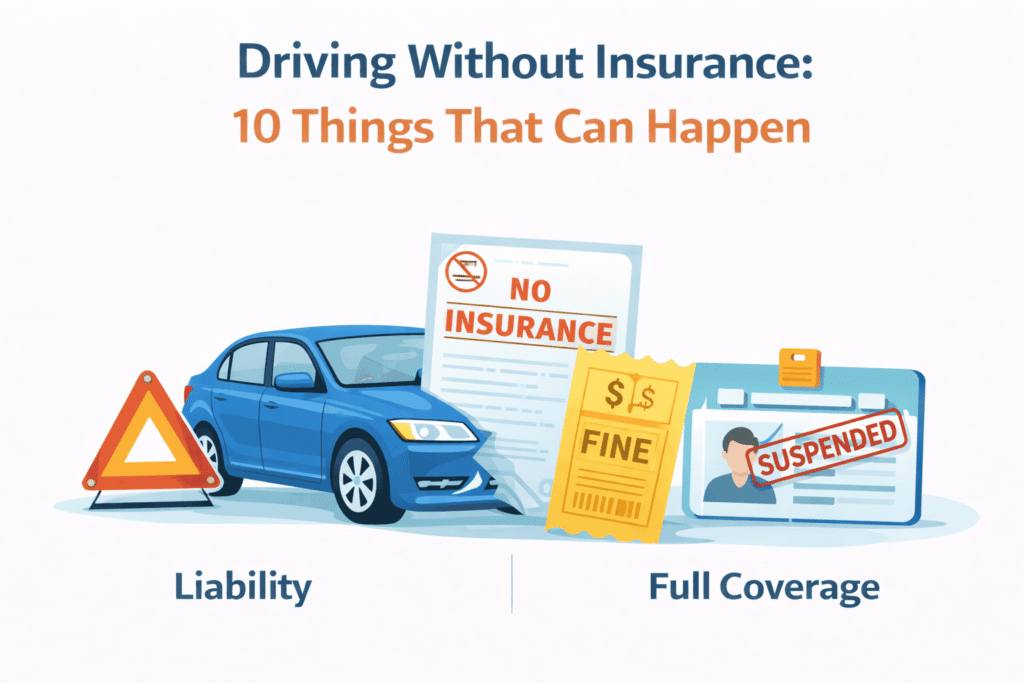
Driving without insurance can feel like a small risk until something goes wrong. Some people let a policy lapse by mistake. Others think they can “just be careful” for a few days. But a traffic stop, a parking lot crash, or a serious accident can quickly turn into a legal and financial problem. If you’re unsure what your state requires in the first place, start with Is Car Insurance Required by Law in the U.S.?.
In the United States, insurance rules are set by each state. That means the exact penalties are not the same everywhere. Still, most states require drivers to show financial responsibility, and insurance is the most common way to meet that requirement. If you’re trying to understand what liability insurance actually pays for (and what it doesn’t), see What Does Liability Car Insurance Cover?.
In this article, you’ll learn what can happen if you drive without insurance, how enforcement usually works, what changes if you cause a crash, and what steps may help you recover if your coverage lapses.
Definition / Core concept
Driving without insurance usually means operating a vehicle on public roads without the minimum required coverage (or without another approved form of financial responsibility). This can happen even if you own the car and normally have insurance, but your policy is canceled or expired.
Simple example: Your policy renews monthly, but a payment fails. The policy cancels after the grace period. If you drive to work the next morning, you may be driving uninsured even if you did not mean to. If you’re considering canceling (or you think your policy was canceled), read Can You Cancel Car Insurance at Any Time?.
How it works in practice
In many states, being uninsured becomes a problem in a few common situations:
- During a traffic stop
Police may ask for proof of insurance. If you cannot show it, you may receive a ticket or a “no insurance” citation. - When registering or renewing a vehicle
Many states require proof of insurance to register a vehicle, keep registration active, or renew plates. - After an accident
Even a minor crash often triggers proof-of-insurance requirements and reporting rules. If you’re not sure how claims work after a crash, see Car Insurance Claims Process. - Through electronic verification
Some states check insurance status using state databases. If your policy cancels, the state may be notified and take action.
If you are flagged as uninsured, you may be required to provide proof of coverage quickly to avoid added penalties.
Main types, coverage, or variations
What happens next depends on why you are uninsured and what the state requires.
Lapsed policy vs never insured
A lapse means you had insurance, but it ended due to non-payment, cancellation, or expiration. “Never insured” means you did not have coverage at all. Some states treat these situations differently, but both can lead to penalties.
Uninsured driver in a no-fault state
In no-fault states, drivers often use their own coverage (like Personal Injury Protection) for certain injury costs. If you are uninsured, you may lose access to protections that help pay medical bills quickly, and you may face additional legal consequences.
Alternatives to insurance (limited and state-specific)
A small number of states allow alternatives to traditional insurance, such as a bond, a cash deposit, or self-insurance approval. These options are not common and usually require proof that you can pay for damages yourself.
What can happen if you drive without insurance
Here are 10 common consequences of driving without insurance. Not every state applies every penalty, but these are widely seen across the U.S.
- Traffic tickets and fines
You may receive a citation for driving uninsured and have to pay penalties. - License suspension
Some states can suspend your driver’s license until you show proof of coverage. - Registration suspension
Your vehicle registration may be suspended, which can make it illegal to drive the car even if you later buy insurance. - Vehicle impoundment
In some situations, your car may be towed or impounded, especially after repeated offenses. - Proof-of-insurance requirements (SR-22 or similar)
Some states require extra proof filings for a period of time after an uninsured violation. - Out-of-pocket costs if you cause a crash
If you are at fault, you may have to pay for other people’s injuries and property damage yourself. If you caused a crash and are trying to understand what insurance would have covered, see Does Car Insurance Cover Accidents?. - Out-of-pocket costs for your own car damage
Without collision or comprehensive coverage, repairs to your vehicle may be entirely your responsibility. Related: Collision vs. Comprehensive Insurance. - Harder claims process if someone else hits you
You may still be able to pursue the other driver’s insurance, but the process can be slower and more complicated, especially if fault is disputed. For a step-by-step, see Car Insurance Claims Process. - Civil lawsuits
Serious accidents can lead to lawsuits. Insurance normally provides legal defense for covered claims. Without it, you may need to handle defense costs and judgments yourself. - Higher risk of future coverage problems
A lapse or uninsured driving record can lead to stricter underwriting rules in the future, such as added paperwork or limited options. It can also contribute to car insurance feeling expensive later, depending on the insurer and state rules. A lapse can change how insurers price you later see What Affects Car Insurance Cost?.
Costs or influencing factors (if applicable)
We won’t discuss prices, but several factors influence what happens after driving without insurance:
- Your state’s rules
Each state defines minimum requirements, penalties, and whether alternatives to insurance exist. - Whether an accident happened
Penalties and financial exposure are usually much worse when there is a crash, injuries, or major property damage. - Whether you were at fault
Fault often affects who pays, whether you can recover damages, and how the legal process works. If you’re trying to protect yourself after a crash (insured or not), see What Are Your Rights After a Car Accident?. - How long the lapse lasted
A short lapse may be easier to fix than a long uninsured period, especially if registration is suspended. - Whether this is a first offense
Repeat violations often lead to higher penalties and longer suspension periods.
The most important idea is that driving without insurance shifts risk back to you. If something expensive happens, you may have fewer protections and more personal responsibility.
Common questions or misunderstandings
Is it illegal to drive without insurance in every state?
Most states require liability insurance. A small number allow alternatives to insurance, but financial responsibility is still required.
What if I forgot my insurance card but I’m actually insured?
You may still receive a ticket for not showing proof at the stop. Some states allow you to fix this by providing proof later, but rules vary.
Can I drive an uninsured car on private property?
State insurance laws usually apply to public roads. However, if the vehicle is registered, the state may still require active insurance to keep registration valid.
What if I’m hit by an uninsured driver?
This depends on your own policy and state rules. Some drivers carry uninsured motorist coverage to help in these situations.
Does “full coverage” replace the legal requirement?
“Full coverage” is not a legal term. The legal requirement usually focuses on liability (and sometimes other required coverages in certain states).
Important to Know
Car Policy Answers is an independent educational website. We do not sell insurance, provide quotes, or recommend insurance companies.
The information in this article is intended for general educational purposes only and is based on publicly available insurance guidelines and common industry practices.