
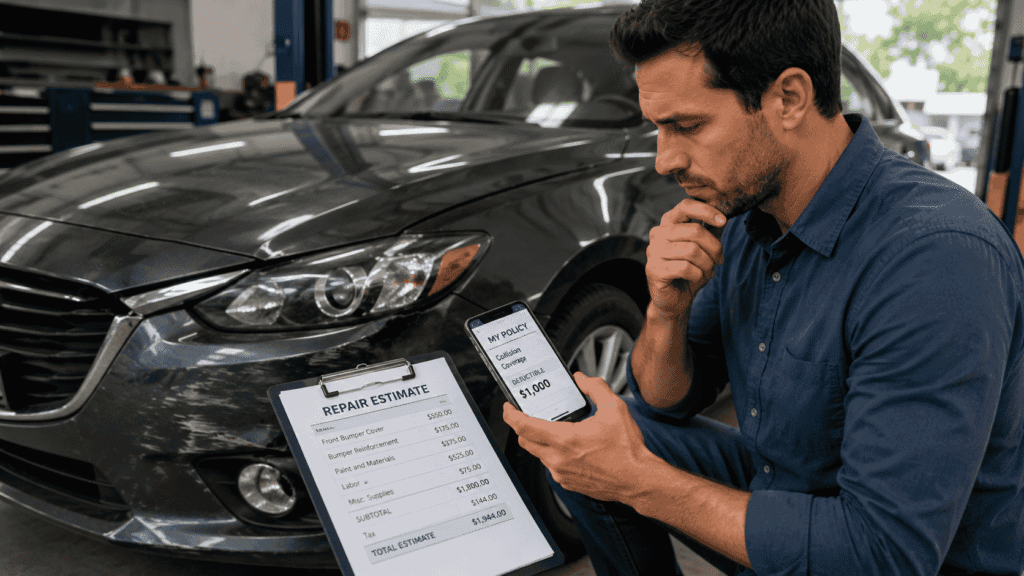
Knowing when not to file a car insurance claim usually starts with the size and certainty of the loss. Paying out of pocket can make sense when damage is minor, only your own vehicle is involved, the repair cost is manageable, and the potential insurance payment after your deductible would be small.
There is no universal dollar cutoff. Injuries, another driver’s involvement, hidden damage, policy notice requirements, and the coverage involved can change the decision. If repairs are below your deductible, see what happens when car damage costs less than your deductible. For the broader process, see our car insurance claims guide.
Quick Summary
- Paying out of pocket can make sense for small, well-understood damage involving only your vehicle.
- Compare the repair estimate with the deductible and the payment that might remain after it.
- There is no universal dollar amount that determines whether you should file a claim.
- Be more cautious when another person, another vehicle, injuries, or other property are involved.
- Hidden damage can turn a small-looking repair into a much larger bill.
- Claims history may affect underwriting or pricing, but the impact varies.
When Might Paying Out of Pocket Make Sense?
The clearest situation is minor damage to your own vehicle with no injuries or other property involved. Examples include scraping a bumper against your garage wall or causing a small cosmetic dent while parking.
Start with a realistic repair estimate and the deductible for the coverage involved. The National Association of Insurance Commissioners notes that when repair costs are not much more than the deductible, a consumer may consider paying for the repairs without filing a claim.
If repairs are above the deductible but only slightly, compare the potential insurance payment with what you can reasonably pay yourself. For example, $1,400 of covered damage with a $1,000 deductible creates a different decision from $8,000 of damage with the same deductible.
Why Do Some Drivers Avoid Small Claims?
Claims history can be one factor insurers consider when evaluating risk. The NAIC identifies claims history among factors that may be used in auto insurance underwriting and rating, subject to state rules.
That does not mean every claim raises every driver’s premium. Claim type, fault, previous history, state rules, insurer practices, and discounts can all matter. See why car insurance rates can increase for the broader pricing issue.
When Cost Should Not Be the Only Consideration
A deductible and repair estimate matter, but some accidents involve more than the visible damage to your car.
- Someone may be injured. Symptoms and medical costs may not be clear immediately.
- Another vehicle or property was damaged. The total loss may be larger than your own repair.
- Fault is disputed. Paying for your own car does not resolve another person’s potential claim.
- Safety-related damage may exist. Sensors, suspension, steering, wheels, lights, or structural components can be expensive.
- Your policy may require notice. Duties after a loss can apply even when you plan to pay for repairs yourself.
- A lender or lease company is involved. Financing agreements may include repair or coverage requirements.
The NAIC recommends contacting your insurer promptly when you need to file a claim. Review your own policy because notice requirements and deadlines can vary.
What If Hidden Damage Makes the Repair More Expensive?
An initial estimate may not include damage hidden behind a bumper, panel, wheel, or trim. The California Department of Insurance explains that additional damage can be discovered during repairs after an initial estimate.
If the first estimate is close to your deductible, ask whether teardown, scans, calibration, structural inspection, or other work could materially raise the final cost before deciding not to file.
What If Another Driver Caused the Accident?
If another driver caused the accident, do not compare the repair bill only with your own deductible. A third-party claim may be available against that driver’s liability coverage, while your own collision coverage may provide another path depending on the circumstances.
Another driver’s involvement adds questions about fault, evidence, injuries, liability, and potentially two insurance policies. That is very different from paying for a simple single-car scrape yourself.
A Practical Checklist Before Filing
- Identify everyone involved. Determine whether only your vehicle was damaged.
- Check for injuries and safety issues. Do not rely only on cosmetic appearance.
- Get a written estimate. Ask whether it is preliminary or likely to change after teardown.
- Confirm the correct deductible. Collision and comprehensive deductibles can differ.
- Estimate the potential insurance payment. Compare the covered repair cost with the deductible.
- Review notice requirements. Check your policy before assuming the event never needs to be reported.
- Keep documentation. Save photos, estimates, invoices, receipts, and repair records either way.
If you are still deciding whether to report the loss, you may first want to understand whether you can ask your insurer a question without opening a claim. If you decide to file, see which documents can help support a car insurance claim.
Simple Examples
Example 1: You scrape your bumper against a post. Repairs are $650 and your collision deductible is $1,000. The deductible would absorb the covered loss.
Example 2: Repairs are $1,350 and your deductible is $1,000. No one else was involved and the estimate appears complete. Paying out of pocket may be worth considering because the potential insurance payment is modest.
Example 3: Visible damage is $1,500 with a $1,000 deductible, but another driver is involved and fault is disputed. This is no longer simply a $500 claim decision.
Conclusion
Knowing when not to file a car insurance claim is less about finding a universal dollar threshold and more about understanding the loss. Paying out of pocket may make sense for minor, well-documented damage limited to your own vehicle when the potential insurance payment is small.
Before deciding, consider who was involved, possible injuries or hidden damage, the deductible, expected payment, policy notice requirements, and the evidence available. Uncertain damage or another person’s involvement can make the decision much more complicated.
Related
- Car Insurance Claims Process: 9 Steps From Report to Payment
- What Happens If Car Damage Costs Less Than Your Deductible?
- Why Did My Car Insurance Rate Increase?
FAQ
Is there a minimum repair cost before I should file a car insurance claim?
No universal dollar cutoff applies to every driver. Compare the repair cost with the deductible, potential payment, circumstances of the loss, policy requirements, and possibility of additional damage.
Should I file a claim if repairs are only slightly above my deductible?
It depends. A small potential payment may make paying out of pocket worth considering when only your vehicle is involved and the repair cost is well established.
Will filing a car insurance claim always increase my premium?
No. The effect can vary by state, insurer, claim type, fault, driving history, discounts, and other factors.
Can I pay for repairs myself if another driver was involved?
You can pay your own repair bill, but another driver’s involvement can create liability, injury, evidence, and reporting issues beyond your vehicle damage.
Should I keep records if I do not file a claim?
Yes. Keep photos, estimates, invoices, payment records, and repair documentation in case hidden damage or another issue appears later.