
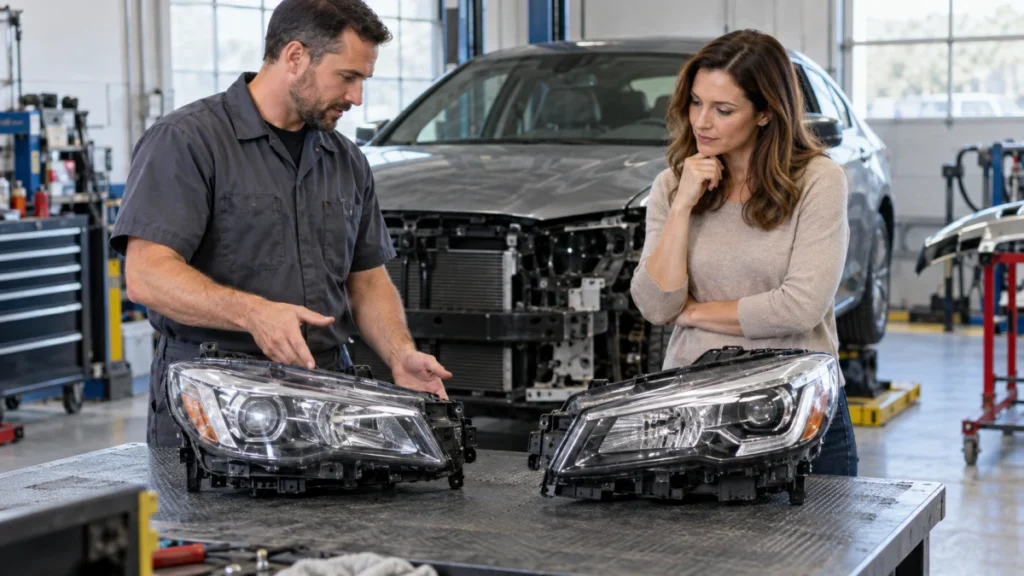
Can car insurance require aftermarket parts? An insurer may base a repair estimate on aftermarket parts, but there is no single nationwide rule that applies everywhere. Your policy, the type and age of the vehicle, part availability, and state repair regulations all matter. In some states, the estimate must disclose non-OEM parts or meet specific quality standards.
The practical question is usually not whether you can ask for an OEM part. You can ask. The harder question is whether the insurer must pay the full OEM price. That decision belongs inside the car insurance claims process and the applicable state rules.
Quick Summary
- Insurance estimates may use OEM, aftermarket, recycled, used, rebuilt, or reconditioned parts.
- State rules may require disclosure, identification, quality standards, or limits for newer vehicles.
- You may request OEM parts, but you may owe the price difference if the policy and state rules allow another part.
- Check fit, safety, calibration, warranty, availability, and the exact estimate language.
- Ask the shop and insurer to resolve part disputes before installation.
OEM, aftermarket, and recycled parts are different
An OEM part is supplied through the vehicle manufacturer’s parts system. An aftermarket part is made by another company for the same function. A recycled or used part comes from another vehicle. Reconditioned and rebuilt parts have been restored to working condition. Estimates should identify the category clearly enough for the owner and shop to understand what is being priced.
These labels do not decide quality by themselves. Fit, material, certification, age, prior use, warranty, sensors, and calibration needs can matter more than the category name. A cosmetic exterior panel raises different questions from a steering, brake, restraint, lighting, or driver-assistance component.
Can car insurance require aftermarket parts?
When drivers ask can car insurance require aftermarket parts, the answer often depends on the policy and state rules. An insurer may write an estimate using aftermarket parts if those rules allow it. The insurer may say an available non-OEM part can restore the vehicle to its pre-loss condition at a reasonable cost. You remain free to discuss another part with the repair shop, but the insurer may not owe more than the covered repair amount it considers reasonable.
State rules can materially change that answer. New Hampshire law says an insurer cannot require an aftermarket part unless it is at least equal in like kind and quality for fit, quality, and performance. It also restricts specifying aftermarket parts for certain vehicles placed in service within the previous two years with 30,000 or fewer miles. Those are New Hampshire rules, not national standards.
Can you demand OEM parts?
You can request them and explain why they are appropriate. The shop may point to fit, corrosion protection, structural procedures, sensor placement, calibration, warranty, lease terms, or manufacturer repair instructions. Whether insurance must fund the full OEM cost depends on the policy, state law, vehicle facts, and available alternatives.
If the insurer approves only a lower-cost alternative and the shop can complete a proper repair with it, you may be asked to pay the difference for OEM. An OEM-parts endorsement, when available and purchased before the loss, may change the result. Review how to read the repair and payment terms in the policy instead of relying on the phrase “full coverage.”
What state rules may require
The California Department of Insurance says non-OEM crash parts used in an insured repair must be comparable in kind, quality, safety, fit, and performance, and repair documents must identify the type of replacement parts used. Pennsylvania’s consumer auto insurance guidance says state law permits non-OEM parts while making operational safety paramount for components such as steering, suspension, brakes, and tires.
These examples show why a national yes or no is misleading. Search your state insurance department’s consumer guide or contact its consumer-services unit. Ask for the rule or policy language being applied rather than arguing only about the label on the part.
How to review the estimate before repairs
- Ask for the insurer’s itemized estimate and the shop’s estimate.
- Mark each OEM, aftermarket, recycled, used, rebuilt, or reconditioned part.
- Ask the shop to explain any fit, safety, calibration, warranty, or availability concern in writing.
- Ask the adjuster which policy term or state rule supports the proposed part and price.
- Resolve the part and price difference before authorizing work when possible.
- Keep the final invoice and confirm it identifies the parts actually installed.
If hidden damage or a part-fit problem appears after teardown, the shop can document it and request a supplement. A supplement does not guarantee approval, but it gives the insurer new evidence to review. This process is common in collision coverage repairs where the first estimate is written before disassembly.
What to do if the disagreement remains
Ask for the insurer’s position in writing and have the shop state its technical concern precisely. Separate a preference for OEM from a documented inability to complete a proper repair with the proposed alternative. If you still disagree, review the policy’s appraisal or dispute provisions and your state department’s complaint process.
CPA’s guide to disputing an insurance claim decision can help organize the question, documents, and requested resolution. It is usually more useful to identify the exact part, price difference, rule, and repair concern than to make a broad claim that all aftermarket parts are unacceptable.
Conclusion
An insurance repair estimate may use aftermarket parts when the policy and applicable state rules allow it. Review the estimate line by line, ask the shop to document any fit, safety, calibration, or warranty concern, and get the insurer’s position in writing before installation. If you prefer OEM parts when another compliant part is allowed, confirm in advance who would be responsible for any price difference.
Related
- Car Insurance Claims Process: 9 Steps
- How to Read a Car Insurance Policy
- How to Dispute an Insurance Claim Decision
FAQ
Can an insurer make you use aftermarket parts?
An insurer may base payment on aftermarket parts when the policy and state rules allow it. Disclosure and quality requirements vary.
Can you choose OEM parts and pay the difference?
Often yes, but confirm the price difference, shop agreement, warranty, and insurer payment before authorizing the repair.
Are recycled parts the same as aftermarket parts?
No. Recycled parts come from another vehicle. Aftermarket parts are newly made by a company other than the vehicle manufacturer.
What if an aftermarket part does not fit correctly?
Ask the shop to document the fit problem and submit it to the adjuster. The estimate may need a supplement or different part.