
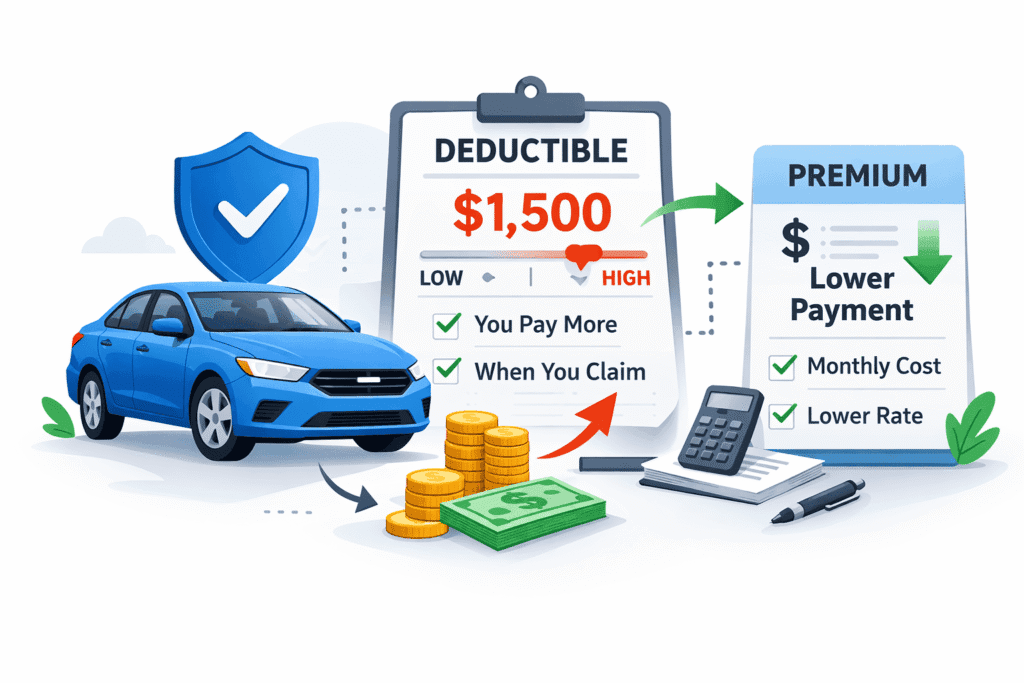
A higher deductible may lower your premium because you agree to pay more out of pocket after a covered claim. The tradeoff is simple: you may save on the policy, but you take on more financial risk when damage happens.
For official context, Texas DOI advises drivers to review deductibles and coverage before buying auto insurance.
This guide explains which coverages usually have deductibles, how the premium difference is calculated, and how to decide whether the change fits your budget. For the broader pricing picture, start with What Affects Car Insurance Cost?.
Quick Summary
- A higher deductible may reduce the premium for collision and comprehensive coverage.
- The premium reduction is not guaranteed to be large.
- A higher deductible means more out-of-pocket cost after a covered claim.
- Liability coverage usually does not use a deductible in the same way.
- The deductible should remain affordable even after an unexpected loss.
What a higher deductible actually changes
A deductible is the amount you pay out of pocket on a covered claim before your insurance coverage pays the remaining approved costs. Deductibles usually apply to certain coverages, not all of them. For a full beginner-friendly overview, see What Is a Deductible in Car Insurance?.
Simple example: if your collision deductible is $1,000 and you have a covered accident with $4,000 in repair costs, you generally pay the first $1,000 and the insurer pays the remaining $3,000 (after claim approval and any limits).
A higher deductible shifts more of the first loss to you, so the insurer may charge less for collision or comprehensive coverage. The NAIC notes that increasing these deductibles may reduce insurance costs, but drivers should first consider whether they could afford the larger out-of-pocket amount after a loss. See its guidance on auto insurance deductibles and cost.
How it works in practice
Changing a deductible is usually a policy-level adjustment you can request at renewal, and sometimes mid-term (rules depend on the insurer and state). Here is how it typically works:
- You choose a coverage to adjust. Most often, this is collision and comprehensive.
- You select a deductible option. Common options include several set amounts (not a custom number).
- The insurer recalculates risk. Higher deductible means you pay more in a claim, which can reduce expected payouts.
- Your premium may change. Many policies show a lower premium with a higher deductible, but the size of the change can vary a lot.
- Your out-of-pocket risk changes immediately. If you have a claim tomorrow, the new deductible is what you may owe.
It is important to separate two things: the premium (what you pay to keep the policy active) and the deductible (what you may pay if you file a covered claim). A lower premium can feel helpful month to month, but a higher deductible can be a bigger financial hit when repairs are needed. If you’re filing a claim (or thinking about it), this overview helps: Car Insurance Claims Process.
Which coverages usually have deductibles
Deductibles are most common on physical damage coverages. The effect of changing them depends on which part of the policy you are talking about.
Collision coverage
Collision helps pay to repair or replace your car after a crash with another vehicle or object (like a pole), regardless of fault in many cases. Collision usually has a deductible. Raising the collision deductible is one of the most direct ways people try to lower premium on a policy. If you’re comparing collision to other “damage to your car” coverage, see Collision vs. Comprehensive Insurance.
Comprehensive coverage
Comprehensive (sometimes called “other than collision”) usually covers damage from events like theft, vandalism, fire, falling objects, or weather-related damage. Comprehensive also usually has a deductible. In many policies, you can choose a different deductible for comprehensive than for collision.
Liability coverage
Liability generally pays for injuries or property damage you cause to others. Most auto liability coverage does not use a deductible the way collision and comprehensive do. So, changing deductibles typically does not apply to liability in the same direct way. If you want a simple comparison, see Liability vs. Full Coverage.
Uninsured/underinsured motorist and PIP/MedPay
These coverages vary by state. Some may have deductibles, some may have different cost-sharing rules, and some may not use deductibles at all. The key point: the “raising your deductible can lower your premium” relationship is strongest and most predictable with collision and comprehensive.
What affects the premium difference
Even if the general idea is true, several factors affect how much a higher deductible changes a premium (and whether it changes it much at all):
- Your driving and claims history: Prior claims, tickets, or accidents can weigh more than deductible choices.
- Vehicle value and repair costs: More expensive repairs can change how the insurer prices collision and comprehensive risk.
- Where you live and park: Local crash rates, theft risk, and weather patterns can affect comprehensive and collision pricing.
- Coverage limits and add-ons: Other policy choices can move the premium up or down more than the deductible does. (Related: Car Insurance Policy Limits.)
- Financing or leasing rules: A lender or lease agreement may require collision and comprehensive and may limit how high the deductible can be.
- Your ability to pay the deductible: This is not a pricing factor, but it is a real-world factor that should guide your decision.
Deductibles are only one pricing lever. For the broader pricing picture, see What Affects Car Insurance Cost?. Coverage limits affect cost differently because they change the maximum protection available rather than the amount paid first on a claim. See how coverage limits affect car insurance cost.
Conclusion
A higher deductible may lower the premium for collision or comprehensive coverage, but it also increases the amount you may need to pay after a covered loss. The change only makes sense when the deductible remains realistic for your budget.
Before changing it, compare the actual premium savings with the additional out-of-pocket risk. A small monthly reduction may not justify a deductible that would be difficult to pay after an accident or other covered damage.
Related
- What Is a Car Insurance Deductible?
- Collision vs. Comprehensive: What’s the Difference?
- Car Insurance Claims Process
FAQ
Does a higher deductible always mean a lower premium?
No. Higher deductibles often reduce collision or comprehensive premiums, but the difference may be small because other rating factors also affect the price.
Does a higher deductible make the coverage worse?
The coverage type may stay the same, but you must pay more out of pocket before the insurer pays an approved claim.
Can collision and comprehensive have different deductibles?
Often, yes. Available deductible options depend on the insurer, policy, state, and any financing or lease requirements.
Do I pay a collision deductible when another driver caused the accident?
You may need to pay it when using your own collision coverage. Your insurer may later seek recovery from the responsible party, but reimbursement is not guaranteed and rules vary.
How should I choose a deductible?
Compare the premium savings with the amount you could comfortably pay after an unexpected loss. The lowest premium is not always the safest financial choice.