
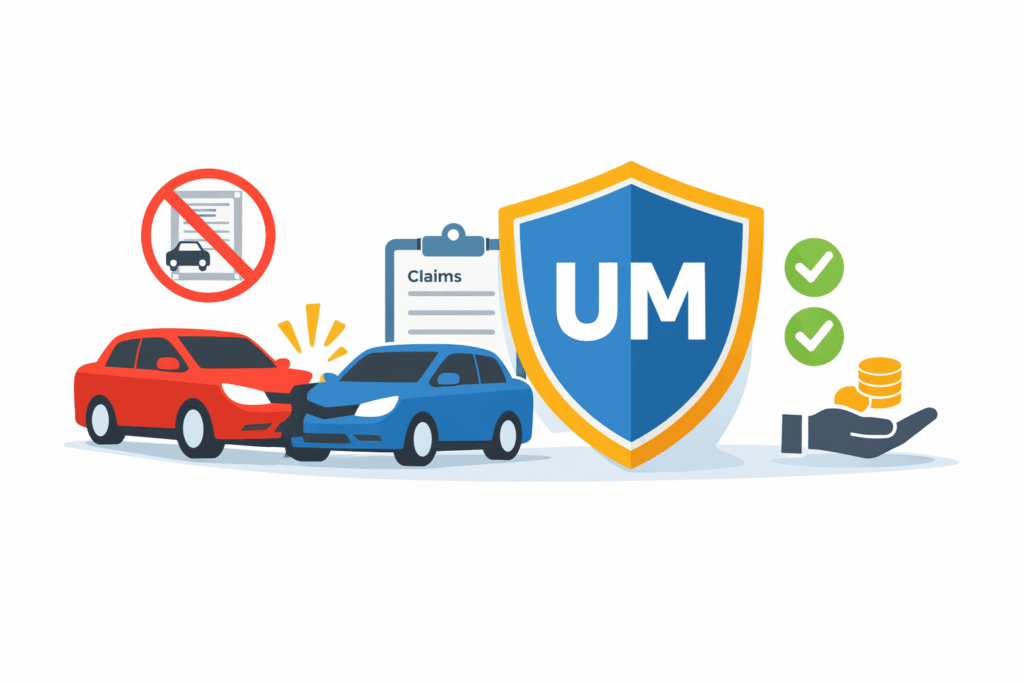
If another driver causes a crash, you might assume their insurance will pay your medical bills and other losses. But some drivers have no insurance. Others may flee the scene, leaving you with no clear way to collect. That’s where uninsured motorist coverage (often called UM coverage) can matter.
For official context, California DOI lists uninsured motorist coverage among common auto insurance options.
UM coverage is designed to protect you when the at-fault driver can’t pay because they’re uninsured (or sometimes unidentified in a hit-and-run). It can help cover injuries and related losses up to your policy limits. In this guide, you’ll learn what UM coverage is, what it commonly covers, how hit-and-run claims work, and the policy details that can change the outcome of a real claim.
Quick Summary
- UM coverage may help when an at-fault driver has no liability insurance or cannot be identified in some hit-and-run claims.
- UM bodily injury focuses on injuries, while UM property damage may address vehicle or property damage where available.
- Limits, definitions, reporting requirements, stacking, and offsets vary by state and policy.
- Your declarations page shows whether UM or UIM coverage is listed and the limits you selected.
What is uninsured motorist coverage?
Uninsured motorist coverage is part of an auto insurance policy that may pay for certain losses when you’re harmed by a driver who has no liability insurance. It’s different from the liability coverage you carry to protect other people when you cause an accident. UM is usually about protecting you and your passengers when someone else is responsible but can’t cover the costs.
The National Association of Insurance Commissioners explains that uninsured motorist coverage can reimburse you when an uninsured or hit-and-run driver causes a crash. Availability, required limits, and claim rules vary by state, so the policy and applicable state rules still control. See the NAIC overview of what auto insurance covers.
Example: You’re stopped at a red light and a driver rear-ends you. You later learn the driver has no insurance. UM coverage may step in (depending on your state and policy terms) to help with covered losses up to your UM limits.
If you want the big picture of how coverages fit together, see: What Does Car Insurance Cover?
UM vs. UIM: what’s the difference?
These two terms are easy to confuse:
- UM (Uninsured Motorist): the at-fault driver has no insurance (or cannot be identified in some hit-and-run cases).
- UIM (Underinsured Motorist): the at-fault driver has insurance, but their limits are too low to cover the full loss.
Many insurers offer UM and UIM together, but the rules and labels can vary by state. The most accurate answer is always the wording on your declarations page and policy.
What does uninsured motorist coverage typically pay for?
UM coverage may be divided into bodily injury and property damage components. Availability and policy names vary by state.
UM bodily injury (UMBI)
UMBI may cover medical expenses, lost income, and other injury-related damages allowed by state law and the policy. Limits are often shown per person and per accident on the declarations page.
UM property damage (UMPD)
UMPD may help pay for vehicle or property damage caused by an uninsured driver. It is not available everywhere and may have a deductible or special conditions. Collision coverage may also handle vehicle repairs, subject to its own deductible and policy terms.
What UM coverage usually does not cover
UM is not broad protection for every loss. It cannot pay more than the applicable limits, does not replace comprehensive coverage for theft or weather damage, and may have strict definitions and reporting requirements. Hit-and-run claims may also require prompt notice and evidence that another vehicle caused the loss.
Does UM coverage apply in a hit-and-run?
It may, depending on state law and policy wording. Report the incident promptly when required, document the scene safely, and keep photos, witness information, vehicle details, and police-report information. The insurer may require evidence that an unidentified vehicle caused the crash. If the main question is how vehicle damage is handled, CPA’s guide to whether collision insurance covers hit-and-run damage explains how collision and uninsured motorist property damage may differ.
Who is covered by uninsured motorist coverage?
This varies, but UM commonly covers:
- You (the named insured)
- Family members in your household (in many policies)
- Passengers riding in your insured vehicle
In some cases, UM may also apply if you’re struck as a pedestrian or cyclist, but not all policies treat that the same way. The safest approach is to check the “Who is an insured” and UM sections of your policy.
Policy limits, stacking, and offsets
UM limits can affect how much is available in a serious claim. Some states allow limits from multiple insured vehicles to be combined, known as stacking, while others restrict it. Offsets may also reduce a payment by amounts received from other sources. Review your declarations page, policy wording, and applicable state rules.
For more context, see how car insurance policy limits work.
How to file a UM claim
If you think UM coverage may apply, this checklist helps you stay organized:
- Get medical care and follow up—health comes first.
- Document the scene: photos, vehicle positions, damage, road conditions, and any relevant signs or signals.
- Collect witness info if anyone saw the crash.
- Report the crash when appropriate (especially for hit-and-run scenarios).
- Notify your insurer promptly and ask how they handle UM claims in your state.
- Keep records: medical bills, time missed from work, repair estimates, and claim communications.
If you were actually hit by a driver who has no insurance, see what happens if an uninsured driver hits you, including what to document and which coverage paths may apply. For a broader view of the overall process, see Car Insurance Claims Process: Steps That Real Claims Follow.
How much UM coverage should you carry?
There is no universal amount that fits every driver. Compare the available limits with potential medical costs, lost income, household needs, and other coverage such as health insurance, PIP, or MedPay. The declarations page shows your current limits, but state requirements and policy options vary.
Conclusion
Uninsured motorist coverage can protect you and eligible passengers when an at-fault driver has no liability insurance or cannot be identified in a qualifying hit-and-run. The result depends on the type of UM coverage, limits, definitions, reporting requirements, and state rules. Review the declarations page and full policy before assuming a loss is covered.
Related
- Uninsured vs Underinsured Motorist Coverage
- Uninsured Motorist Property Damage Coverage
- What Does Car Insurance Cover?
FAQ
Is uninsured motorist coverage required?
It depends on the state. Some states require it, some require insurers to offer it, and others make it optional. Your declarations page shows whether the coverage is included and the limits selected.
Is UM coverage the same as “full coverage”?
No. “Full coverage” is an informal phrase, while UM is a specific coverage for certain losses involving an uninsured or unidentified at-fault driver.
Will UM pay for my car repairs?
Possibly, if the policy includes UMPD and the claim meets its requirements. Collision coverage may also apply to vehicle repairs, subject to its deductible and terms.