
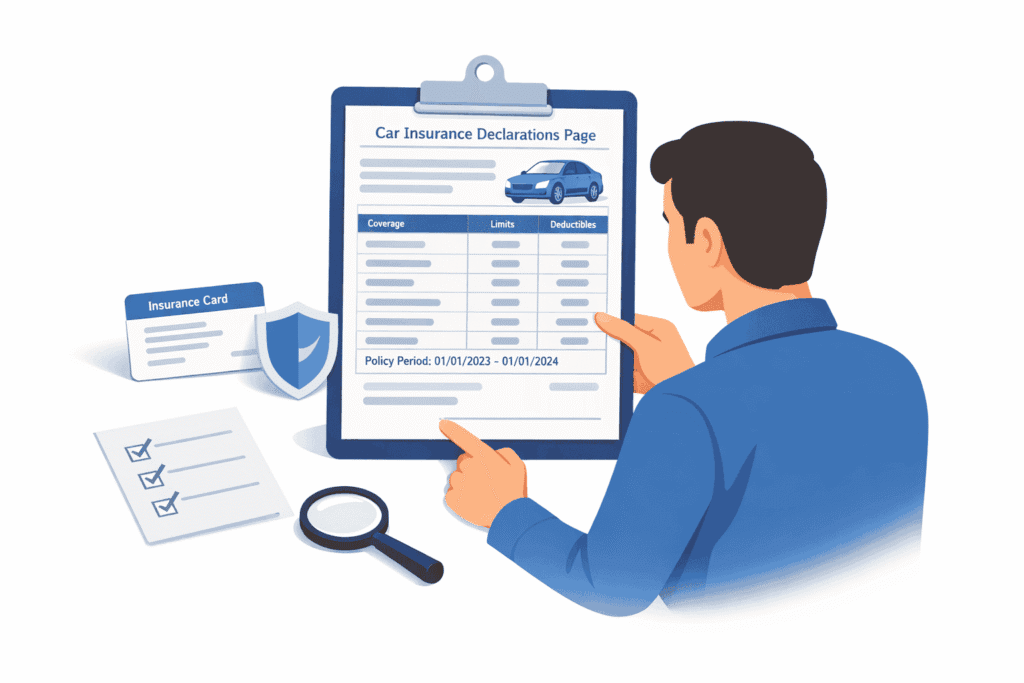
A car insurance declarations page, often called a dec page, is the summary page of your policy. It usually brings the most important details together in one place, including the insured drivers, covered vehicles, policy dates, listed coverages, limits, deductibles, and premium information.
For official context, California DOI explains that auto policies include declarations, coverage, limits, and exclusions drivers should review.
For related context, see proof of insurance.
That makes it one of the most useful documents in your insurance paperwork. Many drivers only look at their bill, proof-of-insurance card, or renewal email. But when you actually want to confirm what protection you have, the declarations page is often the fastest place to start.
If you are still learning how insurance documents fit together, it helps to begin with how to read a car insurance policy. This guide focuses on the declarations page itself, what it usually shows, where to find it, and why reviewing it can help prevent surprises later.
Quick Summary
- A declarations page is the summary page of a car insurance policy.
- It usually shows drivers, vehicles, coverages, limits, deductibles, and policy dates.
- It is not the same as the full policy contract.
- It is often the quickest place to confirm whether a coverage is listed.
- Reviewing it at renewal can help catch mistakes before they turn into claim or billing problems.
What is a declarations page in car insurance?
A declarations page is a policy summary. Instead of making you search through the full contract, it puts the core information in one practical place. That is why many drivers use it first when they want to confirm what is active on the policy before calling the insurer, renewing coverage, or dealing with a claim.
It also helps to understand what the dec page does and does not do. It usually tells you what is listed on the policy, but it does not explain every rule in full detail. The complete policy includes longer sections on definitions, exclusions, conditions, endorsements, and claim handling. If your documents were recently changed, it also helps to understand what changes when you add an endorsement to a policy. The declarations page gives you the snapshot. The full policy gives you the full wording behind that snapshot.
The National Association of Insurance Commissioners explains that an auto insurance policy begins with a declarations page that identifies the policy number and summarizes important information such as the policy term, coverage limits, insured drivers, and covered vehicles. See the NAIC consumer overview of auto insurance policies.
In simple terms, the declarations page is the document that helps you answer questions like: Which car is on the policy? Which coverages are listed? What limits apply? What deductibles did I choose? Is the policy active right now?
What does the declarations page usually show?
Layouts vary by insurer, but most declarations pages include the same main categories. The goal is to show the key facts clearly enough that you can confirm what is active and what is not.
Policyholder and driver details
This section usually lists the named insured and may also include other listed drivers. It can also show the address tied to the policy. These details matter because incorrect driver or garaging information can create pricing issues or confusion later.
Policy number and dates
Most dec pages show the policy number and the coverage period, including the effective and expiration dates. This helps you confirm whether the policy was active at a certain time or when a renewal period begins and ends.
Vehicles on the policy
You will usually see each insured vehicle listed with details such as year, make, model, and VIN. This section is worth checking carefully. If a vehicle is missing or described incorrectly, it is better to catch that early than discover it during a claim or registration issue.
Coverages, limits, and deductibles
This is often the most important part of the page. It usually shows which coverages are listed, such as liability, collision, comprehensive, uninsured or underinsured motorist coverage, MedPay, or PIP. If you want a broader view of how these fit together, see what car insurance usually covers.
The declarations page also often shows the limits tied to certain coverages and the deductibles tied to others. Many drivers recognize the numbers but are not fully sure what they mean until a claim happens. If that section looks confusing, this guide on car insurance policy limits helps translate those numbers into something more practical.
Premium summary
Many declarations pages also include a premium summary for the policy term. It may show the total premium, fees, discounts, or a simple breakdown of cost. Even if it is not a billing statement, it still helps you connect the current price to the current policy setup.
What should you check on your declarations page?
Before you close the document, it helps to check a few basics:
- Are the policy dates current?
- Are the listed vehicles correct?
- Are the named insured and drivers accurate?
- Do the listed coverages match what you think you bought?
- Do the limits and deductibles look right?
- Does the premium summary roughly match what you expected?
If something looks wrong, it is better to ask early than wait until billing or a claim draws attention to it. The declarations page is helpful because it can reveal small problems before they become stressful ones.
Conclusion
A car insurance declarations page is the summary page that shows the most important details of your policy in one place. It usually includes who is insured, which vehicles are listed, what coverages appear on the policy, what limits and deductibles apply, and the policy term.
It is not the full contract, but it is often the fastest and most useful document for checking what your policy says at a glance. If you want fewer surprises at renewal time or after an accident, reviewing your dec page is one of the simplest insurance habits you can build.
Related
- How to Read a Car Insurance Policy: Sections Made Simple
- Car Insurance Policy Limits: What They Mean and How They Work
- What Does Car Insurance Cover?
FAQ
Is the declarations page the same as the full policy?
No. The declarations page is a summary page. The full policy includes the detailed definitions, exclusions, conditions, and endorsements that control how the coverage works.
Does the declarations page show your deductible?
In many cases, yes. Collision and comprehensive deductibles are often listed there, although the exact format can vary by insurer.
Can the declarations page change at renewal?
Yes. Renewal documents can reflect changes to drivers, vehicles, coverages, limits, deductibles, discounts, and premium amounts.