
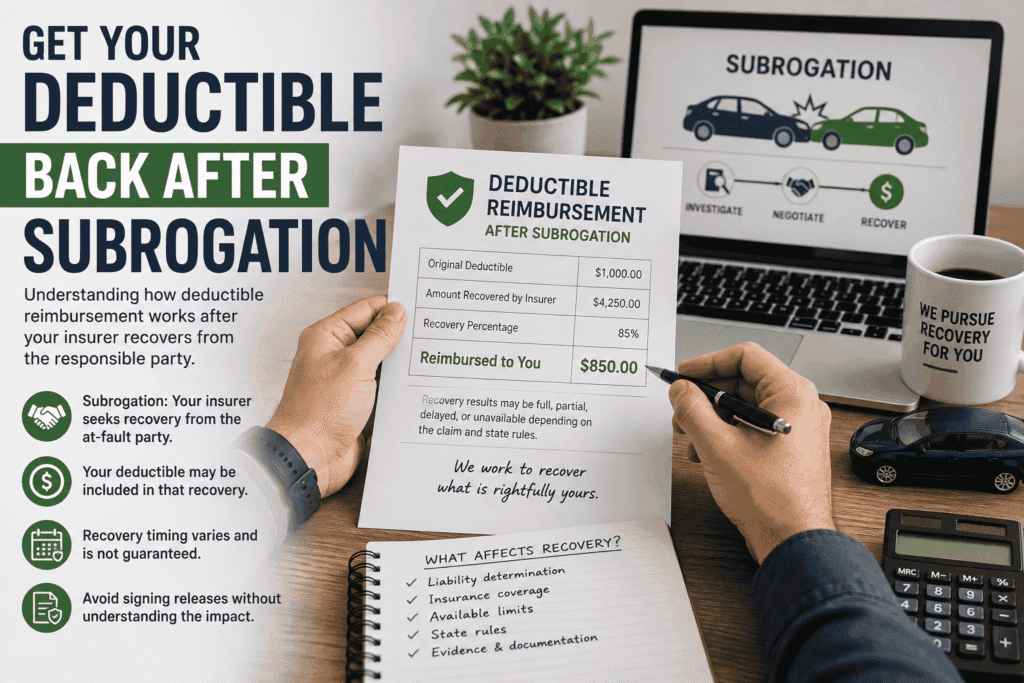
You may get your car insurance deductible back after subrogation if your insurer recovers money from the driver or other party responsible for the loss. The key word is may. Recovery is not guaranteed, and the amount returned can be full, partial, delayed, or unavailable depending on the claim, state rules, and the result of the recovery effort.
This often happens after you use your own collision coverage, pay the deductible, and let your insurer handle the vehicle damage while liability is still being resolved. The car insurance claims process can continue behind the scenes even after your repair or settlement is complete.
Quick Summary
- Subrogation is when an insurer seeks reimbursement from a responsible third party after paying a covered claim.
- Your deductible may be included in that recovery effort, depending on state rules and claim handling.
- A full recovery may lead to a full deductible reimbursement.
- A partial recovery may result in only part of the deductible being returned.
- There is no single national timeline, and some claims never produce a recovery.
- Do not sign a release or separate settlement without understanding how it could affect subrogation.
What Does Subrogation Mean?
The National Association of Insurance Commissioners defines subrogation as an insurer’s right to seek reimbursement from a third party responsible for a loss after the insurer has paid the insured. In auto insurance, a common example is when your insurer pays for vehicle damage under collision coverage and later seeks reimbursement from the at-fault driver’s insurer.
Subrogation does not change the deductible that applied when your policy paid the claim. It is a later recovery process. If you need the basic concept first, review how a car insurance deductible works.
Why Did You Pay the Deductible First?
When you make a claim under your own physical damage coverage, the deductible in that coverage generally applies according to your policy. That can happen even when you believe another driver caused the accident.
Your insurer can pay the covered amount above the deductible while responsibility and recovery are still being investigated. Collision and comprehensive insurance commonly use deductibles, while a liability claim made directly against another driver’s insurer works differently.
How Can You Get Your Deductible Back After Subrogation?
After paying the claim, your insurer may seek reimbursement from the responsible driver, that driver’s insurer, or another legally responsible party. If the recovery succeeds, some or all of your deductible may be returned depending on the recovery and applicable state rules.
California provides a clear state-specific example. The California Department of Insurance says that when an insurer pursues subrogation, it must include the policyholder’s deductible in the recovery process unless the deductible has already been recovered. Its consumer guidance also explains that a partial recovery can result in a proportional deductible reimbursement.
California uses an example in which recovering 65% of the paid claim can result in 65% of the deductible being reimbursed. That example should not be treated as a national formula. Other states can use different rules or procedures.
Why Might the Deductible Refund Be Partial?
A recovery may be reduced because responsibility is disputed, both drivers share fault, the other driver has limited insurance, evidence is incomplete, or the insurer recovers less than the amount it paid. When the insurer does not recover the full claim amount, the deductible reimbursement may also be reduced depending on state law and the recovery process.
This is why it is better to ask for the actual subrogation result than to assume the full deductible will automatically be returned.
How Long Does Subrogation Take?
There is no single national timetable. Some recoveries are straightforward, while disputed liability, uninsured drivers, multiple parties, litigation, or coverage questions can make the process much longer.
Ask your insurer whether subrogation is open, whether another insurer has accepted responsibility, and whether any recovery has been made. If the insurer says it will not pursue recovery, ask what that means for your deductible and whether you may pursue it yourself under your policy and state rules.
Be Careful With Releases and Direct Payments
A responsible driver or insurer may offer to pay your deductible directly. Before accepting money or signing anything, contact your own insurer.
The California Department of Insurance specifically warns consumers not to jeopardize an insurer’s subrogation rights by signing an agreement that releases the other party in exchange for payment of the deductible. Your state may have different rules, but the general lesson is useful: understand how a separate agreement could affect the existing claim before signing it.
For broader post-accident context, review your rights after a car accident.
What Should You Ask Your Insurer?
- Are you pursuing subrogation?
- Is my deductible included in the recovery?
- Has the other insurer accepted responsibility?
- Has any money been recovered?
- If recovery is partial, how will my deductible reimbursement be calculated?
- Do you need documents or cooperation from me?
- How will I be notified when the recovery process closes?
Keep the claim number and correspondence together. If the insurer needs documents, respond promptly so you do not unintentionally slow the recovery effort.
What If the Insurer Does Not Pursue Subrogation?
An insurer may decide not to pursue recovery. The reasons can include disputed responsibility, lack of insurance on the other side, limited evidence, or practical recovery issues.
California guidance says an insurer that does not pursue subrogation must advise the policyholder so the consumer may pursue the deductible independently. That is a California-specific rule and should not be assumed to apply everywhere.
If your insurer declines recovery, ask in writing whether you may pursue your deductible yourself and whether doing so could interfere with any remaining insurer rights.
Conclusion
Getting your deductible back after subrogation depends on successful recovery. If your insurer recovers all or part of what it paid from the responsible party, you may receive all or part of your deductible back. If there is no recovery, there may be no reimbursement.
The practical next step is to ask whether subrogation is being pursued, whether your deductible is included, and how any partial recovery would be handled. Keep expectations realistic and avoid signing separate releases without understanding their effect on the claim.
Related
- What Is a Car Insurance Deductible?
- Car Insurance Claims Process
- What Are Your Rights After a Car Accident?
Frequently Asked Questions
Is deductible reimbursement automatic after subrogation?
No. It depends on whether recovery succeeds, how much is recovered, applicable state rules, and the insurer’s handling of the claim.
Can I get only part of my deductible back?
Yes. A partial recovery may result in partial deductible reimbursement, depending on state rules and the recovery process.
How long does it take to get a deductible back?
There is no single timetable. Claims involving disputed liability, uninsured drivers, multiple parties, or litigation can take longer than straightforward recoveries.
Should I accept deductible payment directly from the other driver?
Ask your insurer before accepting payment or signing a release. A separate agreement could affect the insurer’s recovery rights or other parts of the claim.