
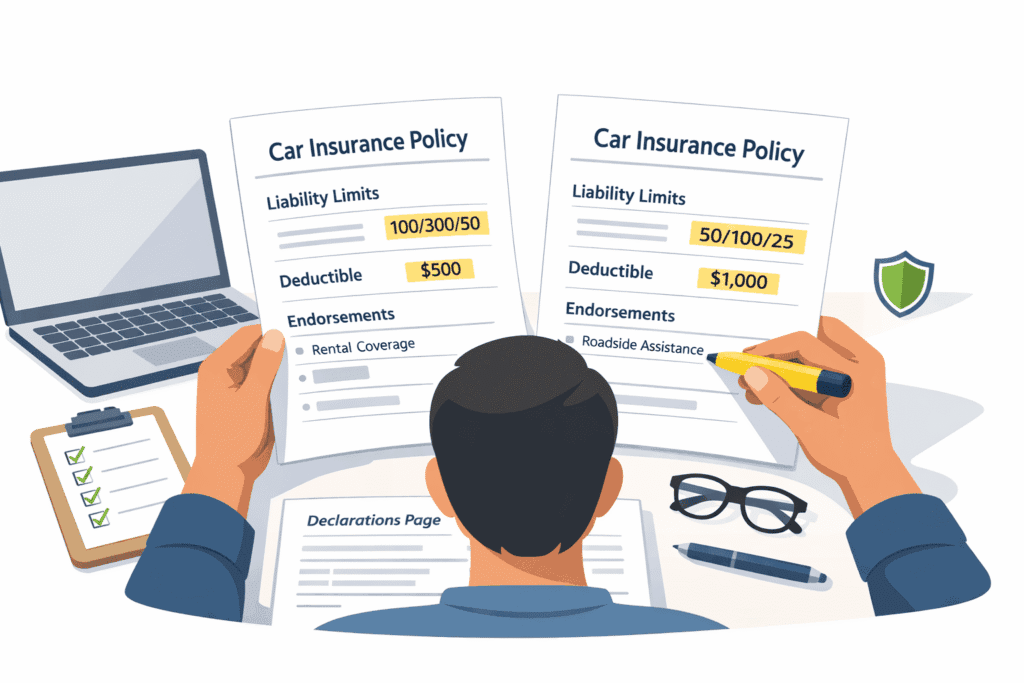
Knowing how to compare two car insurance policies line by line helps prevent a common mistake: choosing the lower premium without noticing that the limits, deductibles, exclusions, or optional benefits are different.
A fair comparison starts with the same vehicle, drivers, address, use, coverage limits, and deductibles. Then review the declarations pages and full policy language side by side. For the broader foundation, see how to read a car insurance policy.
Quick Summary
- Make sure both policies use the same vehicle, drivers, address, and driving information.
- Compare liability limits before comparing premium.
- Check collision and comprehensive deductibles individually.
- Review exclusions, endorsements, and optional benefits for meaningful differences.
- Use the declarations page for the summary, then confirm details in the full policy.
Start with matching policy details
Before reviewing price, confirm that both proposals are based on the same information. Differences in the vehicle, drivers, garaging address, annual mileage, use, coverage dates, or listed household members can change the premium and make the comparison misleading.
The National Association of Insurance Commissioners advises consumers to compare matching coverages and limits. If the quotes do not match, request a revised version using equivalent selections. See the NAIC guidance on buying auto insurance.
Place both declarations pages side by side and verify:
- Named insured and listed drivers
- Covered vehicles and vehicle use
- Liability and uninsured motorist limits
- Collision and comprehensive coverage
- Deductibles
- Optional coverages and endorsements
- Policy period and total premium
Compare the limits, deductibles, and major coverages
Liability limits
Compare bodily injury and property damage liability using the same limits. A policy may be cheaper because it provides lower protection after an at-fault accident. Review how car insurance policy limits affect the maximum amount the insurer may pay.
Collision and comprehensive
Confirm whether both policies include collision and comprehensive coverage. Then compare their deductibles separately. A higher deductible may reduce premium while increasing the amount paid by the policyholder after a covered loss.
Uninsured and underinsured motorist coverage
Compare whether the coverage applies to injuries, vehicle damage, or both, along with its limits and deductible. Similar policy summaries can still contain different uninsured motorist protection.
Optional coverages
Review rental reimbursement, roadside assistance, glass protection, custom equipment, accident forgiveness, and other optional benefits. Also check whether policy endorsements add, remove, or modify standard coverage.
Look for exclusions, limits, and missing benefits
Coverage names alone do not show every difference. Two policies may both list rental reimbursement, roadside assistance, or glass coverage while using different daily limits, towing distances, service-call caps, or deductibles.
Read the exclusions and conditions for restrictions involving household drivers, business or rideshare use, custom equipment, replacement parts, vehicle use, claim reporting, or coverage territory. A missing or narrower provision may explain part of the premium difference.
The California Department of Insurance recommends comparing similar coverages, limits, and deductibles so the proposals can be evaluated on an equivalent basis. See its guidance on comparing auto insurance.
Example: why the lower premium may provide less coverage
Suppose two policies cover the same vehicle. Policy A has a lower premium, but it also includes lower liability limits, a higher collision deductible, no rental reimbursement, and fewer optional benefits. Policy B costs more but retains the broader selections.
Policy A is not automatically a poor choice, and Policy B is not automatically better. The comparison shows that the price difference comes partly from the amount of risk retained by the driver. The useful question is not only which policy costs less, but what changed to produce that price.
Use the same process when comparing a renewal offer with a new quote. Verify that limits, deductibles, drivers, vehicles, endorsements, and optional benefits were not changed or removed.
Final line-by-line comparison checklist
- Are the vehicle, drivers, address, mileage, and use identical?
- Do the bodily injury and property damage limits match?
- Are uninsured motorist and medical-related coverages equivalent?
- Do collision and comprehensive use the same deductibles?
- Are rental, towing, roadside, and glass benefits included under similar limits?
- Do endorsements or exclusions materially change either policy?
- Are payment schedule, fees, discounts, and total policy premium being compared consistently?
Any unexplained difference should be clarified before choosing. A useful comparison identifies both the price difference and the coverage difference behind it.
Conclusion
To compare two car insurance policies line by line, first make sure both use the same driver, vehicle, address, coverage, and deductible information. Then compare liability limits, physical damage coverage, uninsured motorist protection, optional benefits, endorsements, exclusions, and total premium.
The cheaper policy may still be suitable, but the reason for the lower price should be clear. A side-by-side review helps show whether the difference comes from pricing or from transferring more financial risk back to the driver.
This also makes future renewals easier to evaluate because you already know which policy terms matter most.
Related
FAQ
How do you compare two car insurance policies line by line?
Confirm that both policies use the same driver and vehicle information, then compare limits, deductibles, coverages, exclusions, endorsements, optional benefits, and total premium.
Should you compare premium first?
No. First confirm that the policies provide comparable coverage. A lower premium may result from lower limits, higher deductibles, or removed benefits.
Can two policies list the same coverage but work differently?
Yes. They may use different limits, deductibles, exclusions, endorsements, service caps, or claim conditions.
Should you compare the declarations page or the full policy?
Use both. The declarations page provides a summary, while the full policy explains definitions, exclusions, conditions, and how each coverage works.
What should you ask when one policy is much cheaper?
Ask whether the quote changed the liability limits, deductibles, drivers, vehicle use, optional coverages, endorsements, discounts, or payment terms.