
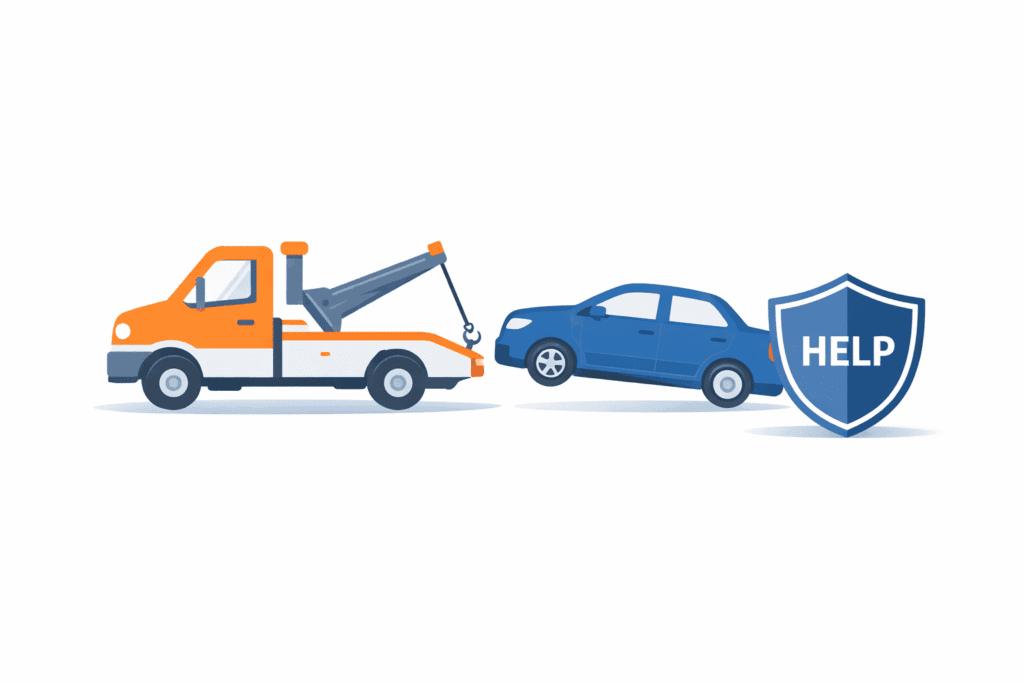
What does roadside assistance coverage include? It may provide towing, battery jump starts, lockout assistance, flat-tire service, and limited fuel delivery when a vehicle becomes disabled. The exact services, towing distance, payment limits, and number of calls depend on the policy or program.
If roadside help is tied to a damaged vehicle claim, the deductible question is separate; review how a car insurance deductible works before assuming towing, repair, and claim costs are handled the same way.
Roadside assistance is often added by endorsement, so it can help to review how car insurance endorsements work before relying on it.
Roadside assistance is designed mainly to help with immediate roadside problems. It generally does not pay for major mechanical repairs, replacement parts, or accident damage. For the broader coverage framework, review what car insurance covers.
Quick Summary
- Roadside assistance may include towing, jump starts, lockout help, tire changes, and fuel delivery.
- Towing distance, reimbursement amounts, and annual service calls may be limited.
- The service call may be covered even when replacement parts, fuel, tires, or repairs are not.
- Roadside assistance is different from collision coverage, rental reimbursement, and a repair warranty.
- Drivers should compare the policy’s limits, covered vehicles, territory, and service process before relying on it.
What roadside assistance coverage may include
The National Association of Insurance Commissioners explains that roadside or towing coverage may reimburse costs when a vehicle becomes disabled. The exact benefits depend on the coverage purchased and its limits. See the NAIC overview of auto insurance coverage.
Towing
The plan may pay for towing to a nearby repair facility or reimburse a specified amount. A mileage or dollar limit may apply, leaving the driver responsible for charges beyond that limit.
Battery jump start
A roadside provider may attempt to jump-start a discharged battery. The service call may be included, while a replacement battery, diagnostic work, or additional repairs may remain the driver’s responsibility.
Lockout assistance
Roadside assistance may provide limited locksmith or vehicle-entry service when the keys are locked inside. Key replacement, programming, or damage to the locking system may not be included.
Flat-tire service
The provider may install the vehicle’s usable spare tire. When no usable spare is available or the vehicle cannot be serviced safely, towing may be the available option instead.
Fuel or fluid delivery
Some plans may deliver enough fuel or another necessary fluid to reach a service location. The delivery service may be covered while the fuel or fluid itself is charged separately.
Common roadside assistance limits
Roadside assistance is not normally unlimited. Review the coverage for restrictions such as:
- Towing distance: the plan may cover only a stated number of miles.
- Dollar limits: towing, locksmith work, or labor may have a maximum reimbursement.
- Number of calls: the policy or program may limit service events during a coverage period.
- Service territory: help may depend on location and provider availability.
- Vehicle eligibility: motorcycles, trailers, commercial vehicles, or unusually heavy vehicles may be treated differently.
- Authorized service: reimbursement may depend on contacting the plan before arranging assistance independently.
The California Department of Insurance defines towing coverage as an addition to an automobile policy that pays a specified amount for towing and related labor costs. This illustrates why the amount and covered labor should be checked rather than assumed. See its glossary of automobile insurance terms.
What roadside assistance usually does not cover
Roadside assistance provides emergency service rather than broad protection against repair costs. Depending on the terms, it may not pay for:
- Engine, transmission, alternator, or other mechanical repairs
- A replacement battery, tire, wheel, key, or other part
- Fuel or fluids delivered during the service call
- Labor beyond the stated roadside limit
- Towing beyond the mileage or reimbursement allowance
- Repeated calls connected to an unresolved mechanical problem
- Service where the vehicle cannot be accessed safely or legally
Roadside assistance should also not be confused with collision or comprehensive insurance. Those coverages address certain types of physical vehicle damage, while roadside assistance mainly arranges or reimburses limited emergency services.
Insurance add-on vs separate roadside program
Roadside assistance may be purchased as an auto-policy add-on or through a separate membership program. An insurance add-on may be convenient because it appears with the policy, while a separate program may offer different towing distances, covered vehicles, service territories, or travel benefits.
| Option | Important details to compare |
|---|---|
| Auto-policy add-on | Tow miles, reimbursement limit, covered vehicle, call limit, and claim or service process |
| Separate roadside program | Covered driver or vehicle, territory, towing distance, waiting periods, and membership limits |
Check whether you already receive roadside service through a vehicle warranty, manufacturer program, credit-card benefit, or another membership before paying for overlapping protection.
Is roadside assistance coverage worth it?
Its usefulness depends on the vehicle, driving habits, existing benefits, and the cost and limits of the plan. Before adding it, consider:
- Whether the vehicle is older or has a history of roadside problems
- How far and how often the vehicle is driven
- The cost of towing in the areas where the vehicle is normally used
- The towing distance and service-call limits offered
- Whether another program already provides similar assistance
- Whether the coverage applies to the vehicle, the driver, or both
Roadside assistance may be useful when the available services and limits match how the vehicle is used. It may be less valuable when the limits are low or substantially overlap with another benefit.
Conclusion
Roadside assistance coverage may provide towing, jump starts, lockout help, flat-tire service, and limited fuel delivery when a vehicle becomes disabled. The practical value depends on towing distance, reimbursement caps, service-call limits, covered vehicles, territory, and whether replacement parts or materials are included. Review these details and any existing roadside benefits before adding or using the coverage.
Related
- What Does Car Insurance Cover?
- Rental Reimbursement vs Rental Car Coverage
- Car Insurance Claims Process
FAQ
Does roadside assistance coverage include towing?
It commonly does, but the towing distance or reimbursement amount may be limited.
Does roadside assistance pay for car repairs?
Generally no. It may provide limited roadside labor or towing, but major repairs and replacement parts are usually separate costs.
Does roadside assistance cover a flat tire without a spare?
The provider may be unable to complete a tire change without a usable spare. Towing may be offered instead, subject to the plan’s limits.
Does roadside assistance cover accident towing?
It depends on the policy and circumstances. Accident-related towing may instead be reviewed as part of a collision or liability claim.
Is roadside assistance the same as rental reimbursement?
No. Roadside assistance addresses immediate services such as towing or jump starts. Rental reimbursement may help with temporary transportation after a covered loss.