
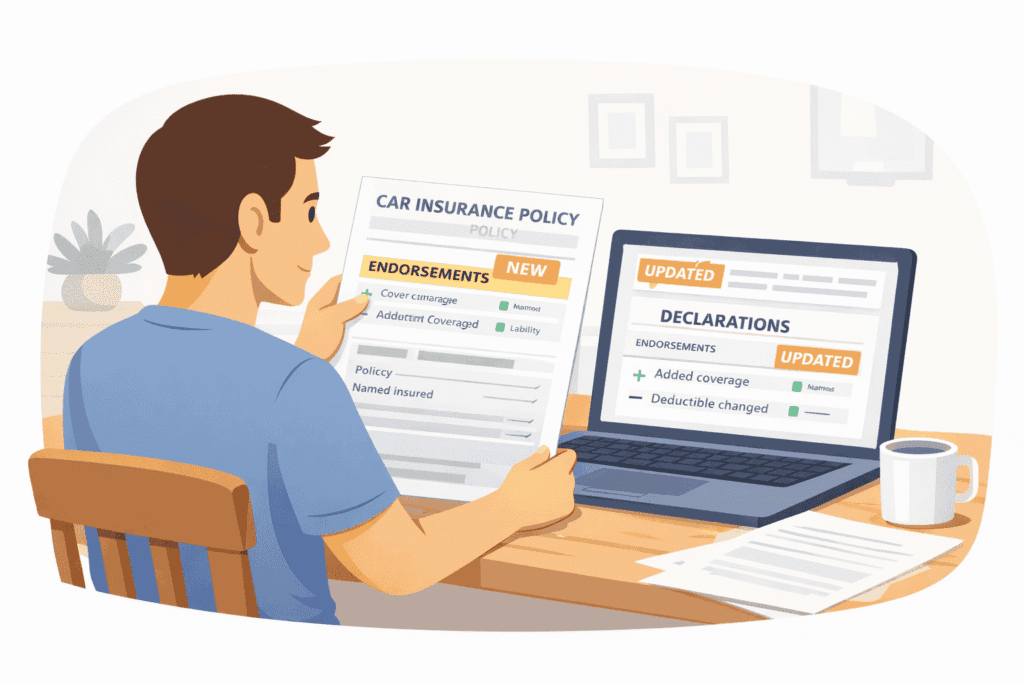
When you add an endorsement to a policy, you are usually changing part of the contract without replacing the whole policy. That change may add coverage, remove coverage, update limits, change deductibles, list a vehicle or driver differently, or add special conditions that did not apply before. If you want a clearer view of where these changes appear, it helps to start with How to Read a Car Insurance Policy: Sections Made Simple.
Many drivers hear the word “endorsement” and assume it always means extra protection. In practice, that is not always true. An endorsement can broaden coverage, but it can also narrow it, clarify it, or apply a restriction to a specific driver, vehicle, or situation.
Quick Summary
- An endorsement changes part of your existing policy.
- It may add, remove, limit, or clarify coverage.
- It can affect premium, deductible, exclusions, or who and what is covered.
- The updated terms usually appear in revised policy documents or a new declarations page.
- An endorsement does not automatically improve coverage just because it sounds official.
- The safest move is to review the effective date and exact wording of the change.
What an endorsement usually changes
An endorsement modifies the policy language already in place rather than replacing the entire contract. The National Association of Insurance Commissioners explains that an endorsement or rider amends an existing insurance contract and changes the original policy’s terms. See its consumer guidance on insurance endorsements and riders.
That change may involve:
- adding optional coverage
- changing a deductible
- increasing or reducing a limit
- adding or removing a driver
- listing an exclusion
- updating lender or vehicle information
- applying special rules to one type of use or one vehicle
The California Department of Insurance defines an endorsement as a written agreement that changes policy terms by adding or subtracting coverage. Read the endorsement together with the original policy because both documents affect the contract. See its glossary of automobile insurance terms.
If you want the broader explanation of how these changes fit into policy wording, see Car Insurance Endorsements: What They Are & Why They Matter.
What may change in real life
The effects of an endorsement usually show up in everyday details, not just in technical wording.
Coverage may expand
Some endorsements add protection that was not included before. For example, a policyholder may add rental reimbursement, roadside assistance, custom parts coverage, glass coverage, or a rideshare-related endorsement where available.
Coverage may narrow
Not all endorsements make the policy broader. Some do the opposite. A driver exclusion endorsement, for example, may remove coverage for claims involving a specific person. Another endorsement may restrict how a vehicle can be used or place a condition on certain losses.
Deductibles or limits may change
An endorsement can also change how much the policy pays or how much the insured pays first. That can mean a new deductible for a certain type of damage, a different coverage limit, or a special sub-limit for one item or situation.
What usually happens to your premium
A premium change is common when you add an endorsement, but not every endorsement affects price the same way.
In many cases:
- broader coverage raises the premium
- a narrower endorsement may reduce the premium
- a clarification or administrative update may have little or no premium effect
- a driver or vehicle-related endorsement may change how the policy is rated
Compare the price change with the new terms. A lower premium may reflect reduced protection, while a higher premium may reflect broader coverage or a newly disclosed risk.
What documents usually update
When an endorsement is added, the paperwork often changes too.
You may receive:
- an endorsement form
- a revised declarations page
- updated policy documents
- a notice showing the effective date of the change
- new premium information or billing details
Verify the revised documents and effective date rather than relying only on the change you requested.
What to check before relying on the endorsement
An endorsement only helps if it does what you think it does. Before relying on it, review the actual terms carefully.
Check these points:
- the exact effective date
- whether the endorsement adds, limits, or excludes something
- whether it applies to one vehicle or the whole policy
- whether it applies to all drivers or only one person
- whether a deductible changed
- whether a limit changed
- whether the declarations page now reflects the update
- whether the premium changed because of broader or narrower coverage
Many drivers also benefit from reading the wording in simpler terms before making assumptions. A plain-language explanation can help if the document feels technical, which is why some people also look for resources like Plain Language Insurance Policies: What Drivers Should Know.
Common situations where endorsements matter
A driver adds roadside assistance. The policy now includes help for breakdown-related situations that were not part of the earlier version.
A household changes, and one driver is added or excluded. That changes who is covered and may also affect the premium.
A financed vehicle requires updated lender information. The policy may be endorsed to reflect that new interest.
A driver adds glass coverage or changes a deductible. The policy still exists, but the claim experience may now look different than it did before.
Conclusion
When you add an endorsement to a policy, the biggest change is not the form itself. It is the contract term that now works differently. That difference may involve coverage, exclusions, deductibles, limits, driver status, vehicle details, or premium.
The safest approach is to treat every endorsement as a real policy change, not just an administrative update. Reading the revised wording, checking the effective date, and confirming what actually changed can help prevent confusion later, especially when a claim puts those details to the test.
Related
- How to Read a Car Insurance Policy: Sections Made Simple
- Car Insurance Endorsements: What They Are & Why They Matter
- Plain Language Insurance Policies: What Drivers Should Know
FAQ
Does an endorsement always add coverage?
No. Some endorsements add coverage, but others limit coverage, clarify terms, or apply exclusions.
Does adding an endorsement create a new policy?
Usually not. It typically changes part of the existing policy instead of replacing the whole contract.
Can an endorsement change my premium?
Yes. It may raise, lower, or leave the premium mostly unchanged, depending on what the endorsement changes.
Where do I see the endorsement in my documents?
It often appears in an endorsement form, a revised declarations page, or updated policy documents sent after the change.
Why does the effective date matter?
Because the endorsement usually applies from a specific date forward. A requested change and an active change are not always the same thing.