
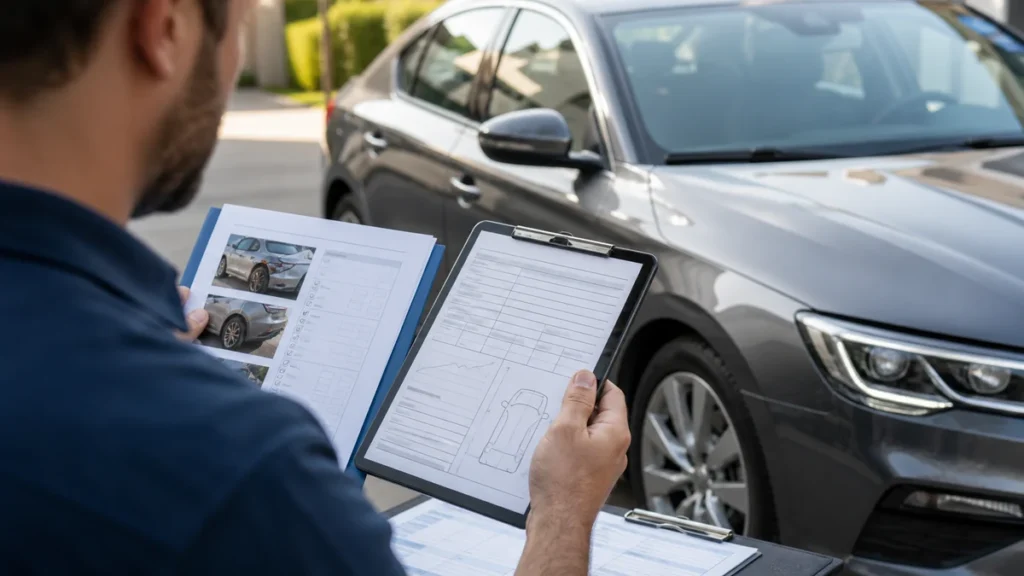
Diminished value after a car accident is the possible loss in market value that remains after a damaged vehicle has been repaired. The car may look fixed and drive normally, but buyers may still value it differently because it now has an accident history.
This is separate from total loss, deductible math, or a general claim dispute. The narrow question is whether the repaired vehicle is worth less than it would have been without the accident and whether that difference can be supported with evidence. For the broader workflow, see our car insurance claims process.
Quick Summary
- Diminished value is a claimed loss in market value after an accident, even after repairs.
- Accident history, repair quality, vehicle condition, mileage, and local market evidence can matter.
- First-party and third-party diminished value claims may be treated differently.
- There is no single national formula that applies to every diminished value claim.
- Useful proof can include repair records, photos, appraisals, vehicle-history information, and comparable vehicles.
What Does Diminished Value Mean?
The Idaho Department of Insurance describes diminished value as loss in market value caused by vehicle damage. Its consumer guidance also notes that payment under your own policy depends on what the contract provides. That is an Idaho explanation, not a national rule.
The key issue is market value after repair. A vehicle with a clean history and an otherwise similar vehicle with an accident history may not be viewed the same by buyers, dealers, or appraisers. That does not mean every accident creates a measurable diminished value loss.
Why Can a Repaired Car Be Worth Less?
A repaired vehicle may be worth less because an accident appears in its history or because buyers worry about structural damage, airbag deployment, paint work, frame measurements, sensors, or future reliability. The size of any loss can depend on the vehicle’s age, mileage, prior condition, severity of damage, repair quality, and local market.
Poor repair quality is related but different. If panels do not align, paint does not match, sensors malfunction, or related damage was missed, the issue may involve repair quality rather than only market stigma. That can overlap with a repair estimate dispute.
Common Types of Diminished Value
Inherent diminished value
This is the value loss that may remain after proper repairs because the accident history itself affects what buyers may be willing to pay.
Repair-related diminished value
This can involve incomplete, improper, or visibly poor repairs that leave the vehicle worth less than it would be after a proper repair.
Immediate diminished value
This compares value immediately before the accident with value immediately after the accident and before repair. Many consumer disputes, however, focus on value that remains lost after repairs are completed.
First-Party vs. Third-Party Diminished Value
A first-party claim is made under your own policy. A third-party claim is made against another driver’s liability coverage when that driver may be responsible. If that distinction is unclear, see first-party vs. third-party car insurance claims.
The NAIC Journal of Insurance Regulation has published research specifically examining differences in state law for first- and third-party diminished value claims. That is why a nationwide yes-or-no answer can be misleading.
Practically, do not assume your own collision claim and a claim against an at-fault driver’s insurer are handled the same way. Policy wording, liability, state rules, evidence, and settlement releases can all matter.
What Evidence Can Support a Diminished Value Claim?
A claim is usually stronger when it is based on documents rather than a general belief that the car is now worth less. Useful evidence can include repair invoices, before-and-after photos, vehicle-history information, mileage and trim records, an appraisal, and comparable vehicles with and without accident history.
Choose comparables carefully. Similar year, trim, mileage, options, condition, and location make the comparison more useful. An appraisal can help organize the evidence, but it does not automatically require an insurer to accept the appraiser’s number.
How Might an Insurer Evaluate the Claim?
An insurer may question whether the vehicle lost measurable market value, whether the comparable vehicles are truly similar, whether prior damage existed, whether the appraisal method is reliable, or whether the policy provides the claimed coverage. In a third-party claim, liability can also be disputed.
Do not treat the so-called 17c formula as a mandatory national rule. The NAIC research on diminished value describes multiple valuation approaches and significant state variation rather than one universal formula. Ask what method the insurer used and what evidence it will consider.
When Might a Diminished Value Claim Not Be Worth It?
The effort may not make sense when the vehicle is older, has high mileage or prior accidents, the repair was minor, the estimated value loss is small, or the cost of an appraisal is high compared with the realistic recovery.
Financed or leased vehicles can add another issue because the lender or leasing company may have requirements involving repairs or claim proceeds. Before signing a third-party release, confirm whether it settles only repair costs or also other vehicle-damage claims.
Diminished Value vs. Total Loss
Diminished value generally concerns a vehicle that has been repaired or can be repaired but may still be worth less afterward. A total loss claim asks whether the vehicle should instead be treated as uneconomical to repair and settled based on its covered value.
If the disagreement is broader than diminished value, see how to dispute an insurance claim decision.
Checklist Before Opening a Diminished Value Claim
- Confirm whether the claim is first-party, third-party, or another coverage path.
- Read the relevant policy language before assuming first-party coverage applies.
- Gather repair records, photos, vehicle-history information, and market comparables.
- Ask what valuation method the insurer will consider.
- Check whether a release would settle diminished value along with other property-damage claims.
- Compare the likely recovery with the cost and time of obtaining an appraisal.
Conclusion
Diminished value after a car accident is the possible market-value loss that remains after repairs. It can be real, but it is not automatic. The result depends on the claim type, state rules, policy wording, repair quality, vehicle history, market evidence, and the strength of the documentation.
Related
- First-Party vs Third-Party Car Insurance Claim
- Repair Shop Estimate Higher Than Insurance Estimate
- Dispute Insurance Claim Decision
FAQ
Does every accident create diminished value?
No. Age, mileage, prior damage, accident severity, repair quality, vehicle history, and local market evidence can all affect whether there is a measurable loss.
Does your own insurance have to pay diminished value?
Not necessarily. First-party coverage depends on policy language and applicable state law.
Can you claim diminished value from the at-fault driver’s insurer?
Possibly. Third-party claims still depend on liability, damages, state rules, evidence, and any settlement release.
Is the 17c formula required everywhere?
No. There is no single mandatory national formula for diminished value claims.
What documents can help support a diminished value claim?
Repair invoices, photos, vehicle-history records, market comparables, appraisals, and evidence of the vehicle’s pre-loss condition can help support the claimed loss.