
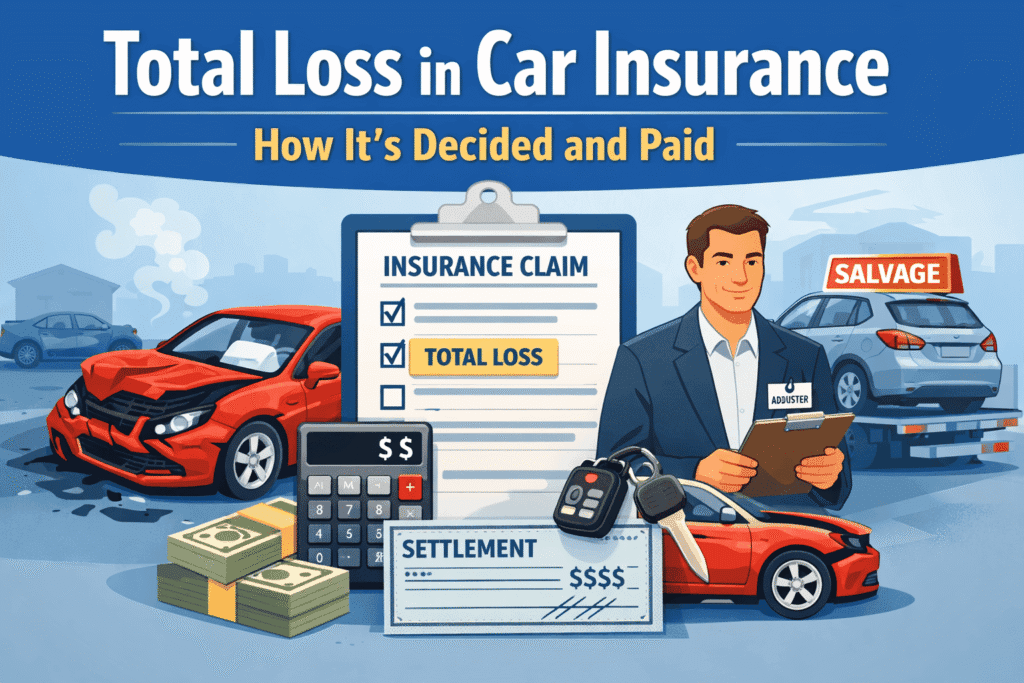
Many drivers hear the phrase total loss in car insurance and assume it means the car is completely destroyed. In practice, that is not always the reason. A vehicle can be declared a total loss even when it still looks repairable, if the cost to fix it is too high compared with the car’s value or the way state rules apply.
For official context, NAIC describes collision and comprehensive coverage, Texas DOI materials discuss totaled cars and actual cash value, and OPIC recommends keeping claim documents.
For related context, see when hail damage is considered a total loss.
For related context, see what to do after hitting a deer.
In simple terms, a total loss usually means the insurer decides it makes more sense to settle the claim based on the vehicle’s value than to pay for repairs. That decision can affect how much you receive, whether a deductible applies, what happens to the title, and whether a loan balance is still left over. If you want the broader timeline first, this guide to the car insurance claims process helps show where a total-loss decision fits.
This article explains what a total loss means, how insurers usually decide it, how payouts are calculated, and what to review before accepting a settlement.
Quick Summary
- A total loss usually means the car is not economical to repair compared with its value.
- The decision may depend on repair cost, actual cash value, salvage value, and state rules.
- The payout is often based on the car’s pre-loss value, not what you paid for it.
- A deductible may still reduce the final amount on a first-party claim.
- If you owe more on the loan than the car is worth, the insurance payment may not clear the balance.
What a total loss means in car insurance
A total loss means the insurer treats the vehicle as a claim that will be settled by value instead of repaired. That does not always mean the car is burned out, crushed, or beyond recognition. What usually matters is the financial result of repairing it safely.
For example, imagine a newer car with major front-end damage, deployed airbags, and hidden structural issues. From the outside, the car may still look fixable. But once labor, parts, supplemental damage, calibration work, and safety concerns are added up, the numbers may point toward a total loss instead of a repair approval.
This is why many drivers feel surprised by a total-loss decision. They are focused on whether the car can be repaired. The insurer is usually focused on whether the repair cost makes sense under the policy and under state rules.
How insurers usually decide a total loss
While the exact method can vary, the decision usually comes down to a few practical factors:
- Repair cost: the estimated amount needed to restore the car safely
- Actual cash value: what the vehicle was worth right before the loss
- Salvage value: what the damaged vehicle may still be worth after the accident
- State rules: some states use a total-loss threshold or formula that affects the decision
In practice, the insurer compares the likely repair path with the vehicle’s pre-loss value. If repair costs rise too close to, or beyond, that value, the car may be declared a total loss. What often complicates things is that the first estimate is not always the final one. Once the vehicle is disassembled, more damage may appear. For drivers reviewing whether to keep optional crash protection, this is also why it can help to consider whether collision car insurance is worth it based on vehicle value, deductible, premium, and replacement risk.
Water damage is one example where hidden electrical, safety, contamination, and corrosion issues can change the estimate after the first inspection. See when water damage may become a total loss for insurance.
This is one reason a total-loss decision can feel sudden. A driver may hear that the car looks repairable at first, then see the claim change after a deeper inspection. If your claim is being handled under your own policy, it also helps to understand how a deductible works in car insurance, because that can still affect the final settlement amount.
How a total-loss payout is usually calculated
When a car is totaled, the payment is often based on actual cash value. That usually means the vehicle’s market value right before the loss, not the cost of a brand-new replacement and not necessarily the amount you still owe on a loan.
Actual cash value is often shaped by factors such as the car’s age, mileage, condition, trim, options, and local market comparisons. Then other adjustments may come into play, such as your deductible, prior damage, taxes or fees where applicable, and whether you keep the totaled car when owner-retained salvage is allowed. CPA’s guide to whether a total-loss settlement includes sales tax and fees explains how those additional amounts can vary by state and claim rules.
A simple example helps. If the vehicle’s actual cash value is determined to be $18,000 and your collision deductible is $1,000, the settlement on your own policy may be lower than the headline value. If the loan balance is above that amount, the insurance payment may still leave a shortfall. That is where GAP insurance may become relevant, depending on its terms and limits.
Many drivers expect the payment to match what they need to buy a similar replacement right away. Sometimes it feels close. Sometimes it does not. The key point is that the settlement is usually tied to pre-loss value under the policy, not to your personal replacement budget.
Conclusion
A total loss in car insurance usually means the vehicle is being settled by value instead of repaired. The decision often depends on repair cost, vehicle value, salvage, and state rules, while the payout is commonly based on actual cash value and may still be reduced by a deductible or affected by a loan payoff.
The most important thing is to understand the numbers behind the decision, not just the label “totaled.” When you know how the value was calculated and what documents still matter, the process becomes much easier to evaluate.
Related
- Car Insurance Claims Process: 9 Steps That Really Happen
- What Is a Deductible in Car Insurance?
- What Affects Car Insurance Cost? 11 Key Factors
FAQ
Does a total loss mean the car is completely destroyed?
No. A car can be declared a total loss even if it still looks repairable, if the numbers no longer support fixing it.
Is the payout based on what I still owe on the car?
Usually no. The settlement is often based on the car’s actual cash value before the loss, not on the remaining loan balance.
Does a deductible still apply on a total-loss claim?
It often does on a first-party collision or comprehensive claim, depending on the policy and how the loss is being handled.