
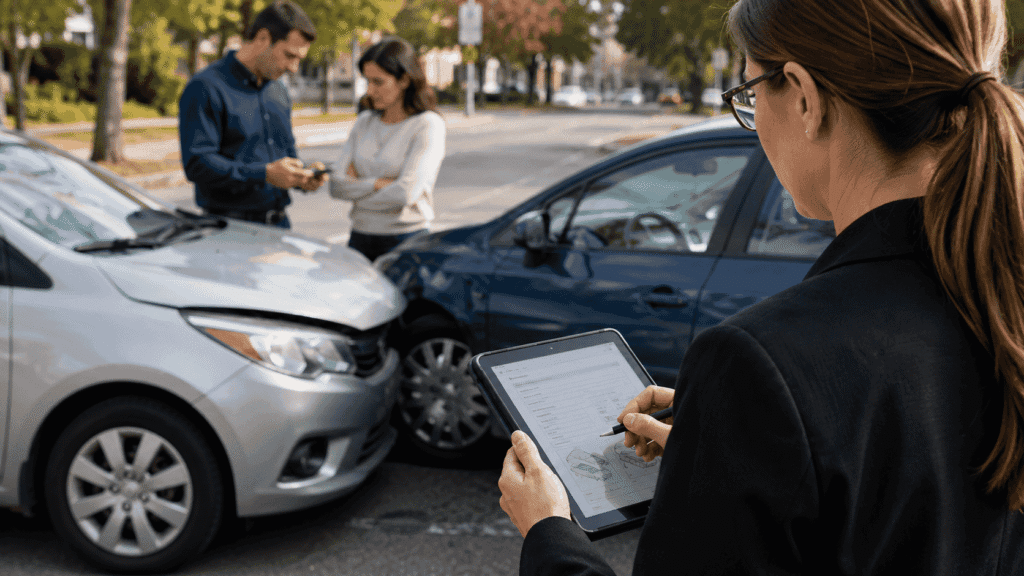
How car insurance determines fault after an accident depends on the evidence available and the rules that apply in the state. The insurer usually reviews driver statements, photos, vehicle damage, witnesses, police information, road conditions, and video before taking a liability position on the claim.
A police report, traffic ticket, or one driver’s statement can matter, but none automatically decides every insurance claim. Adjusters may compare statements, witnesses, photos, vehicle damage, police information, road conditions, and video. This review is part of the broader car insurance claims process.
Quick Summary
- Insurance companies generally investigate an accident before deciding fault.
- A police report or traffic ticket can be evidence but does not automatically control the insurer’s decision.
- Photos, statements, witnesses, vehicle damage, road conditions, and video can all matter.
- More than one driver may share responsibility depending on the facts and state rules.
- Two insurance companies can reach different conclusions about the same accident.
- No-fault insurance does not mean responsibility is irrelevant to every part of a claim.
How Does an Insurance Company Determine Fault?
An insurance company generally determines fault for its claim by investigating the accident and comparing the available evidence. The Idaho Department of Insurance explains that an insurer must investigate before determining fault and may decide that both drivers were partially responsible.
Police have a different role. An officer may document statements, vehicle positions, road conditions, apparent violations, and citations. Those records can become evidence for the insurer, but the insurer still evaluates the claim. If a fault dispute cannot be resolved through the claim process, legal responsibility may ultimately be addressed through the applicable legal process.
What Evidence Do Insurers Use to Determine Fault?
There is rarely one piece of evidence that tells the entire story. An adjuster may consider:
- Statements from the drivers
- Photos and video from the scene
- Location and pattern of vehicle damage
- Police or incident reports
- Traffic citations or documented violations
- Independent witness statements
- Lane markings, signs, signals, weather, and visibility
- Dashcam or security-camera footage
The California Department of Insurance recommends collecting witness information, photographs, and accident-scene details. These records can help show direction of travel, point of impact, traffic controls, and surrounding conditions. See also documents that can support a car insurance claim.
Does a Police Report Decide Who Is at Fault?
Not automatically. A police report can preserve important facts and observations, but the insurer still conducts its own review. The Idaho Department of Insurance also states that an insurer does not automatically assign fault to the driver who received a traffic ticket.
A claim can also be evaluated without a police report when other evidence is available. If that applies to your accident, see whether a claim can be denied without a police report.
Can Both Drivers Be Partly at Fault?
Yes. An insurer may conclude that both drivers contributed to the accident. The California Department of Insurance discusses comparative negligence, under which responsibility can be divided between drivers.
For example, one driver might make an unsafe lane change while another driver is traveling too fast for conditions. How shared responsibility affects payment depends on the state, claim type, and applicable rules, so percentages should not be treated as a universal national formula. See what happens when both drivers are partly at fault for a closer look at shared-fault claim outcomes.
Does No-Fault Insurance Mean Fault Does Not Matter?
No. “No-fault” generally affects how certain injury benefits are paid rather than eliminating responsibility from every part of an accident.
The National Association of Insurance Commissioners explains that under no-fault systems, an injured person’s own insurer may pay certain injury losses regardless of who caused the accident. State systems vary, and responsibility can still matter for property damage and other claims.
What If the Insurance Companies Disagree About Fault?
Two insurers can review the same accident and reach different liability conclusions. This can happen when statements conflict, evidence is incomplete, or each insurer interprets the facts differently.
The Idaho Department of Insurance notes that a third-party claim may be denied when there is not enough evidence to establish that the insured driver was responsible. If you have applicable collision coverage, you may be able to use your own policy for vehicle repairs while responsibility is still disputed. A deductible may apply initially; see how a deductible can work when someone else hits your car.
How Can You Make Fault Easier to Evaluate?
- Photograph vehicle damage, lanes, signs, signals, and the surrounding scene when it is safe.
- Save dashcam or other video before it is overwritten.
- Collect contact information from independent witnesses.
- Write down the basic sequence of events while it is still fresh.
- Keep the police or incident report number when a report was made.
- Save estimates, claim emails, photos, and other records together.
- If fault is disputed, ask the insurer to explain its liability decision and supporting evidence.
Simple Fault Investigation Example
Suppose two vehicles sideswipe during a lane change. Driver A says the lane change was already complete, while Driver B says there was not enough room.
Those statements alone may not resolve the dispute. Photos showing the impact locations, an independent witness, and dashcam footage showing the vehicles before contact could provide a much clearer picture. Fault determination is generally an evidence-based process rather than a single-document decision.
Conclusion
How car insurance determines fault after an accident usually involves investigating the collision, comparing available evidence, considering applicable state rules, and reaching a liability position for the claim. Police reports and traffic tickets can matter, but they do not automatically control the insurer’s determination.
Fault may also be shared, and insurers can disagree when evidence is incomplete or disputed. Clear photos, witnesses, video, reports, and written claim records give the adjuster a stronger factual basis for evaluating what happened.
Related
- Car Insurance Claims Process: 9 Steps From Report to Payment
- Can a Claim Be Denied Without a Police Report?
- Do You Pay a Deductible If Someone Hits You?
FAQ
Does the police officer decide who is at fault for insurance?
Not automatically. Police may document the accident and issue citations, but the insurer generally performs its own investigation before taking a liability position.
Does getting a traffic ticket automatically make you at fault?
No. A citation can be relevant evidence, but insurers may consider other facts before determining responsibility for the claim.
Can both drivers be found at fault?
Yes. Depending on the evidence and state rules, responsibility may be divided when both drivers contributed to the accident.
What if the other driver’s insurer says I was at fault?
Ask for the reasoning behind the liability decision. Depending on your coverage and the circumstances, you may also have a claim path under your own policy while the disagreement is addressed.
Does no-fault insurance mean fault never matters?
No. No-fault systems generally affect certain injury benefits. Responsibility can still matter for property damage and other parts of a claim, depending on state law.