
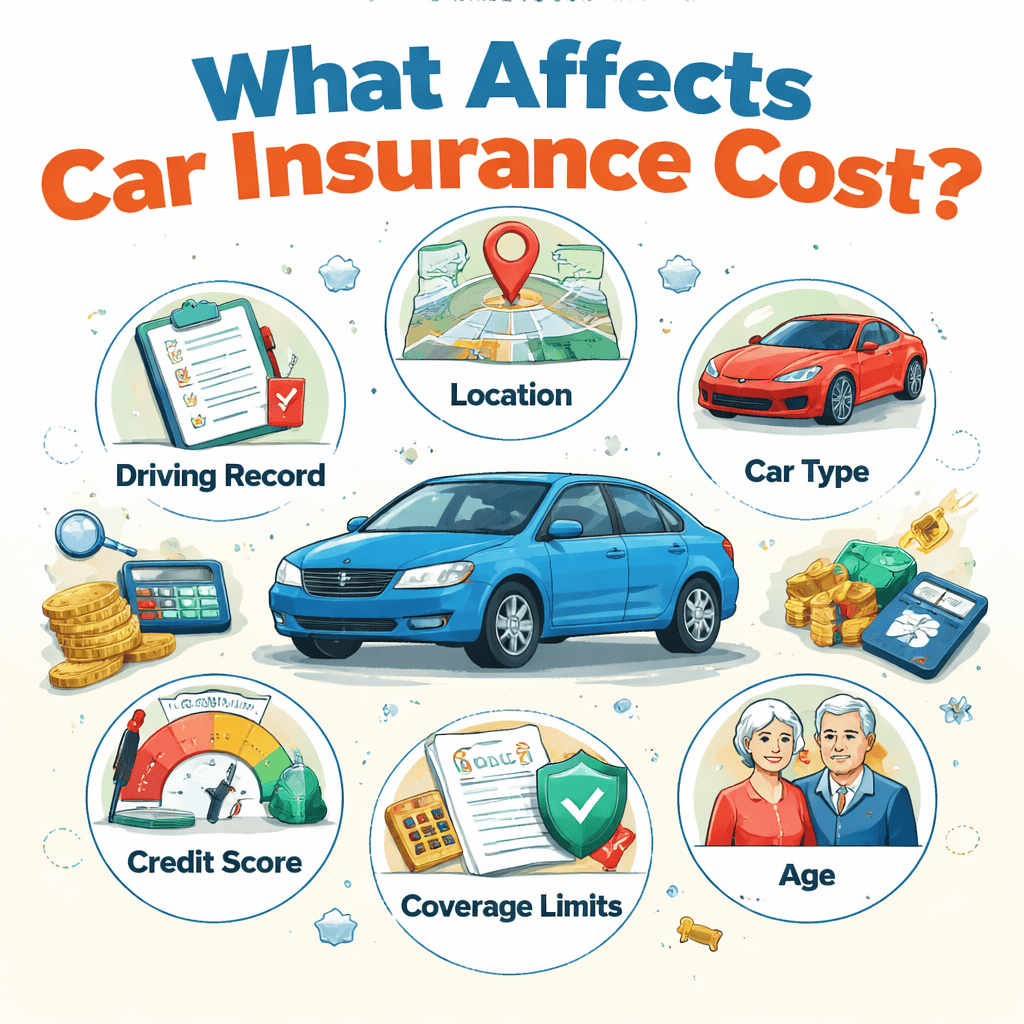
What affects car insurance cost? Insurers generally price policies by estimating how likely a claim is, how expensive it could be, and how much protection the policy provides. That is why two drivers in the same city can pay different premiums even when their vehicles look similar.
Location, driving history, vehicle type, mileage, household details, coverage choices, limits, deductibles, and broader claim trends can all matter. For the insurance basics first, review what car insurance is and how it works. This guide explains the 11 pricing factors that commonly matter and what to check when your premium changes.
Quick Summary
- Car insurance cost is based on risk, not on one single factor.
- Your location, driving record, age, vehicle type, mileage, coverage choices, limits, and deductibles can all affect pricing.
- Higher protection often costs more, while higher deductibles can lower premiums but increase out-of-pocket cost after a claim.
- State rules matter because insurers do not use every rating factor the same way everywhere.
- If your premium changes, your declarations page is usually the best place to start reviewing what may have affected the price.
What affects car insurance cost in simple terms?
In simple terms, what affects car insurance cost usually comes down to three practical questions:
- How likely is a claim? This includes the chance of a crash, theft, vandalism, weather damage, or injury claim.
- How expensive could that claim be? Repair costs, medical bills, lawsuits, and vehicle value all matter.
- How much coverage did the driver choose? Limits, deductibles, and optional protections change how much the insurer might need to pay.
Insurers use those ideas to rate a policy. That is why two drivers can both be “good drivers” and still pay different amounts. One may live in a higher-claim area. The other may drive a vehicle that is cheaper to repair. One may choose state minimum liability, while the other carries broader protection. Same basic product, different risk picture.
Many drivers assume price is mostly about whether they had an accident. In practice, it is broader than that. Insurance pricing tries to predict both frequency and severity: how often losses may happen, and how costly those losses could be when they do happen.
What affects car insurance cost? 11 key factors
The National Association of Insurance Commissioners explains that auto premiums may reflect factors such as driving history, vehicle use, garaging location, coverage choices, limits, deductibles, claims history, and credit-based insurance scores where permitted. State laws affect which factors may be used. See the NAIC Consumer’s Guide to Auto Insurance.
1) Your location
Location can affect price because accident frequency, theft, weather exposure, repair labor, medical costs, traffic density, and state insurance rules vary. Even a move within the same city can change the garaging ZIP code and the risk profile used to price the policy. If your residence or the vehicle’s normal location changed, see when to change your car insurance address after moving and which policy details should be updated.
2) Your driving record
Tickets, at-fault crashes, and serious violations may increase premium because they can indicate a higher chance of future claims. The effect depends on the event, how recent it was, the insurer’s rating method, and the rules in your state.
3) Your age and driving experience
Drivers with less experience often have less history for an insurer to evaluate and may be rated as higher risk. Age and experience do not affect pricing the same way in every state, and some personal rating factors are limited by law.
4) The vehicle you drive
Make, model, year, trim, value, theft frequency, safety features, parts prices, and repair complexity can all matter. Vehicles with costly sensors, cameras, body panels, or specialized parts may create more expensive collision or comprehensive claims.
5) Mileage and how the vehicle is used
More time on the road generally creates more exposure to a claim. Personal use, commuting, business use, delivery work, and rideshare activity may be rated differently, and the policy must accurately describe how the vehicle is used. If you want to understand this factor in more detail, see how annual mileage may affect car insurance cost.
6) Coverage types you choose
A liability-only policy usually costs less than one that also includes collision, comprehensive, and optional protections. Compare the actual coverage before comparing prices. This guide explains the difference between liability and broader “full coverage”. If you are reviewing optional vehicle protection to reduce premium, it also helps to consider whether comprehensive car insurance is worth keeping for your vehicle and risk profile.
7) Your limits
Policy limits cap what the insurer may pay for covered losses. Higher limits can increase premium because they provide more financial protection. For the narrower pricing tradeoff, see how coverage limits affect car insurance cost.
8) Your deductible
Deductibles commonly apply to collision and comprehensive claims. A higher deductible can reduce premium because you accept more out-of-pocket cost after a covered loss. Review how a car insurance deductible works and the tradeoff between a higher deductible and lower premium.
9) Prior claims history
Previous claims may influence how an insurer estimates future risk. A pattern of losses may matter more than a single event, but the effect varies by claim type, insurer, timing, and state law.
10) Credit-based insurance score, where allowed
In many states, insurers may use a credit-based insurance score as one rating factor. Other states restrict or prohibit the practice. When allowed, it is used as a statistical pricing variable rather than as a measure of driving skill.
11) Household and policy details
Listed drivers, number of vehicles, garaging address, household composition, vehicle use, discounts, and policy structure may affect price. Incorrect mileage, an outdated address, or missing driver information can also produce unexpected changes and should be corrected.
Examples of how these factors change cost in real life
It often helps to see the rating factors in everyday situations instead of just as a list.
- Same driver, different car: A newer SUV with expensive driver-assist sensors may cost more to insure than an older sedan with lower repair complexity.
- Same car, different location: A vehicle kept in a higher-theft ZIP code may carry more comprehensive risk than the same vehicle garaged in a lower-theft area.
- Same profile, different deductible: A higher deductible may reduce the premium, but it also means the driver pays more before insurance contributes after a covered loss.
- Same city, different use: One driver uses the car only on weekends, while another commutes every day through dense traffic. The insurer may view those exposures differently.
- Same coverage type, different limits: Two policies may both say liability coverage, but the one with stronger limits may cost more because it provides broader financial protection.
These examples show why comparing premiums without comparing policy details can lead to the wrong conclusion. A lower price is not automatically a better value if the protection is thinner.
Why rates can go up even if you did nothing wrong
Premiums can change even when you had no ticket or claim. Repair and replacement costs, medical expenses, theft, severe weather, and claim trends in a region may affect an insurer’s rates. The NAIC summarizes these broader pressures in its explanation of why insurance premiums may increase.
For a wider pricing explanation, review why car insurance can be expensive. For a renewal-specific change, see why an insurance rate increase can happen.
What to review on your policy if the price changes
If you are trying to understand what affects car insurance cost on your own policy, start with the declarations page and compare the current version to the prior one. That is often the fastest way to spot what changed. It helps you see whether the premium moved because of coverage, limits, deductibles, listed drivers, vehicle details, or endorsements.
- Your active coverage types
- Your liability limits
- Your collision and comprehensive deductibles
- The listed drivers on the policy
- The vehicle year, make, model, and garaging address
- Any endorsements or optional features that were added or removed
If the reason is not obvious, verify mileage, address, vehicle use, and listed-driver details. Correct inaccurate information before reducing coverage, then compare the updated price with the protection the policy provides.
How to lower car insurance cost without weakening protection too much
Before cutting coverage, confirm the policy information is accurate and compare the price change with the protection being removed.
- Review whether the policy is liability-only or broader protection before comparing prices.
- Check whether a higher deductible would reduce premium without creating an out-of-pocket problem after a claim.
- Look at your policy limits before lowering them just to reach a cheaper monthly price.
- Make sure mileage, garaging address, vehicle use, and listed-driver details are still correct.
- Compare like with like. A cheaper quote is not always a better value if the protection is thinner.
The goal is a policy that remains affordable without becoming too weak for a serious loss.
Common misunderstandings about what affects car insurance cost
“My premium should match my friend’s.”
No. Small differences in ZIP code, vehicle trim, driving record, mileage, limits, or deductibles can change the rate.
“Full coverage is required by law.”
No. “Full coverage” is not an official legal requirement in most states. Usually, liability coverage is the legal base, while broader vehicle protection may be optional unless a lender requires it.
“If I never file a claim, my rate should always go down.”
No. Broader pricing conditions in your area can still affect renewal cost even if you personally had no losses.
“The cheapest policy is the smartest choice.”
Not always. Lower price can mean lower limits, less coverage, or a deductible that becomes hard to handle after a claim.
Conclusion
Car insurance cost reflects a combination of driver, vehicle, location, household, coverage, and broader claim factors. Review the declarations page and compare policy details before assuming one event or one coverage caused the price. When considering changes, compare the actual savings with the protection, limits, or deductible being changed.
Related
- How Coverage Limits Affect Car Insurance Cost
- Higher Deductible, Lower Premium
- Why an Insurance Rate Increase Can Happen
FAQ
What factor affects car insurance cost the most?
There is usually no single factor that matters most for every driver. Location, driving record, vehicle type, and coverage choices are often among the biggest influences, but the exact weight varies by insurer and state.
Does a higher deductible lower car insurance cost?
Often yes, especially for collision and comprehensive coverage. But a higher deductible also means you may pay more out of pocket after a covered loss.
Why did my rate go up if I had no accident?
Your premium can still change because of broader claim trends, repair inflation, theft patterns, state-level pricing conditions, or other policy changes not tied to a personal accident.
Does the car model really change insurance cost?
Yes. Repair complexity, parts pricing, theft frequency, safety equipment, and claim patterns tied to a specific model can all affect pricing.
Should I lower coverage just to reduce premium?
Not before reviewing the tradeoff. Lower premium can mean weaker protection. It is usually better to understand what changed and what each coverage is doing before reducing the policy.