
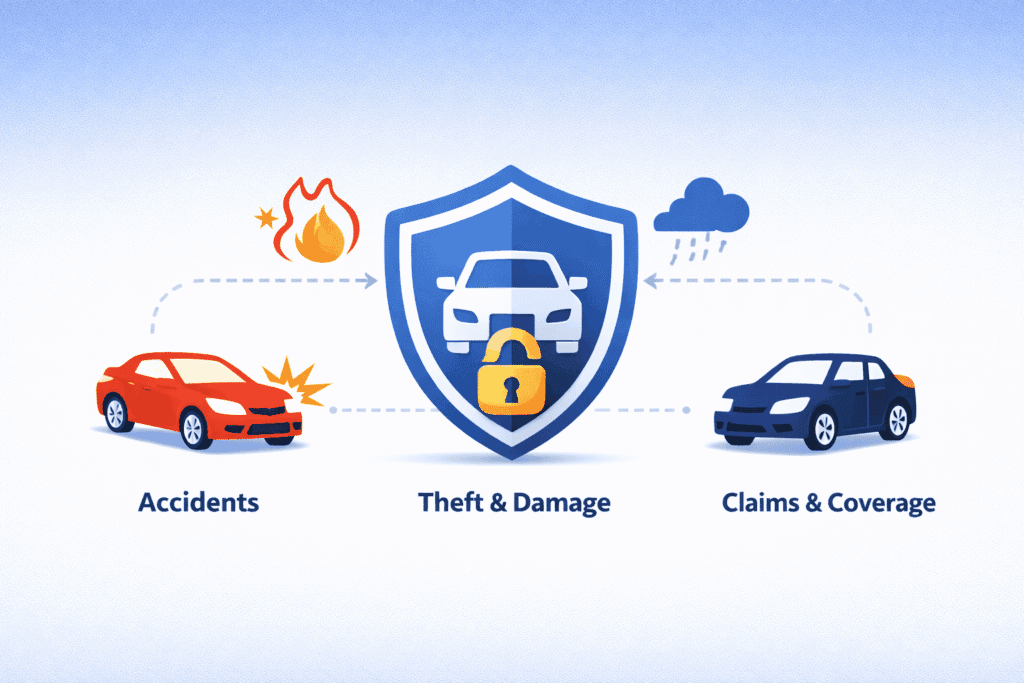
What is car insurance? It is a contract that transfers certain financial risks from a driver to an insurer. You pay a premium, and the insurer agrees to handle covered losses according to the policy’s coverages, limits, deductibles, exclusions, and conditions.
Car insurance can help with injuries or property damage you cause to others and, when selected, damage to your own vehicle. The exact protection depends on the policy and state rules. This guide explains how auto insurance works, the main coverage types, what affects claims, and what to review before you need to use the policy.
Quick Summary
- Car insurance is a contract that may help pay for covered losses involving injuries, property damage, or damage to your vehicle.
- Liability coverage usually protects you when you cause damage or injuries to others, while other coverages may protect your own car.
- Claims are not paid just because an accident happened; they are reviewed against policy language, limits, deductibles, exclusions, and the facts of the loss.
- “Full coverage” does not mean every problem is covered, and state minimum insurance does not always mean strong financial protection.
- The best place to understand your own policy is your declarations page, plus the sections that explain limits, deductibles, exclusions, and endorsements.
What car insurance really is
Car insurance is a legal and financial agreement between you and an insurance company. You agree to keep the policy active by paying premiums and following the policy rules. In return, the insurer agrees to provide protection for certain losses described in the policy.
The National Association of Insurance Commissioners explains that auto insurance generally combines liability protection with coverage for vehicle damage, depending on what the policy includes. Policy sections also describe the insured’s obligations, exclusions, limitations, and available coverage. See the NAIC auto insurance overview.
The key word is certain. A car insurance policy is not a blank check. It does not pay for every problem connected to your car, and it does not work the same way in every situation. Some coverages protect other people when you cause damage. Other coverages help protect your own vehicle. Some losses are limited by deductibles or dollar caps, and some losses may be excluded entirely.
That is why it helps to think of insurance as a risk-sharing system. A serious crash, a stolen vehicle, or a major hail loss can be expensive. Instead of one driver carrying the full financial burden alone, insurance spreads risk across many policyholders. In exchange, each individual policy has rules about when protection applies and how much may be paid.
For example, if you rear-end another car at a red light, your policy may help pay for the other driver’s vehicle damage or injuries if you carry the right liability protection. If a tree branch falls on your parked car during a storm, the claim may depend on whether you carry coverage for non-collision damage. And if you only carry the minimum insurance required in your state, your policy may still leave you exposed to major out-of-pocket costs.
How car insurance works in practice
Many drivers understand the idea of insurance in theory, but real-life claims are where confusion usually starts. What usually happens is more structured than people expect.
- You choose your coverages. When you buy the policy, you select what protections you want. Some states require minimum liability insurance to drive legally. If you want broader protection for your own vehicle, you may choose additional coverages. If you are unsure about the legal side, it helps to review when car insurance is required in the U.S..
- You agree to policy terms. The policy explains what is covered, what is excluded, how much the insurer may pay, and what your responsibilities are after a loss.
- You keep the policy active. Coverage only works while the policy is in force. Missed payments, cancellation, or lapse problems can affect whether a claim is covered.
- An incident happens. This might be a crash, a broken windshield, vandalism, theft, hail, flooding, or another insured event.
- You report the claim. You give the insurer the basic facts: what happened, when it happened, who was involved, photos, police report information when available, and other supporting details.
- The claim is investigated. The insurer compares the facts of the loss to your policy language. This is where coverage type, limits, deductibles, endorsements, excluded drivers, vehicle use, and timing can matter.
- Payment or repair handling follows the policy. If the loss is covered, the insurer may pay a repair shop, reimburse you, pay another party, or declare the vehicle a total loss depending on the situation.
The legal side also depends on documents and state requirements. Review what counts as proof of insurance, how much car insurance you may need to drive legally, and what an SR-22 is when a state requires a financial-responsibility filing.
Keeping the policy active matters too. This guide explains what can happen when someone is driving without insurance.
In practice, that means car insurance is not just “money after an accident.” It is a system of rules. Two drivers can have the same crash but very different outcomes because their policies are different.
Main types of car insurance coverage
Understanding the major coverage types is one of the fastest ways to understand what is car insurance. A policy often combines several protections, and each one is designed for a different kind of risk.
The NAIC explains that the protection available depends on the coverage selected and the rules where the driver lives. Common categories include liability, collision, comprehensive, medical-related coverage, and uninsured or underinsured motorist protection. See the NAIC explanation of what auto insurance covers.
Liability coverage
Liability coverage usually helps pay when you cause injury or property damage to someone else. This is the part of the policy that often matters most for legal driving requirements. It may include bodily injury liability and property damage liability. It generally does not repair your own vehicle.
Collision coverage
Collision coverage can help pay to repair or replace your own car after a crash, regardless of who caused it. Hitting another vehicle, backing into a pole, or sliding into a guardrail are common examples. Collision usually comes with a deductible, which is the amount you pay before the insurer pays the rest of the covered loss. If that part still feels fuzzy, read more about how a deductible works in car insurance.
Comprehensive coverage
Comprehensive coverage usually applies to non-collision damage. That can include theft, vandalism, fire, falling objects, hail, animal strikes, and some weather-related losses. It also commonly has a deductible. Many drivers assume comprehensive means “complete,” but it still comes with limits and exclusions.
Medical Payments or Personal Injury Protection
Depending on your state and policy, MedPay or PIP may help with medical costs after an accident. In some places, PIP can also extend beyond direct medical bills. The rules vary a lot, which is why this part of a policy often needs a closer look.
Uninsured or underinsured motorist coverage
This coverage may help if the at-fault driver has no insurance or not enough insurance. Depending on the policy and state rules, it may apply to injuries, vehicle damage, or both.
If you want a broader overview of what each protection can do, this related guide on what car insurance may cover helps connect the pieces.
What car insurance usually pays for — and what it usually does not
One of the biggest mistakes drivers make is assuming that any car-related problem should be an insurance problem. In reality, insurance is built around specific risks, not general ownership costs.
Car insurance may help pay for:
- Damage or injuries you cause to others, if liability coverage applies
- Damage to your own vehicle after a crash, if you carry collision
- Theft, vandalism, hail, fire, animal strikes, or similar non-collision losses, if you carry comprehensive
- Medical expenses, depending on your MedPay or PIP coverage
- Losses involving an uninsured or underinsured driver, depending on the policy
Car insurance usually does not pay for:
- Routine maintenance, oil changes, tires, or brake wear
- Mechanical failure caused by age or normal use
- Wear and tear, rust, corrosion, or slow damage over time
- Custom parts or accessories beyond stated policy limits, if they are not properly covered
- Losses that fall under a policy exclusion
In practice, a broken engine from normal mechanical failure is very different from engine damage caused by a sudden covered event. A stolen car is different from a car that simply stopped working. That difference between sudden accidental loss and ownership-related expense is one of the most important insurance basics to understand.
What affects claim decisions and how much gets paid
Claims are not decided by one factor alone. Insurers look at the event itself, the policy wording, and the details around the vehicle and driver. Many drivers focus only on whether they have “coverage,” but that is only the starting point.
- Coverage type: The policy has to include the right protection for that kind of loss.
- Limits: Every coverage has a maximum amount the insurer may pay. If you have questions about that part, review how policy limits work.
- Deductible: A deductible can reduce the amount you receive for certain losses.
- Facts of the loss: Who was driving, where the vehicle was, what caused the damage, and whether the event fits the policy all matter.
- Exclusions and endorsements: Policies can exclude certain situations or modify standard coverage through endorsements.
- Vehicle use: Personal use and business use are not always treated the same way.
- Ownership status: If the car is financed or leased, the lender may require broader protection than the state minimum.
- Timing and documentation: Late reporting, unclear evidence, or missing details can slow down a claim and complicate the review process.
For example, imagine two hail claims. Driver A has comprehensive coverage with a manageable deductible and good documentation. Driver B only has liability coverage. The same storm hits both cars, but only one driver may have coverage for vehicle damage. The weather was the same; the policy setup was not.
What to check in your policy before you ever need a claim
Many insurance problems feel like surprises only because the policy was never reviewed in plain language. A few minutes spent checking the right sections can prevent a lot of confusion later.
- Declarations page: This is where you usually see your active coverages, limits, deductibles, vehicles, and listed drivers.
- Liability limits: Make sure you know how much protection you actually carry for injuries and property damage.
- Physical damage coverages: Check whether collision and comprehensive are included, and what deductibles apply.
- Driver details: Review who is listed, whether anyone is excluded, and whether there are usage restrictions.
- Exclusions: These explain when the policy may not apply, even if the event seems connected to your car.
- Endorsements: These can add, remove, or modify standard policy terms.
- Claim instructions: It helps to know what your insurer expects after an accident, theft, or other sudden loss.
Many drivers only look at the premium amount and skip the rest. In practice, the premium tells you what you pay. The declarations page tells you what you bought.
Common misunderstandings about car insurance
“If I have insurance, every car problem should be covered.”
No. Insurance usually covers specific accidental or insured losses, not every expense of owning a vehicle.
“Full coverage means I am covered for everything.”
No. Full coverage car insurance is an informal phrase, not a guarantee of unlimited protection. Policies still have exclusions, limits, deductibles, and coverage conditions.
“Minimum required insurance is enough in every situation.”
Not necessarily. State minimum rules are about legal compliance, not always about strong financial protection after a serious crash.
“Insurance only matters if I am a risky driver.”
No. Careful drivers can still face theft, hail, vandalism, animal strikes, or be hit by someone else.
“A denied claim means the insurer is automatically wrong.”
Not always. Sometimes the loss falls outside the coverages purchased, exceeds a limit, or runs into a policy exclusion. Sometimes the issue is documentation or a disputed fact pattern. The important thing is to compare the claim situation to the actual policy language.
Conclusion
Car insurance is a contract that provides specific financial protections rather than unlimited coverage for every vehicle problem. Understanding the coverages, limits, deductibles, exclusions, drivers, and policy conditions makes it easier to know what the policy may do after a loss. Review those details before relying on the policy, especially when legal requirements or vehicle-financing obligations apply.
Related
- Is Car Insurance Required by Law in the U.S.?
- Proof of Insurance: What Counts and When You Need It
- What Is an SR-22?
FAQ
Is car insurance required in every U.S. state?
No. Requirements vary by state, and the type of financial responsibility rule can vary too. That said, most drivers in the U.S. will need some form of insurance or legally accepted financial responsibility to drive.
Does car insurance follow the car or the driver?
It depends on the situation and the policy terms. In many cases, coverage is tied heavily to the insured vehicle, but driver status, permission, exclusions, and state rules can also affect how coverage applies.
Can car insurance cover windshield damage?
It may. Windshield damage is often connected to comprehensive coverage, but handling can vary by policy, deductible, and state-specific rules.
Will car insurance pay if my engine fails?
Usually no, if the problem is normal mechanical failure or wear and tear. Insurance is generally built for sudden covered losses, not routine breakdowns or maintenance-related issues.
Why do two people get different claim outcomes after similar accidents?
Because claims depend on the exact policy, coverage types, limits, deductibles, exclusions, endorsements, driver details, and the facts of the loss. Similar accidents do not always mean identical coverage results.