
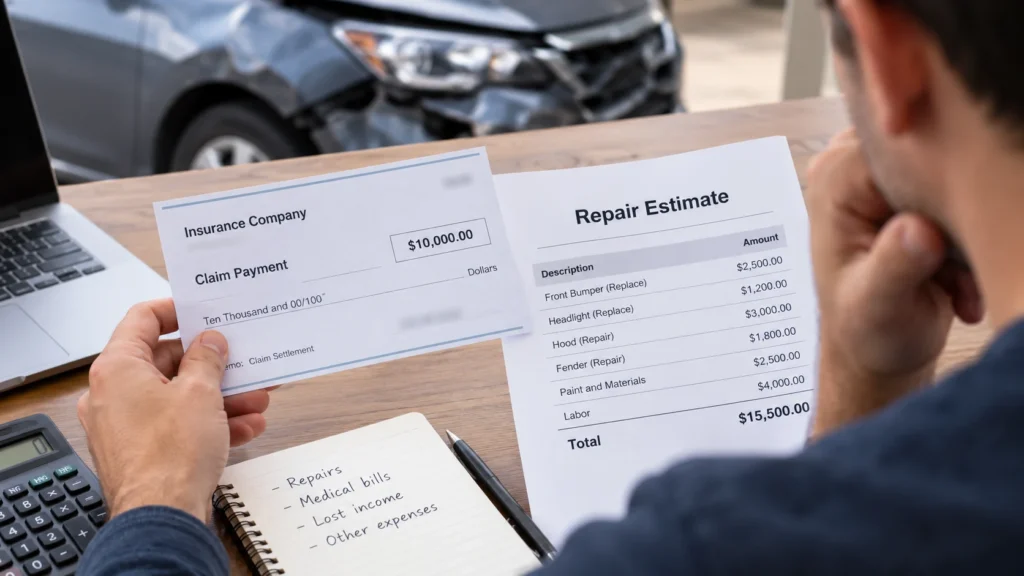
If the other driver’s insurance limits are not high enough to cover your losses after an accident, the at-fault driver’s insurer generally does not keep paying beyond the applicable policy limit. That can leave part of the vehicle damage, medical bills, lost income, or other covered losses unpaid.
What happens next depends on the type of loss, your own coverage, the other driver’s policy limits, state rules, whether other people were injured, and whether you accept a settlement that includes a release. In some cases, your own collision or underinsured motorist coverage may become important.
Quick Summary
- The at-fault driver’s insurer generally cannot pay more than the applicable liability limit.
- Your own collision or underinsured motorist coverage may help with some losses.
- Multiple injured people or damaged vehicles may have to share a per-accident limit.
- A policy-limits payment may come with a release, so read it carefully before signing.
- Coverage and settlement rules can vary significantly by state and policy.
What if the other driver’s insurance limits aren’t enough?
The first step is confirming that the problem really is the insurance limit. A settlement offer that seems too low does not automatically mean the policy has been exhausted.
Ask the adjuster which liability limit applies, whether fault has been accepted, whether other claims are competing for the same limit, and whether the proposed payment is intended to be final. Our guide to car insurance policy limits explains how per-person, per-accident, and property-damage limits work.
For example, a driver might carry enough bodily injury coverage for one injured person but not enough to pay all claims when several people are hurt in the same crash. Property-damage limits can create a similar problem when several vehicles or other property are damaged.
What can happen with vehicle damage?
If the other driver’s property-damage liability limit is lower than the amount of covered damage, you may have other options depending on your policy.
If you carry collision coverage, you may be able to make a claim through your own insurer rather than waiting for the other carrier to resolve every competing claim. Your collision deductible normally applies first. Your insurer may then try to recover money from the responsible party or insurer through subrogation.
If money is later recovered, some or all of the deductible may also be returned, depending on the amount recovered, the policy, and state law. Our guide to what happens to your deductible when someone hits your car explains that process in more detail.
Underinsured motorist property-damage coverage may also be relevant in some states, but it is not available or structured the same way everywhere.
What can happen with injury claims?
Injury claims can become more complicated because liability limits are commonly expressed as a maximum per person and a maximum per accident.
If several people are injured, the total available amount may have to be divided among multiple claims. A severe injury can also exceed the maximum available for one person even when money remains within the broader per-accident limit.
Your own underinsured motorist coverage may help when an at-fault driver has insurance but not enough to fully cover the loss. The National Association of Insurance Commissioners describes underinsured motorist coverage as protection for this type of situation.
However, how UIM benefits are calculated can differ by state. Some states have offsets, exhaustion requirements, notice rules, or different forms of coverage. Our uninsured versus underinsured motorist guide explains the distinction.
Why you should be careful with a release
An insurer offering the remaining policy limit may ask you to sign a release. That document can matter just as much as the amount of the check.
A release may limit your ability to pursue additional recovery from the at-fault driver. Depending on your policy and state, settling without notifying your own insurer can also affect an underinsured motorist claim or the insurer’s subrogation rights.
Before accepting a final policy-limits settlement, ask whether your own insurer requires notice, consent, or specific documentation. For serious injuries, large losses, multiple claimants, or disputed release language, individual legal advice may be appropriate.
Example: damage is higher than the available limit
Suppose your covered vehicle damage and related expenses total $18,000, but only $10,000 of property-damage liability coverage is available from the at-fault driver.
If yours is the only property-damage claim, the other insurer may eventually offer up to the available limit, subject to liability and damage evaluation. But if another vehicle, guardrail, fence, or other property was also damaged, the available $10,000 may need to address several claims.
If you have collision coverage, using your own policy may allow the vehicle claim to move forward while insurers address recovery behind the scenes. That does not mean you receive duplicate payment for the same damage.
What documents should you keep?
- Written liability decision from the other insurer.
- Confirmation of the applicable policy limit when available.
- Repair estimates, photographs, invoices, and total-loss valuations.
- Medical bills, treatment records, and documentation of lost income.
- The proposed settlement and release.
- Your own declarations page and applicable endorsements.
- Written instructions from your insurer regarding collision or UIM coverage.
Also distinguish a coverage-limit problem from a valuation dispute. If the insurer offers $10,000, that does not necessarily mean the insurer agrees your damages are worth more than $10,000 and simply lacks coverage. The carrier could be disputing fault, repair costs, medical expenses, or another part of the claim.
What should you do next?
- Document the accident, damage, injuries, expenses, and communications.
- Ask whether the other insurer is offering the policy limit or disputing the value of the claim.
- Notify your own insurer and ask which first-party coverages may apply.
- Check collision, UIM, PIP, MedPay, and other applicable coverage on your policy.
- Review any settlement release before signing it.
- Confirm any notice or consent requirements with your insurer.
- Keep track of payments so the same expense is not paid twice.
The broader car insurance claims process can help you organize documents, deadlines, communication, and the next stages of the claim.
State rules can change the result
Underinsured motorist rules vary significantly by state. The Maryland Insurance Administration, for example, explains different forms of UIM protection available there. Check your declarations page, endorsements, settlement documents, and the rules that apply in your state before assuming every underinsured-driver claim works the same way.
Conclusion
If the other driver’s insurance limits are not enough, the unpaid portion of the loss does not automatically become payable by the other insurer. Your own collision, underinsured motorist, medical, or other applicable coverage may become relevant, and the responsible driver may remain exposed beyond the insurance limit.
Before accepting a final settlement, confirm what limit applies, identify your own available coverage, and understand exactly what any release would resolve.
Related
- Car Insurance Policy Limits
- Uninsured vs. Underinsured Motorist Coverage
- Your Rights After a Car Accident
Frequently Asked Questions
Does underinsured motorist coverage always pay the difference?
No. Payment depends on your coverage, limits, damages, policy terms, and state rules. The calculation is not the same everywhere.
Can I use collision coverage if the other driver’s insurance is not enough?
Collision coverage may pay for covered damage to your vehicle even when another driver caused the crash, subject to your deductible and policy terms.
Should I accept the other driver’s policy limit?
Do not evaluate the amount alone. Understand what the settlement and release cover, and check whether your own insurer requires notice or consent before you settle.
Can several people have to share the same insurance limit?
Yes. A per-accident liability limit may apply to the combined claims of multiple injured people or multiple property-damage claims, depending on the policy.