
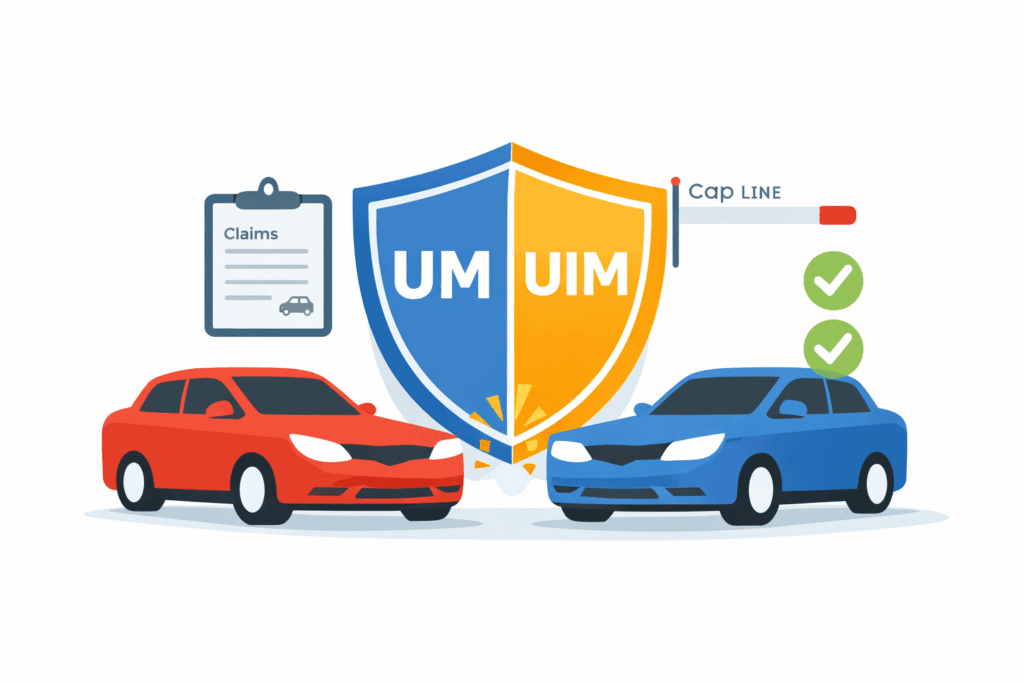
Drivers often hear uninsured vs underinsured motorist and assume the terms mean the same thing. They are related, but they solve different claim problems. Uninsured motorist coverage is about a driver with no insurance. Underinsured motorist coverage is about a driver who has insurance, but not enough to fully pay for a serious loss.
For related context, see UMPD coverage.
This guide explains the key differences, what each coverage may pay for, and how to read your limits. For the bigger map of how these fit with liability, collision, and other protections, start with what car insurance covers.
Quick Summary
- UM helps when the at-fault driver has no liability insurance or cannot be identified in many hit-and-run claims.
- UIM helps when the at-fault driver has insurance, but the limits are too low for the loss.
- Both commonly focus on injury losses, though property damage versions may exist depending on the state and policy.
- Your declarations page and policy wording control your limits, deductibles, covered people, and claim requirements.
- State rules vary, so official state insurance resources are useful when checking offer, waiver, and hit-and-run rules.
Definitions: UM vs UIM in plain English
Uninsured motorist (UM)
Uninsured motorist coverage may help when the driver who caused the crash has no liability insurance. The NAIC explains that uninsured motorist coverage can reimburse you if an uninsured or hit-and-run driver hits you. In practical terms, UM addresses the “no insurance” problem.
Underinsured motorist (UIM)
Underinsured motorist coverage may help when the at-fault driver does have liability insurance, but the limit is too low for the injury or damage claim. UIM addresses the “not enough insurance” problem, especially after serious crashes where medical bills, lost income, and other damages exceed the other driver’s policy limit. If that shortfall has already happened, our guide to what happens when the other driver’s insurance limits aren’t enough explains the practical next steps, including your own coverage, competing claims, settlement releases, and claim documentation.
Comparison table: what’s different?
| Topic | UM | UIM |
|---|---|---|
| At-fault driver | No liability insurance, or unknown in many hit-and-run cases | Has insurance, but not enough |
| Main purpose | Replace missing liability insurance | Help fill the gap after the at-fault driver’s limit is exhausted |
| Common focus | Bodily injury; sometimes property damage | Usually bodily injury; property damage rules vary |
| Key limit question | What are your UM limits? | How does your state calculate available UIM? |
What UM and UIM can pay for
UM/UIM is usually discussed as injury protection. Depending on the policy, it may help with medical bills, lost wages, rehabilitation, and pain and suffering. The California Department of Insurance describes uninsured and underinsured motorist coverage as protection for accidents when the other driver is at fault and either has no insurance or not enough insurance.
Some states also offer uninsured motorist property damage, often called UMPD. That may help repair your vehicle after damage caused by an uninsured driver, but availability, deductibles, and hit-and-run rules vary. Collision coverage is separate and may still be the coverage used to repair your car, subject to your deductible.
Examples: when each coverage applies
If you are rear-ended by a driver with no insurance, UM may apply to covered losses up to your UM limits. If you are hit by a driver who has a low liability limit and your injuries cost more than that limit, UIM may apply after the at-fault driver’s available insurance is addressed.
Hit-and-run claims often point to UM, but the details matter. Many policies require prompt notice, a police report, or evidence that another vehicle caused the crash. Texas Department of Insurance guidance notes that uninsured/underinsured motorist coverage can apply when a hit-and-run driver cannot be found, while also emphasizing state-specific deductibles and requirements.
How limits affect the claim
Your car insurance policy limits cap what UM or UIM can pay. UM is usually easier to understand because the other driver has no liability coverage available. UIM can be more confusing because states may calculate the available amount differently after the at-fault driver’s insurer pays its limit.
The safest check is to compare three things: the at-fault driver’s liability limit, your UM/UIM limits, and the exact policy language. Do not assume UIM always stacks on top of the other driver’s insurance or always equals your full UIM limit. If the claim involves several injured people, multiple vehicles, or a settlement release, ask your insurer how the payment sequence works before signing anything.
How to file a UM or UIM claim
- Get medical care and keep records.
- Document the crash with photos, witness information, and a police report when appropriate.
- Notify your insurer promptly, especially after a hit-and-run.
- Track medical bills, time missed from work, treatment plans, and repair costs.
- Confirm the UM/UIM limits and requirements shown on your declarations page.
For the broader process after a loss, review the car insurance claims process.
Conclusion
Uninsured vs underinsured motorist coverage comes down to the other driver’s insurance status. UM is for no insurance. UIM is for not enough insurance. Both can be valuable after a serious crash, but your state rules, policy wording, and limits decide how much protection you actually have.
Before you rely on either coverage, check your declarations page and ask your insurer how UM, UIM, property damage, deductibles, and hit-and-run rules work in your state.
Related
FAQ
Is uninsured vs underinsured motorist coverage required?
It depends on your state. Some states require it, some require insurers to offer it, and some allow you to reject it in writing. Your declarations page shows whether you have UM/UIM and what limits apply.
Can UM apply if I am not in my car?
Sometimes. Some policies extend UM/UIM protection to covered people as pedestrians or cyclists, while others are narrower. Check who qualifies as an insured person under your policy.
Is UM/UIM the same as full coverage?
No. Full coverage is not a standardized insurance term. UM and UIM are specific coverages for losses caused by drivers who cannot fully pay.