
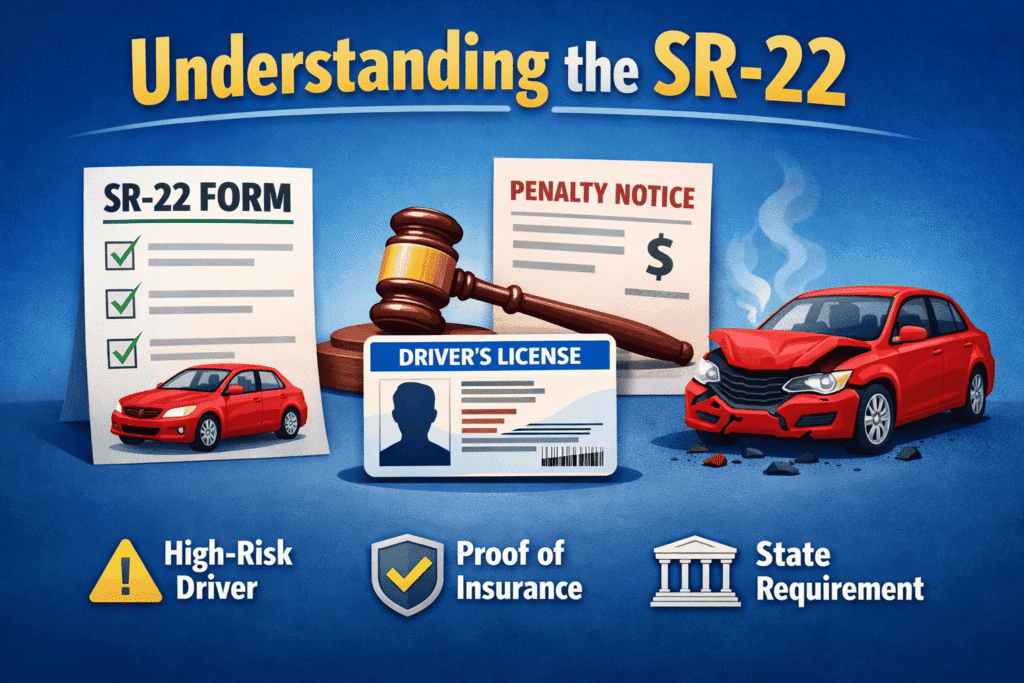
What is an SR-22? Many drivers hear this term after a license suspension, a serious violation, or an insurance-related problem. Despite the name, an SR-22 is usually not a separate insurance policy. It is generally a filing tied to proof of financial responsibility.
For related context, see Proof of Insurance.
Drivers usually want to know three things right away: what an SR-22 actually is, why the state may require it, and whether it changes what the policy covers. If you want the bigger foundation first, start with What Is Car Insurance?.
This guide explains what an SR-22 does, what it does not do, when it may be required, and what to check before assuming it solves every insurance issue. Because rules vary by state, think of this as a general educational overview, not state-specific legal advice.
Quick Summary
- An SR-22 is usually a state-required insurance filing, not a separate insurance policy.
- It is often used to prove that a driver has the required liability coverage after certain violations or license issues.
- An SR-22 does not automatically mean “full coverage,” and it does not replace understanding your actual policy.
- How long it is required and when it applies can vary by state and driver situation.
- If the policy lapses while an SR-22 is required, it can create additional problems with driving privileges or reinstatement.
What an SR-22 actually is
An SR-22 is usually a filing made by an insurer to the state to show that a driver has the required liability insurance or other required proof of financial responsibility. In practical terms, it helps the state track whether required coverage stays active.
That is why an SR-22 is not best understood as a special kind of insurance. It is better understood as a filing requirement tied to legal driving status. One common path to this requirement is a lapse or violation involving insurance status, which is why this guide on driving without insurance can help connect the dots.
What an SR-22 does
The practical purpose of an SR-22 is usually straightforward: it helps show the state that the driver has active required insurance on file.
- It can help satisfy a state requirement tied to license reinstatement or continued driving privileges.
- It can help the state monitor whether required coverage stays active.
- It can connect insurance status more directly to the driver after a violation or suspension issue.
The driver usually keeps a qualifying insurance policy active, and the insurer files the SR-22 with the state when that service is available and required.
What an SR-22 does not do
This is where many misunderstandings happen. An SR-22 does not automatically change the policy into broader coverage, and it does not guarantee that every future claim will be covered.
- It does not automatically mean you have collision or comprehensive coverage.
- It does not replace reading your declarations page and policy terms.
- It does not erase past violations or remove every legal consequence tied to them.
- It does not guarantee low cost or simple approval for future insurance changes.
That is why it helps to separate the filing from the actual insurance policy. The policy decides what is covered. The SR-22 usually helps prove that the policy is active in the way the state requires. If you need a refresher on what the policy itself may cover, see What Does Car Insurance Cover?.
When a driver may need an SR-22
An SR-22 may be required after certain insurance violations, suspensions, or other driving-status problems. The exact trigger and required period depend on the state and the driver’s situation, so the official notice or licensing agency should be treated as the primary source.
For example, the California DMV identifies the SR-22 as a proof-of-insurance certificate that may be required in certain situations. Drivers should verify the rules with the licensing or insurance authority in their own state.
How an SR-22 and your insurance policy work together
The SR-22 and the policy are connected, but they are not the same thing. The policy explains coverages, limits, deductibles, exclusions, and who is insured. The SR-22 is usually a filing attached to that policy relationship for state compliance purposes.
That means a driver can have an SR-22 requirement and still need to understand the actual policy details. If you want to review that side more clearly, see How to Read a Car Insurance Policy.
What to check if you are told you need an SR-22
If you receive notice that an SR-22 is required, avoid treating it as just another insurance term. Check the practical details instead.
- Which state agency or notice is requiring it
- Whether the requirement is tied to license reinstatement, suspension, or another issue
- Whether your current insurer handles SR-22 filings
- What liability coverage or other requirements must stay active
- How long the filing may need to remain in place under the applicable rules
- What happens if the policy lapses before the requirement ends
Drivers can locate the appropriate state regulator through the NAIC state insurance department directory.
Conclusion
So, what is an SR-22? Usually, it is a state-required insurance filing that helps prove a driver has the required financial responsibility coverage in place. It is not a separate policy, and it does not automatically expand what the policy covers.
The easiest way to think about it is this: the SR-22 is about compliance, while the policy is about coverage. If the requirement applies to you, confirm the exact filing and policy details tied to your own case instead of assuming the term means more than it does.
Related
- What Is Car Insurance?
- Driving Without Insurance: 10 Things That Can Happen
- How to Read a Car Insurance Policy
FAQ
Is an SR-22 the same as car insurance?
No. It is usually a filing connected to proof of required insurance, not the insurance policy itself.
Does an SR-22 mean I have full coverage?
No. An SR-22 does not automatically add collision, comprehensive, or other broader coverages to a policy.
Why would a driver be required to have an SR-22?
It is often tied to a state requirement after certain insurance or driving-related problems, but the exact reason can vary by state and situation.
What happens if the policy lapses while an SR-22 is required?
That can create additional compliance problems, which is why it is important to understand both the filing requirement and the policy status.
Where should I look first if I am told I need an SR-22?
Start with the actual notice or state requirement, then confirm how it connects to your active policy and filing status.