
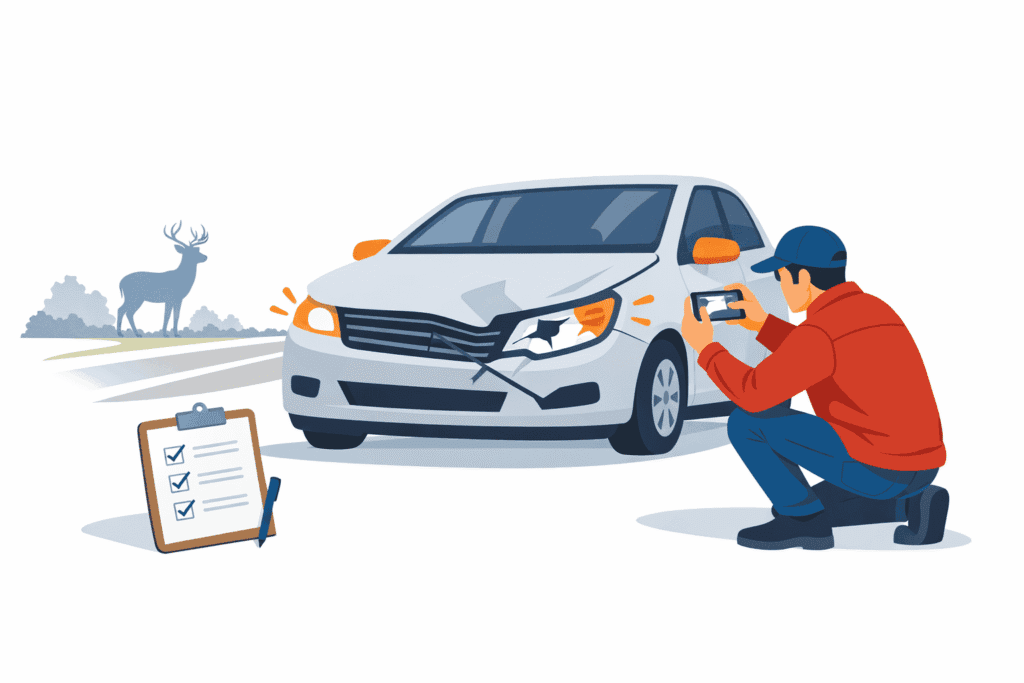
What to do after hitting a deer for insurance purposes starts with protecting people and moving away from traffic when that can be done safely. Once the immediate danger is controlled, document the scene, check whether the vehicle appears safe to operate, and review the policy before making assumptions about coverage.
For official context, OPIC advises keeping claim records such as estimates, receipts, and emails.
A direct impact with a deer is commonly handled under comprehensive coverage, but the deductible, policy terms, and facts of the loss still matter. For the broader foundation, review what car insurance usually covers.
Quick Summary
- Move away from traffic and turn on the hazard lights when possible.
- Check for injuries and contact emergency services when necessary.
- Stay away from the deer and alert authorities if it is blocking the road.
- Photograph the vehicle damage, roadway, debris, and general location when safe.
- Check comprehensive coverage, the deductible, and claim instructions before repairs.
What to do first after hitting a deer
Deal with the immediate safety risks before thinking about the insurance claim. Move the vehicle to a safer location only when it can be done without creating another hazard. Turn on the hazard lights and check yourself and any passengers for injuries.
- Contact emergency services if anyone is injured.
- Alert authorities if the vehicle or animal is blocking traffic.
- Do not approach or attempt to move an injured deer.
- Look for leaking fluid, damaged tires, broken lights, loose parts, or a hood that will not remain secured.
- Request towing when the vehicle may not be safe to drive.
The NAIC provides similar guidance in its consumer information about animal collisions and auto insurance. Police-reporting requirements vary by state and by the seriousness of the incident, so check the applicable state or local rule.
How to document the deer strike for insurance
Once the scene is reasonably safe, take clear photographs of the vehicle damage and wider photographs showing the roadway, shoulder, debris, weather, and general location. Photograph visible damage before cleanup, towing, or temporary repairs when that can be done safely.
Write down the date, approximate time, location, direction of travel, and a brief factual description of what happened. Avoid guessing about details you did not see clearly. Keep any police or incident number, towing record, storage document, repair estimate, and receipt connected to the event.
A direct impact with an animal is typically associated with comprehensive coverage rather than liability-only protection. Review whether car insurance covers hitting a deer, then confirm the actual coverage and deductible on the declarations page.
What may help or complicate the claim
Prompt reporting, clear photographs, consistent facts, and organized towing or repair records can make the loss easier to evaluate. When reporting the event, describe what happened without trying to determine coverage or the final repair cost yourself.
The review may take longer when there is prior unrepaired damage, limited documentation, uncertainty about how the damage occurred, or additional damage discovered after the vehicle is disassembled. The insurer may request an inspection, estimate, or additional information before completing the evaluation.
For the broader sequence, review the car insurance claims process, including reporting, investigation, estimates, repairs, and possible supplemental damage.
What to check before repairs or towing
Check the declarations page for comprehensive coverage and its deductible. Also review the insurer’s claim instructions before authorizing nonemergency permanent repairs. Necessary towing or temporary measures to prevent further damage may still be appropriate when the vehicle cannot remain safely where it is.
Keep receipts and written estimates, but do not assume every towing, storage, or repair charge will automatically be reimbursed. Payment depends on the coverage, applicable limits, deductible, policy terms, and circumstances.
Visible bumper or hood damage may not show the entire repair. Headlights, cooling components, sensors, cameras, mounting points, alignment, and safety systems may need inspection. Additional damage can be added to the estimate if it is found during the repair process and accepted as part of the covered loss.
How the deductible affects the claim
Comprehensive coverage commonly uses a deductible. That amount is generally applied before the insurer pays the remaining covered vehicle damage, subject to the policy terms and claim evaluation.
Compare the deductible with a reliable repair estimate rather than relying only on the visible damage. A deer strike that appears minor can involve lighting, sensors, cooling parts, or calibration work that is not obvious at the roadside. Review how a car insurance deductible works before evaluating the likely out-of-pocket amount.
Conclusion
What to do after hitting a deer for insurance purposes follows a practical order: address injuries and roadway hazards, stay away from the animal, document the scene, check whether the vehicle is safe to drive, and report the loss with clear facts.
After that, confirm comprehensive coverage and the deductible, keep towing and repair records, and allow for the possibility of hidden damage. The final claim outcome depends on the policy language, the facts of the impact, and the completed damage evaluation.
Related
FAQ
Should you call the police after hitting a deer?
Contact authorities when someone is injured, the road is unsafe, the vehicle cannot be moved, or the animal is blocking traffic. Separate reporting requirements may apply under state or local law.
Should you keep driving after hitting a deer?
Do not continue if the vehicle has leaking fluid, tire damage, broken lights, loose parts, an unsecured hood, deployed airbags, or unusual steering or braking behavior. Request towing when its condition is uncertain.
Is hitting a deer a comprehensive or collision claim?
Damage from directly striking an animal is commonly handled under comprehensive coverage. The policy wording and exact facts still control the claim.
What photos should you take after hitting a deer?
When safe, photograph the vehicle damage, roadway, shoulder, debris, general location, and any visible conditions that help explain the incident.
Can hidden damage appear later?
Yes. Sensors, lights, cooling parts, alignment, mounting points, and other components may require inspection before the full repair cost is known.