
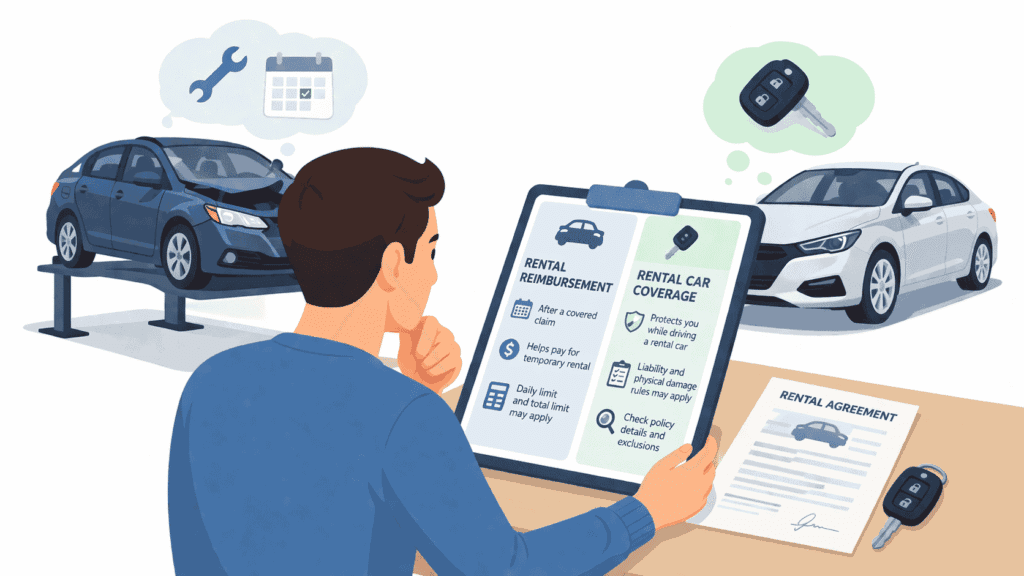
Rental reimbursement vs rental car coverage compares two protections that solve different problems. Rental reimbursement may help pay for temporary transportation when your own vehicle is unavailable after a covered loss. Coverage for a rental car concerns what protection applies while you are driving the rented vehicle.
The terms can be confusing because “rental car coverage” is sometimes used broadly for protection from a personal auto policy, a rental company, a credit card benefit, or a state-specific policy provision. For the broader foundation, review what car insurance covers.
Quick Summary
- Rental reimbursement helps with temporary transportation after a qualifying loss involving your own vehicle.
- Coverage for a rental car addresses liability, physical damage, or other risks while you use the rented vehicle.
- Rental reimbursement commonly has daily and total limits.
- Your personal policy may extend some protection to a rental vehicle, but exclusions and gaps can remain.
- Check the personal policy, rental agreement, rental-company options, and any credit card benefit separately.
What rental reimbursement covers
Rental reimbursement is usually optional coverage that helps pay for substitute transportation while your insured vehicle is being repaired after a covered loss. It may apply to a rental vehicle or, depending on the policy, another permitted transportation expense.
The National Association of Insurance Commissioners explains that rental reimbursement commonly uses a daily maximum and a total maximum. See its consumer guidance on rental reimbursement and optional auto coverage.
Coverage usually depends on a qualifying comprehensive or collision loss. It generally does not pay merely because the vehicle is unavailable for maintenance, mechanical failure, or another reason outside the policy.
- Daily limit: the maximum payable for each day.
- Total limit: the maximum available for the entire loss.
- Eligible period: the time allowed under the policy for repair or total-loss handling.
- Qualifying loss: the covered event that caused the insured vehicle to become unavailable.
What coverage for a rental car can mean
Coverage for a rental car concerns the risks created while you are using the rented vehicle. It is not necessarily one coverage with one universal definition.
Possible sources of protection include:
- Your personal auto policy
- Liability protection included in or required by the rental agreement
- A collision or loss damage waiver offered by the rental company
- Supplemental liability or personal accident insurance sold by the rental company
- A credit card rental-car benefit
Your personal liability, collision, or comprehensive coverage may extend in some circumstances, but the rental period, vehicle type, location, driver authorization, business use, deductible, and policy wording can change the result. Review whether car insurance covers rental cars before declining or purchasing protection at the counter.
The NAIC explains the main products commonly offered by rental companies and notes that existing insurance or credit card benefits may overlap with some of them. Confirm the terms directly rather than assuming the protections are identical. See its overview of rental car insurance options.
Rental reimbursement vs rental car coverage: key differences
| Question | Rental reimbursement | Coverage for a rental car |
|---|---|---|
| What problem does it address? | Temporary transportation after your own vehicle becomes unavailable because of a qualifying loss | Financial risks while you drive or possess a rented vehicle |
| What can it pay? | Eligible rental or transportation expense | Liability, physical damage, medical, personal-property, or waiver-related costs, depending on the source |
| What usually triggers it? | A covered claim involving the insured vehicle | Use of a rental vehicle under the applicable policy, benefit, or rental agreement |
| What limits matter? | Daily limit, total limit, and eligible rental period | Coverage limits, deductible, vehicle restrictions, territory, rental duration, and exclusions |
| Where is it found? | Usually as optional coverage on the personal auto policy | Personal policy, rental agreement, rental-company product, credit card benefit, or state-specific protection |
New York’s Department of Financial Services gives a clear state-specific example: it expressly warns consumers not to confuse “Rental Vehicle Coverage” with “Rental Reimbursement.” The first concerns damage to a rented vehicle under New York rules, while the second concerns substitute transportation after the policyholder’s own vehicle becomes unavailable following a covered loss. Other states may use different requirements and terminology. See the department’s automobile insurance FAQ.
Roadside assistance is separate from both. It commonly concerns towing, jump starts, lockout help, or another service after a vehicle becomes disabled. Review what roadside assistance coverage includes.
What to check before renting a vehicle
Review each possible source of protection separately:
Your personal auto policy
- Does liability extend to the rental?
- Do collision and comprehensive apply?
- Which deductible would apply?
- Are rental trucks, luxury vehicles, motorcycles, international rentals, or business use excluded?
Rental reimbursement
- Is the coverage active?
- What are the daily and total limits?
- Which losses qualify?
- When does payment begin and end?
Rental agreement and optional products
- What liability protection is already included?
- What does the CDW or LDW waive?
- Are loss-of-use, administrative, towing, or diminished-value charges addressed?
- Who qualifies as an authorized driver?
Credit card benefits
- Is the benefit primary or secondary?
- Must the full rental be paid with the card?
- Which vehicles, countries, and rental periods are excluded?
- Does the benefit include liability or only collision and theft?
Because rental-related protection may depend on added forms, review how car insurance endorsements modify the base policy.
Conclusion
Rental reimbursement vs rental car coverage compares two different needs. Rental reimbursement helps with substitute transportation after your own insured vehicle becomes unavailable because of a qualifying loss. Coverage for a rental car addresses the liability, damage, and other risks involved while using the rented vehicle.
Confirm the personal policy, reimbursement limits, rental agreement, optional rental-company products, and any credit card benefit separately. Having one type of protection does not automatically mean the other exists.
Related
FAQ
Is rental reimbursement the same as rental car coverage?
No. Rental reimbursement concerns the cost of substitute transportation after a qualifying loss involving your own vehicle. Rental car coverage concerns protection while you use a rented vehicle.
Does rental reimbursement require a covered claim?
Usually yes. The insured vehicle generally must be unavailable because of a loss covered by the applicable comprehensive or collision protection.
Does a personal auto policy always cover a rental car?
No. Some protection may extend, but vehicle type, rental duration, location, use, deductible, authorized drivers, and policy exclusions can change the result.
Does rental reimbursement pay every rental expense?
Not necessarily. Daily limits, total limits, eligible rental periods, vehicle class, and policy conditions may restrict payment.
What should you check before declining rental-company coverage?
Confirm what your personal policy and credit card actually provide, including deductibles, excluded vehicles, rental duration, territory, loss-of-use charges, and whether liability is included.