
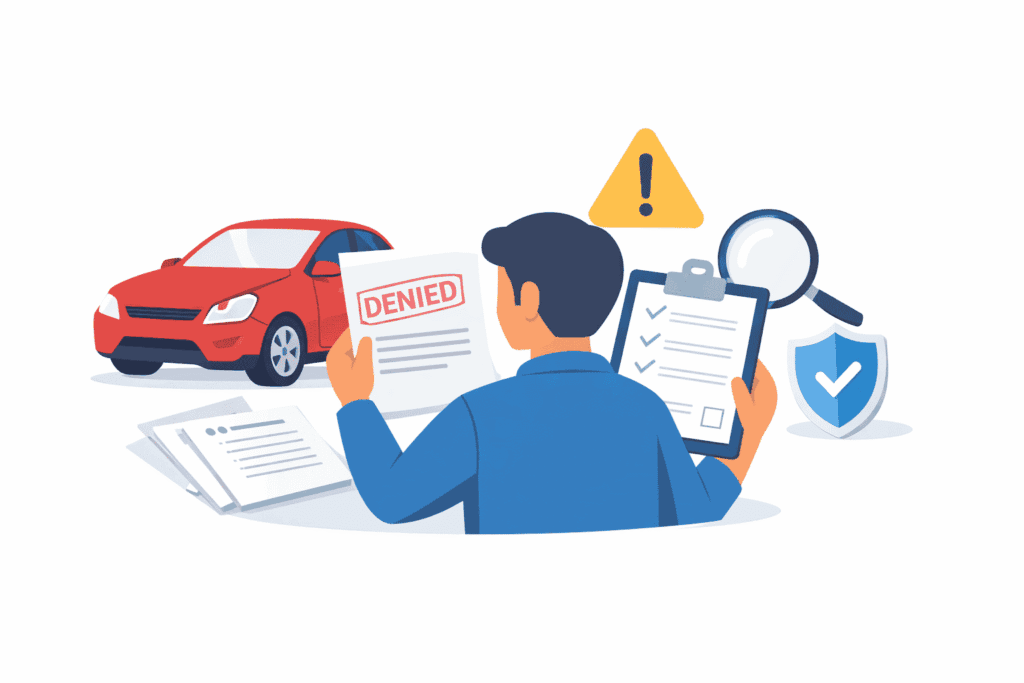
A denied insurance claim can be frustrating, especially when a driver expects the policy to help after an accident, theft, or sudden damage. The short answer is yes: an insurance company can deny a claim under certain conditions. But the denial should not be random. It should be tied to the policy language, the facts of the loss, or both.
Many drivers assume that an active policy automatically means every claim will be paid. In practice, that is not how car insurance works. Coverage depends on what the policy includes, what exclusions apply, whether deadlines were met, and whether the insurer received enough information to evaluate the loss.
If you want the bigger picture first, start with the full car insurance claims process. This guide focuses on a narrower question: when an insurer may deny a claim, the most common reasons it happens, and what you can do if the denial does not seem right.
Quick Summary
- An insurance company can deny a claim if the loss does not fit the policy terms.
- Common reasons include missing coverage, exclusions, late reporting, lack of proof, or policy lapse.
- A denial should usually point to policy language, facts, or missing claim requirements.
- Some denials are final, but others can be reviewed if the insurer missed facts or documents.
- The best next step is usually to read the denial letter carefully and identify the exact reason given.
When can an insurance company deny a claim?
An insurer may deny a claim when it concludes that the reported loss does not qualify for payment under the policy. Car insurance is a contract. It explains what is covered, what is excluded, how much the policy may pay, and what the driver must do after a loss.
That is why a denial does not always mean the insurer is acting unfairly. Sometimes the issue is simple: the policy never covered that type of damage in the first place. Other times, the problem is procedural, such as late notice, missing documents, inconsistent statements, or failure to cooperate with the investigation.
If you are not sure what your policy actually includes, it helps to review what car insurance usually covers and compare that with the coverage listed on your own documents.
7 common reasons an insurer may deny a claim
1) The policy does not include the right coverage
This is one of the most common reasons. If the loss requires a type of coverage that is not on the policy, the insurer may deny payment. For example, theft, vandalism, and hail damage are usually tied to comprehensive coverage. Damage to your own car after a crash may depend on collision coverage. If that coverage is missing, the claim may not be payable.
2) The policy was not active on the date of loss
If the policy lapsed, was canceled, or never took effect before the accident happened, coverage may not apply. Even a short lapse can matter. This is one reason drivers should check policy dates carefully and not assume the account is current just because a renewal was expected.
3) An exclusion applies
Policies contain exclusions, which are situations the insurer does not cover. The exact list varies, but examples may include intentional damage, some types of commercial use, racing, or mechanical breakdown that was not caused by a covered event. A denial letter often points to one of these exclusions if that is the reason.
4) The insurer did not receive enough proof
Sometimes the policy could apply, but the file is still too weak. Missing photos, repair estimates, receipts, witness information, police report numbers, or a clear timeline can lead to problems. In practice, some denials happen because the insurer says the claim was not supported well enough, not only because coverage was missing.
5) The claim was reported too late
Most policies require prompt notice after a loss. What counts as too late can vary, but long delays can make investigation harder and may give the insurer a reason to deny or dispute the claim. A parked-car incident reported months later, with little documentation, is often harder to prove than one reported promptly.
6) The driver failed to cooperate with the investigation
Insurers usually expect reasonable cooperation after a claim is opened. That may include answering questions, providing documents, allowing inspection of the vehicle, or clarifying inconsistent facts. If the insurer believes the driver did not meet those duties, that can become part of the denial reasoning.
7) The policy limits or deductible change the result
Sometimes people describe a claim as “denied” when the issue is really that the policy pays less than expected, or not at all after the deductible. In other cases, the insurer may pay part of the claim but deny another part. That is why it helps to understand how policy limits work and how deductibles affect what comes out of your own pocket.
For official context, California DOI describes claim documentation, OPIC advises keeping estimates and claim records, and NAIC explains complaint options after unresolved insurer issues.
Conclusion
So, can an insurance company deny a claim? Yes, under certain conditions. A claim may be denied because the policy did not include the right coverage, an exclusion applied, the policy was not active, the proof was incomplete, or claim requirements were not met.
The most useful response is usually to identify the exact reason, compare it against your policy, and decide whether the denial reflects a real coverage issue or something that still needs clarification. A denial feels less confusing when you know whether the problem is coverage, timing, documentation, or the facts of the loss.
Related
- Car Insurance Claims Process: 9 Steps That Really Happen
- How to Dispute an Insurance Claim Decision
- What Does Car Insurance Cover?
FAQ
Can an insurance company deny a claim even if the policy is active?
Yes. An active policy does not automatically mean every loss is covered. The claim still has to fit the coverages, exclusions, limits, deductibles, and claim requirements in the policy.
Can late reporting cause a claim denial?
It can. Many policies require prompt notice after a loss, and long delays can make investigation harder. Whether that leads to denial depends on the policy and the facts.
Does a denial always mean the insurer is acting unfairly?
No. Some denials are valid under the policy terms. The important question is whether the insurer clearly explained the reason and tied it to the policy language or documented facts.