
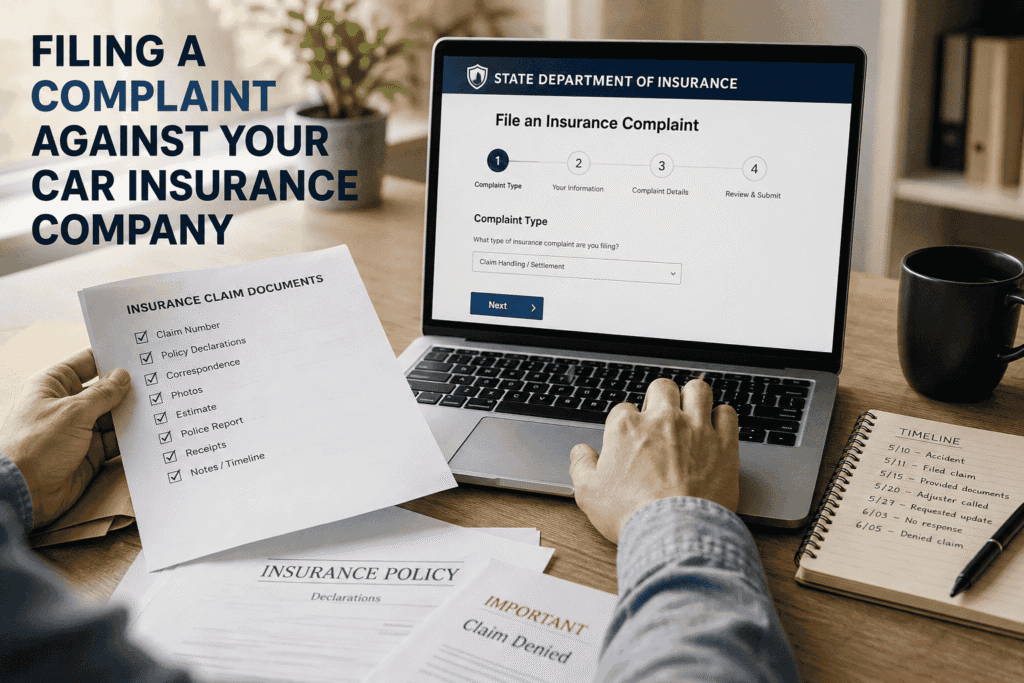
To file a complaint against a car insurance company, start by documenting the problem and asking the insurer for a written response. If the issue remains unresolved, you can use your state Department of Insurance complaint process. Filing a complaint does not automatically force payment, but it can trigger regulatory review of the insurer’s conduct.
In most cases, a strong complaint is factual, organized, and supported by documents. Before filing, it helps to understand the car insurance claims process, what the company has already decided, and exactly what you want the regulator to review.
Quick Summary
- Try to resolve the problem with the insurer first and ask for important explanations in writing.
- Your state Department of Insurance may review claim delays, denials, communication problems, cancellation or nonrenewal, and other insurance complaints.
- A complaint does not guarantee a claim payment or a specific outcome.
- Keep policy pages, claim letters, emails, estimates, photos, receipts, and a simple timeline.
- Complaint procedures and regulator authority vary by state.
When to File a Complaint Against a Car Insurance Company
The National Association of Insurance Commissioners says consumers should generally try to resolve a problem with the insurer first. If the issue remains unresolved, the state Department of Insurance may be able to investigate complaints involving unfair claim delays or denials, failure to honor a policy, lack of timely communication, possible violations of state insurance laws, or cancellation and nonrenewal concerns.
Not every disagreement needs to go to a regulator immediately. A missing estimate line, unclear photo review, or repair question may be resolved by asking the adjuster for a written explanation or requesting a supervisor review. If your problem involves a coverage denial, first review why a car insurance claim may be denied so you can separate a policy disagreement from a possible claim-handling issue.
What to Do Before Filing
Start with the insurer’s normal review process. Ask what policy language, claim fact, estimate item, deadline, or underwriting rule supports the decision. If the answer is unclear, request a supervisor or internal review and keep the request focused on one issue at a time. If the delay is tied to the other driver not cooperating with their insurer, see what can happen when the other driver is not responding to insurance.
If you need to dispute an insurance claim decision, give the company a reasonable opportunity to respond in writing. A regulator reviewing the file will benefit from seeing what you asked, what evidence you supplied, and how the insurer answered.
- Save the declarations page and relevant policy sections.
- Keep claim letters, emails, portal messages, and payment explanations.
- Organize repair estimates, invoices, photos, police reports, and rental receipts.
- Create a short timeline with dates, names, and key conversations.
- Ask for claim decisions and reasons in writing whenever possible.
How to File a Complaint With Your State Insurance Department
Insurance regulation is primarily state based, so complaints are usually filed with the Department of Insurance or equivalent regulator in your state. The NAIC directory of state insurance departments can help you find the correct regulator and its complaint process. Follow that department’s current instructions because filing methods, required documents, complaint categories, and eligibility rules can differ.
When completing the complaint, focus on facts instead of frustration. Explain what happened, what the insurer decided, when you asked for review, and which documents support your position. The NAIC recommends keeping a record of communications and using policy language when possible.
Keep the complaint easy to follow. If several problems are involved, separate them by issue and date. For example, distinguish a claim valuation disagreement from a cancellation notice or communication delay instead of combining everything into one long narrative.
What May Happen After You File
According to the NAIC, once a Department of Insurance determines that a complaint is within its authority, it may forward the complaint to the insurer and require a response. The regulator can then review the insurer’s explanation against the policy and applicable state rules. If the department finds improper conduct within its authority, it may require corrective action under state insurance law.
A complaint still does not guarantee that the insurer will pay more or reverse every decision. Coverage, liability, valuation, and factual disputes can depend on the policy, evidence, and state law. The complaint process is regulatory review, not a promise of a particular settlement.
A State Example: California
State processes can illustrate the types of issues regulators handle without creating a national rule. The California Department of Insurance, for example, lists improper claim denial, delay in settlement, cancellation or nonrenewal, alleged agent misrepresentation, and unfair underwriting practices among matters for which consumers may request assistance.
California’s Consumer Services Division also separates claims-related complaints from rate and underwriting complaints. Other states may organize their complaint systems differently, which is why the correct state regulator should be your final source for procedure.
How to Make the Complaint Easier to Review
A regulator should be able to understand the problem quickly. Use a short opening statement, then a timeline and supporting documents. State the outcome you are requesting, such as an explanation, review of a denial, correction of a notice, or review of claim handling. Avoid exaggeration and do not make assumptions about motives that you cannot document.
For broader context after a crash, review your rights after a car accident. Then use your state’s insurance department for the rules and complaint options that apply to your situation.
Conclusion
Knowing how to file a complaint against a car insurance company may help when direct communication has failed and you want your state insurance regulator to review a claim-handling, cancellation, underwriting, or communication issue. The strongest complaint is specific, documented, and focused on facts.
Before filing, ask the insurer for written explanations, organize your records, and locate the correct state Department of Insurance. Keep expectations realistic: the regulator can review conduct within its authority, but the final result still depends on the policy, evidence, and state rules.
Related
Frequently Asked Questions
Will a complaint force the insurer to pay my claim?
No. A complaint can trigger regulatory review and an insurer response, but the outcome still depends on the policy, evidence, facts, and applicable state rules.
Should I contact the insurer before filing a complaint?
Generally yes. The NAIC recommends first trying to resolve the problem with the insurer. Keep records of your request and the company’s response.
What documents should I include?
Useful records can include policy pages, claim letters, payment or denial explanations, estimates, invoices, photos, and a short timeline of communications.
Where do I file an insurance complaint?
Use your state Department of Insurance’s current complaint process. The NAIC directory can help you find the correct state regulator and its official contact information.