
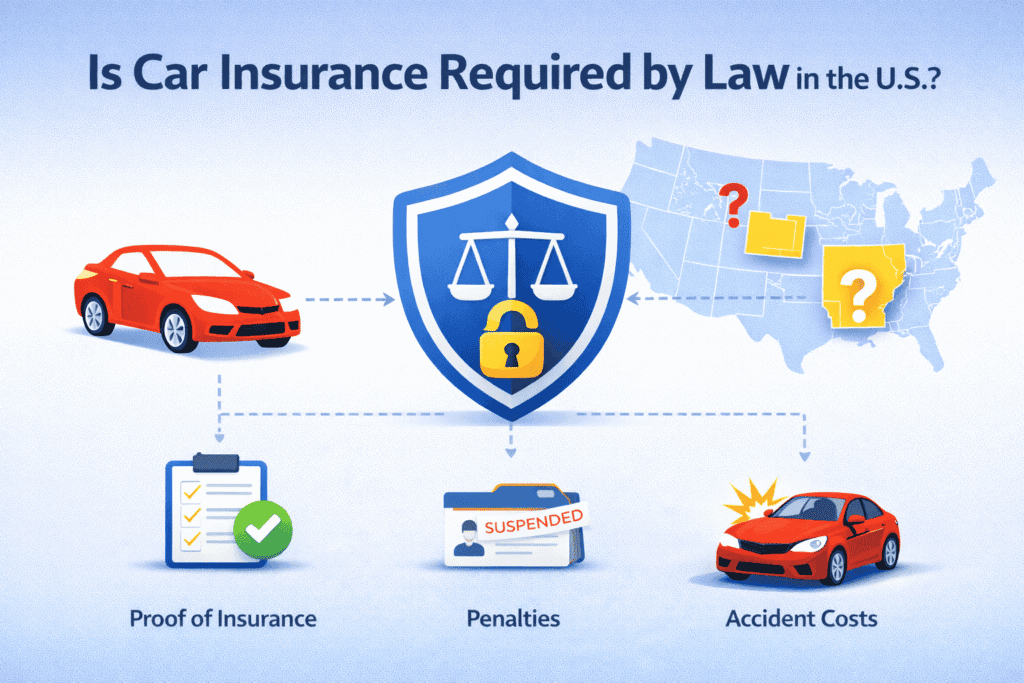
Is car insurance required is one of the most common questions drivers ask in the United States. The answer sounds simple, but it depends on your state and your situation. Most states require drivers to carry at least some form of auto liability insurance or financial responsibility before driving legally.
If you want a basic foundation first, start with what car insurance is and how it works. This guide focuses on legal requirements, common mandatory coverages, alternatives, and what can happen if you drive without required protection.
Quick Summary
- Most states require auto liability insurance or another form of financial responsibility.
- Required limits and coverage types vary by state.
- Liability insurance is the most common legal requirement.
- No-fault, PIP, and uninsured motorist rules can add requirements in some states.
- Collision and comprehensive are usually not required by law, but lenders may require them.
Is car insurance required by law in the U.S.?
In most U.S. states, some form of car insurance is required by law to legally drive on public roads. NAIC consumer guidance says most states require some kind of insurance coverage to drive legally. These laws are meant to make sure drivers can pay for injuries or property damage they may cause to others. They also give police, DMVs, and insurers a way to verify that a registered vehicle is financially responsible before and after a crash.
Requirements are not identical everywhere. Each state decides which coverages are required, the minimum coverage limits, how proof must be shown, and whether alternatives to a traditional insurance policy are allowed. A driver who is legal in one state may need a policy update after moving, registering a car elsewhere, or adding a financed vehicle.
How requirements work in real life
Car insurance requirements usually appear when you register a vehicle, renew registration, drive on public roads, get stopped by law enforcement, or report a crash. The California DMV says insurance, also called financial responsibility, is required on vehicles operated or parked on California roads, and drivers must carry evidence of insurance.
If a policy lapses or is cancelled, consequences may follow quickly. Depending on the state, that can include registration suspension, license issues, reinstatement fees, tickets, or personal responsibility for accident costs. Some states also receive electronic reports from insurers, so a lapse can create a DMV problem even before a traffic stop.
What coverage is typically required?
Liability insurance
Liability insurance is the most common requirement. It helps pay for injuries or property damage you cause to others. It usually includes bodily injury liability and property damage liability. The California Department of Insurance explains that most people show financial responsibility by buying auto liability insurance.
Liability generally does not pay to repair your own vehicle. For minimum-limit details, review how much car insurance you need to drive legally.
No-fault, PIP, and uninsured motorist rules
Some states require personal injury protection, medical payments, uninsured motorist coverage, or underinsured motorist coverage. These rules vary widely. That is why a driver moving states should not assume the old policy still satisfies the new state’s rules.
Collision and comprehensive are usually not state-law requirements. They may still be required by a lender or leasing company if the vehicle is financed or leased, especially when comparing liability vs full coverage.
Alternatives to traditional insurance
Some states allow limited alternatives to a standard policy, such as a surety bond, cash deposit, or self-insurance certificate. These options still require proof that you can meet financial responsibility obligations. They are not the same as simply driving uninsured. For most individual drivers, buying an auto liability policy is the practical way to satisfy the rule, while bonds, deposits, and self-insurance tend to be less common or harder to maintain.
What happens if you drive without required insurance?
Driving without required coverage can lead to fines, tickets, license suspension, registration suspension, reinstatement fees, impoundment, SR-22 or similar filing requirements, and personal responsibility for crash costs. Even a minor accident can become financially serious if you cannot prove required coverage. If you cause injuries or property damage and do not have enough coverage, you may still be personally responsible for amounts above the policy limit or outside the policy terms.
For a deeper breakdown, see driving without insurance.
Conclusion
Car insurance is required by law in most of the United States, but the exact requirement depends on the state. Liability insurance is the most common requirement, while PIP, uninsured motorist, and other coverages may also be mandatory in certain states.
The safest approach is to check your state DMV or insurance department, confirm the limits on your declarations page, and update your policy before driving in a new state or after any coverage lapse. Do not rely on a generic phrase like “legal coverage” unless you know the exact state requirement and the policy limits that satisfy it. Keep proof in the vehicle or available digitally if your state accepts it.
Related
- Driving Without Insurance: 10 Things That Can Happen
- Liability vs Full Coverage: 9 Key Differences
- What Does Car Insurance Cover?
FAQ
Is car insurance required in every state?
Most states require auto insurance or financial responsibility. A few allow alternatives, but drivers still must prove they can pay for damages.
Is full coverage required by law?
Usually no. State laws commonly focus on liability or financial responsibility. Lenders may require collision and comprehensive on financed or leased cars.
Do I need insurance if I do not drive often?
If the vehicle is registered, parked on public roads, or driven, many states still require active coverage or proof of financial responsibility.
What proves I have car insurance?
Common proof includes an insurance ID card, digital proof, a state-approved certificate, or another document accepted by your state.