
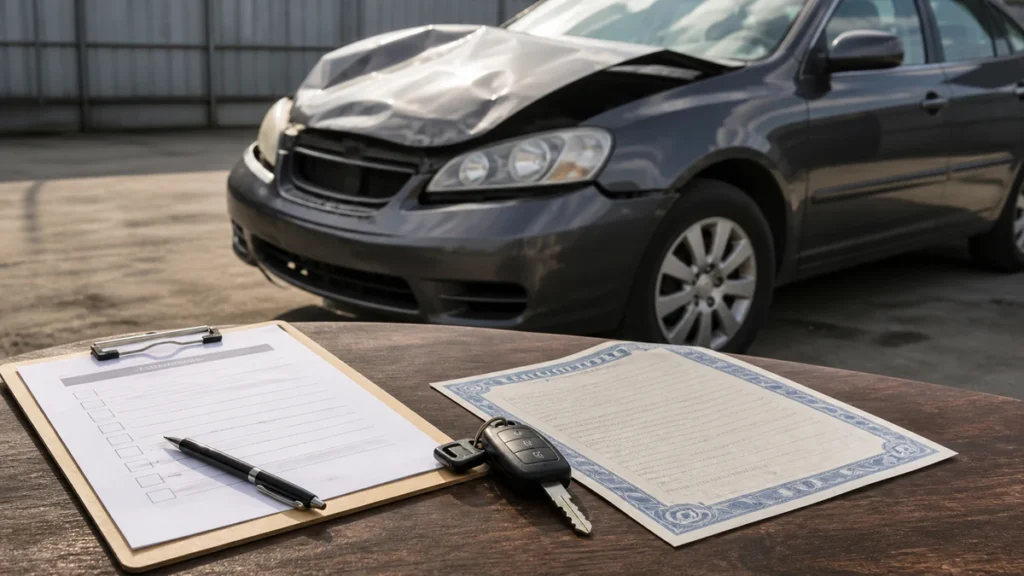
If you keep a totaled car, the insurer may let you retain the vehicle, but the settlement usually changes. Instead of receiving the full total-loss settlement and giving up the car, the insurer may subtract the vehicle’s salvage value from what it otherwise owes.
This is often called owner-retained salvage. The vehicle has already been declared a total loss; the question is whether keeping it makes sense after considering the reduced payment, repairs, title rules, financing, and future insurance. For the broader process, see our car insurance claims process.
Quick Summary
- A totaled vehicle is not necessarily completely destroyed; total loss is usually an economic or state-rule determination.
- If you keep the car, the insurer may deduct its salvage value from the settlement.
- Your deductible may still apply when your own collision or comprehensive coverage pays the claim.
- State rules may require a salvage, rebuilt, reconstructed, or similar branded title.
- A lender or lienholder can affect whether keeping the vehicle is practical.
- Future registration, resale, and insurance can be more complicated with a branded-title vehicle.
Can You Keep a Totaled Car?
Sometimes. The National Association of Insurance Commissioners explains that an insurer may take title to a totaled vehicle when it pays the claim, but a consumer may be able to negotiate to retain the vehicle for its agreed salvage value.
Whether owner-retained salvage is available can depend on the insurer, state rules, title requirements, vehicle condition, and any lien on the car. It is separate from the question of how a vehicle becomes a total loss.
How Does Keeping the Car Change the Settlement?
Salvage value represents what the damaged vehicle is worth in its current condition. When you keep the vehicle, that value may be deducted because the insurer is no longer receiving the salvage.
The Washington Office of the Insurance Commissioner explains that salvage value is what the damaged vehicle is worth, or roughly what a salvage buyer might pay for it. Washington’s current rules allow an insurer to deduct salvage value when the claimant retains the total-loss vehicle. That is a state-specific example; calculations elsewhere can differ.
For example, suppose the vehicle’s covered value is $13,000, the deductible is $1,000, and the salvage value is $2,200. In a simplified example, retaining the vehicle could reduce the payment to $9,800 before any other taxes, fees, adjustments, or policy provisions. For a closer look at that part of the calculation, see how the deductible works when a car is totaled.
Salvage Value Is Not the Same as Repair Cost
Salvage value and repair cost answer different questions. Salvage value is what the damaged vehicle may be worth as it sits. Repair cost is what it may take to restore the vehicle.
A car could have a relatively high salvage value and still require expensive repairs. Before deciding to keep it, get a realistic repair estimate that considers hidden structural, electrical, safety-system, water, or sensor damage.
What Happens to the Title?
Title rules vary by state. The Washington State Department of Licensing and California DMV both illustrate that totaled vehicles can face special salvage or rebuilt-title procedures. Exact terminology and requirements differ by state.
Do not assume that keeping the vehicle means you can immediately register or drive it. Repairs, inspections, receipts, title paperwork, emissions requirements, or other state steps may apply.
What If the Totaled Car Is Financed?
A lienholder can change the decision. If a lender has a financial interest in the vehicle, the insurer may need to include the lender in the settlement or title process.
If the settlement is lower than the remaining loan balance, GAP insurance may become relevant depending on the contract. GAP does not automatically mean you can keep the totaled vehicle or avoid title requirements.
Before accepting owner-retained salvage, ask the insurer and lender who receives the settlement, whether the lien must be satisfied, and who must sign the title documents.
Can You Insure a Salvage or Rebuilt Vehicle?
Possibly, but coverage can be harder to obtain. The NAIC notes that some insurers may decline vehicles previously declared a total loss. Availability depends on the insurer, state, vehicle condition, title status, and requested coverage.
Before paying for repairs, confirm whether liability, collision, and comprehensive coverage will be available after the vehicle completes the required title and inspection process.
When Keeping a Totaled Car May Make Sense
- The damage is limited and a qualified repair facility believes the vehicle can be repaired safely.
- You understand the salvage-value deduction and lender requirements.
- You can satisfy your state’s title, inspection, and registration requirements.
- You have confirmed that insurance will be available and accept the possible reduction in resale value.
When Keeping It May Not Be Worth It
Keeping the car can become risky when the damage involves structural components, flooding, airbags, complex electronics, or expensive diagnostics. It may also make little financial sense when the salvage deduction is high, the loan remains unpaid, or future coverage is difficult to obtain.
The better question is not simply, “Can I keep it?” Ask whether the reduced settlement will still leave you better off after repairs, title costs, inspections, insurance limitations, and lower resale value.
Simple Example
Suppose a vehicle has a covered value of $16,500, a $1,000 deductible, and a $3,000 salvage value. In a simplified example, giving up the vehicle could produce $15,500 before other adjustments. Keeping it could reduce the payment to $12,500, leaving the owner responsible for repairs and the state title process. Actual calculations vary.
Conclusion
You may be able to keep a totaled car, but owner-retained salvage changes more than the claim payment. The salvage value can reduce the settlement, state title requirements may apply, a lender can affect the decision, and future insurance or resale may become more difficult.
Before deciding, compare the reduced settlement with realistic repair costs and confirm the title, lender, registration, and insurance requirements that apply to your vehicle and state.
Related
FAQ
Can you keep a totaled car after insurance pays?
Sometimes. The insurer, lienholder, state rules, and vehicle title can all matter. If owner-retained salvage is allowed, salvage value may be deducted from the settlement.
Do you still get paid if you keep a totaled car?
Usually there can still be a payment, but the amount may be reduced by the deductible, salvage value, and other applicable adjustments.
Is a totaled car always unsafe to drive?
No. Total loss is often an economic determination, not proof that the vehicle is completely destroyed. However, the car may still require inspection and repairs before it can be safely or legally driven.
What is the difference between a salvage and rebuilt title?
Generally, salvage identifies a vehicle that has been declared a serious loss, while rebuilt or similar branding may be used after required repairs and state procedures. Exact terminology varies by state.
Will insurance cover a rebuilt totaled car?
It depends on the insurer, state, vehicle condition, title history, and coverage requested. Check availability before committing to the repair and title process.