GAP insurance helps address a specific financial problem: your car is totaled or stolen, the auto insurance settlement is less than what you still owe on the loan or lease, and a balance remains after the vehicle is gone.
Standard physical-damage insurance generally pays based on the covered value of the vehicle rather than automatically paying off the entire loan. If you are dealing with this after a loss, start with the car insurance claims process and how a total loss is determined and paid.
Quick Summary
- GAP insurance may help when you owe more on a vehicle than the applicable insurance settlement.
- It is most relevant when a loan or lease has negative equity.
- Low down payments, long loan terms, and rapid depreciation can increase the chance of a gap.
- GAP products can have limits and exclusions, so they do not necessarily pay every dollar remaining on a loan.
- GAP is generally an optional add-on product, although a lease agreement may include or require similar protection.
What Is GAP Insurance?
GAP is commonly described as Guaranteed Asset Protection. The Consumer Financial Protection Bureau explains that GAP is an optional product intended to cover the difference between the amount you owe on an auto loan and what insurance pays if the vehicle is stolen or totaled.
The basic problem is negative equity. If the loan payoff is higher than the vehicle’s covered value when a total loss occurs, the regular auto insurance payment may not eliminate the entire loan balance.
Exact GAP terms vary. A product offered through an insurer may not work exactly like one offered through a lender, lease company, or dealer, so always review the actual contract rather than relying only on the name.
Simple GAP Insurance Example
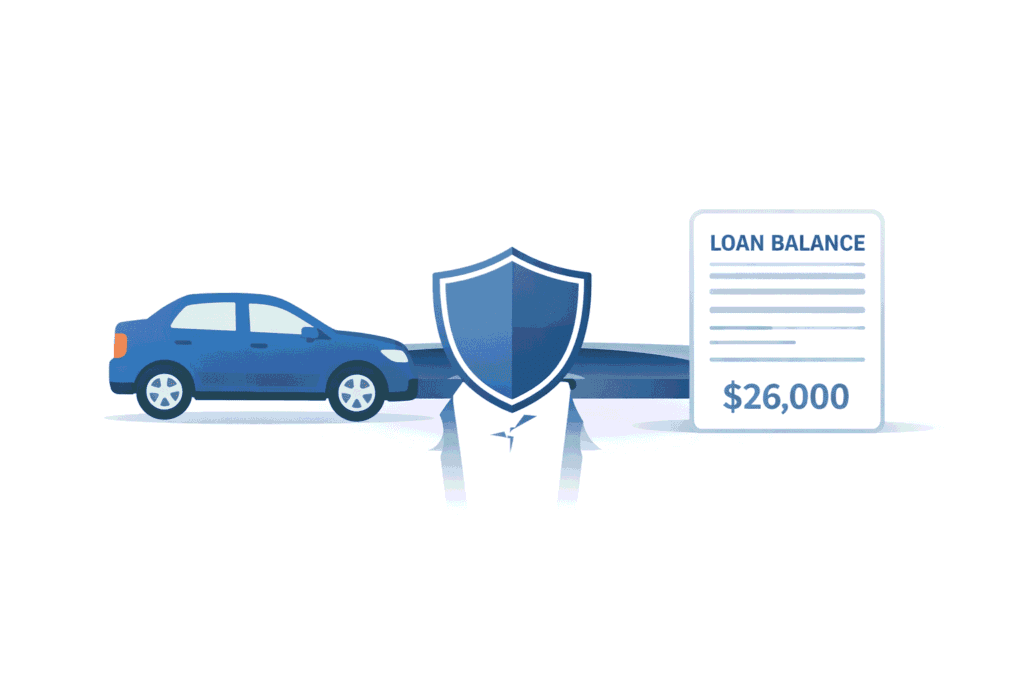
Suppose your vehicle is totaled and the applicable covered value is $22,000, but the loan payoff is $26,000. That creates a $4,000 difference before considering any deductible, excluded loan amounts, or other adjustments.
A qualifying GAP product may help with some or all of that eligible difference according to its terms. The example is simplified; actual settlements and GAP calculations can differ.
What Does GAP Insurance Usually Cover?
GAP generally becomes relevant after a qualifying total loss or, depending on the product, an unrecovered theft. Its purpose is the financial shortfall between the eligible loan or lease balance and the amount used to settle the covered vehicle loss.
This is different from ordinary physical-damage coverage. Collision and comprehensive address covered damage to the vehicle, while GAP focuses on a remaining financing shortfall. See collision vs. comprehensive insurance for that distinction.
What Might GAP Not Cover?
GAP is not a promise to erase every amount connected with an auto loan. Depending on the contract, excluded or limited amounts may include:
- Past-due payments or late fees
- Extended warranties or service contracts financed with the vehicle
- Credit insurance or other optional add-ons
- Certain amounts of negative equity rolled in from a previous vehicle
- Some or all of the auto insurance deductible
- Amounts above a GAP product’s maximum benefit or loan-to-value limit
The CFPB notes that GAP products can have eligibility restrictions and may not provide the same value for every consumer. Read the exclusions, maximum benefit, cancellation terms, and eligible balance definition before buying.
When Can GAP Insurance Be Useful?
GAP tends to be more relevant when there is a realistic chance that the loan or lease balance will remain above the vehicle’s value. Situations that can increase that risk include:
- A small down payment or financing most of the purchase price
- A long auto loan term
- Rolling negative equity from a previous vehicle into the new loan
- A newer vehicle that depreciates quickly
- High annual mileage that may reduce the vehicle’s market value faster
The decision should be based on actual numbers. Compare the current loan payoff with a reasonable estimate of the vehicle’s value rather than assuming every financed vehicle needs GAP.
When Might GAP Be Unnecessary?
GAP may provide little benefit once the vehicle is worth more than the remaining eligible loan balance. That can happen after a large down payment or after the loan principal has been reduced substantially.
Recheck the numbers periodically. A product that made sense early in a long loan may become less useful once negative equity disappears. The CFPB also notes that consumers may be entitled to a refund in some situations involving cancellation, refinancing, sale, or early payoff, depending on the product and circumstances. If the loan has been fully paid, see what changes with insurance after paying off a car, including the lienholder, collision, comprehensive, and GAP decisions that may need review.
Where Can You Get GAP?
GAP or similar protection may be offered through an auto insurer, lender, lease company, or dealership. The CFPB advises consumers to compare prices and coverage because costs can vary significantly.
| Source | What to check |
|---|---|
| Auto insurer | Eligibility, required collision/comprehensive coverage, limits, and cancellation terms |
| Lender or lease company | Whether protection is optional or included, eligible balance, and exclusions |
| Dealership | Price, whether the cost is financed, exclusions, and how cancellation or refunds work |
If a GAP product is financed into the auto loan, its cost becomes part of the financed balance and can increase the total interest paid over time. That is another reason to compare the total cost rather than only the monthly payment.
Does GAP Replace Collision or Comprehensive Insurance?
No. GAP addresses a loan or lease shortfall; it does not replace physical-damage insurance. A qualifying GAP benefit generally depends on an underlying vehicle loss being handled first. If the vehicle is financed, see how insurance on a financed car can involve lender requirements for collision, comprehensive, deductibles, lienholder information, and continuous coverage.
Also remember that policy limits and settlement rules can affect what is paid under the underlying auto policy. See how car insurance policy limits work and what car insurance covers.
Conclusion
GAP insurance addresses one narrow risk: a totaled or stolen vehicle leaves an eligible loan or lease balance above the applicable insurance settlement. It can be useful when negative equity is significant, but it may become unnecessary once the loan balance falls below the vehicle’s value.
Before buying or keeping GAP coverage, compare your current payoff with the vehicle’s value and review the product’s limits, exclusions, cost, cancellation terms, and eligible loan amounts.
Related
- Total Loss in Car Insurance: How It’s Decided and Paid
- What Does Car Insurance Cover?
- Collision vs Comprehensive Insurance
FAQ
Does GAP insurance cover a deductible?
It depends on the specific GAP product. Some may cover part or all of an eligible deductible, while others exclude it. Check the contract.
Does GAP insurance cover engine failure or repairs?
No. GAP is designed for an eligible financial shortfall after a qualifying total loss or similar event. It does not pay ordinary repair or maintenance costs.
Is GAP insurance only for new cars?
No. What matters is whether an eligible loan or lease balance is higher than the vehicle’s value. That situation can occur with some used vehicles as well.
What happens to GAP after you pay down the loan?
Once the loan balance is below the vehicle’s value, the financial gap may disappear. Review the product’s cancellation and possible refund provisions if the coverage is no longer useful.