
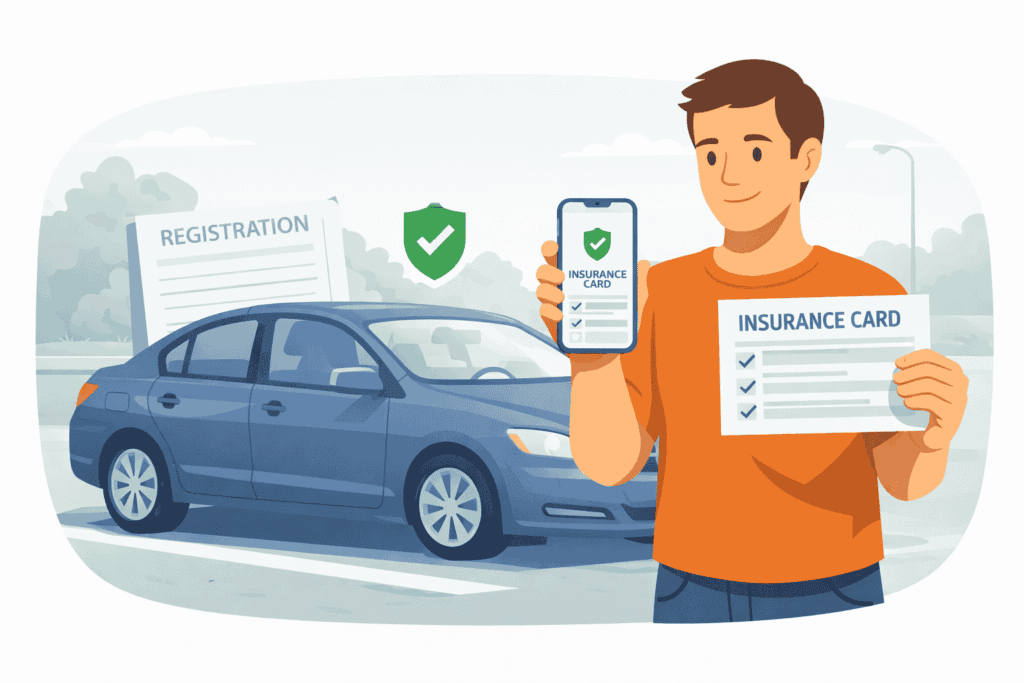
Proof of insurance is a document or digital record showing that a car insurance policy is active. The most common examples are a paper insurance card, an official digital card, or another document requested for a specific purpose.
For official context, California DMV explains insurance and financial responsibility evidence requirements.
What counts can depend on the state, agency, and situation. For the broader foundation, start with What Is Car Insurance?. This guide explains which documents are commonly accepted, when drivers may need them, and what to check before relying on them.
Quick Summary
- Proof of insurance usually shows that your policy is active for a specific vehicle or driver situation.
- A paper insurance card and a digital insurance card are the most common forms.
- Some situations may call for extra documents, such as a declarations page or insurer letter.
- You may need proof of insurance during a traffic stop, after an accident, at registration, or when picking up a car from a lender or lot.
- What is accepted can vary by state, agency, or circumstance.
- It is smart to keep both digital access and a backup paper copy when possible.
What usually counts as proof of insurance
In most everyday situations, proof of insurance means a document that shows the policy is currently active and identifies the vehicle, policy term, and insurer information. The most common example is the insurance ID card, whether printed or shown on a phone.
What usually counts may include:
- a paper insurance ID card
- a digital insurance card in the insurer’s app or portal
- a printable PDF insurance card
- a declarations page, in some situations
- a binder or temporary proof document when a new policy has just started
- a letter or confirmation from the insurer, when a specific agency requests it
In practice, the insurance card is the document most drivers use first. It is simple, portable, and designed for exactly this purpose. But not every situation is solved with the same document. For example, if there is a question about the policy term, vehicle details, or exact coverage, a declarations page may be more helpful than the ID card alone.
When you usually need proof of insurance
Drivers are often asked for proof of insurance in routine situations, not just after a crash. That is why this issue matters more than many people expect.
As one state example, the California DMV says drivers must carry evidence of insurance and provide it when requested by law enforcement, when renewing vehicle registration, or after a traffic collision. Requirements and accepted formats vary by state, so drivers should confirm the rules where they live. See the DMV guidance on financial responsibility and proof of insurance.
During a traffic stop
This is one of the most common situations. If you are pulled over, you may be asked for your license, registration, and proof of insurance. In many places, a digital insurance card may be accepted, but that is not something to assume blindly. It is still wise to know what your state and local rules allow.
After an accident
After a collision, proof of insurance helps confirm that the policy was active and gives the other party basic policy information. It does not decide fault, but it does help everyone exchange the right details. If you are unsure what information matters after a crash, it also helps to read Car Insurance Claims Process: 9 Steps That Really Happen.
At registration or vehicle-related paperwork
Some states or agencies require proof of insurance when registering a vehicle, renewing plates, or completing related paperwork. The document requested may vary, so it is not always enough to just know the policy is active.
When a lender or leasing company asks for it
If the car is financed or leased, the lender may want proof that certain coverages are in place. In those cases, the declarations page or a more detailed document may matter more than the standard insurance card.
When you switch, renew, or restart coverage
Proof of insurance also comes up when starting a new policy or replacing an old one. A driver may need immediate digital proof while waiting for mailed documents. That is one reason it helps to understand what happens when you switch car insurance mid-policy and how proof is handled during the transition.
What a proof of insurance document usually shows
Most proof of insurance documents include the basic details needed to show that a policy is active. That usually means:
- the insurer name
- the policy number
- the named insured
- the effective and expiration dates
- the vehicle information, often including the VIN or model details
These details confirm the policy and vehicle information, but they may not show limits, deductibles, or endorsements. For those details, the declarations page is usually more useful.
What to check before you rely on it
Review the document before you need it. Common problems include expired dates, the wrong vehicle, or a digital card that has not updated after a policy change.
- make sure the policy dates are current
- confirm the correct vehicle is listed
- check that your digital card is accessible without delay
- keep a paper backup if possible
- review whether a declarations page is needed for lender or registration tasks
- replace outdated cards after policy changes or renewals
This matters even more if there has been a recent gap or policy restart. If that applies to your situation, it may help to review Lapse in Car Insurance: What It Means and What Happens, since a current card only helps if the policy is truly active and continuous where required.
Conclusion
Proof of insurance shows that a policy is active when verification is required. A paper or official digital insurance card handles many everyday situations, while a declarations page, binder, or insurer confirmation may be needed for more detailed requests.
Keep the document current, confirm that it matches the correct vehicle and policy dates, and check state or agency requirements before relying on one format.
Related
- What Is Car Insurance? 9 Essential Basics Explained
- What Is an SR-22? What It Does (and What It Doesn’t)
- Driving Without Insurance: 10 Things That Can Happen
FAQ
Is a photo of my insurance card enough?
Sometimes it may help, but it is usually better to use an official digital card from the insurer app, portal, or printed document. A simple photo may not be accepted in every situation.
Does a declarations page count as proof of insurance?
In some situations, yes. It can help confirm policy details, but many everyday requests are handled with the standard insurance ID card instead.
Do I need paper proof if I have the insurer app?
Not always, but keeping a paper backup is often practical. Phones can run out of battery or be hard to access when you need them quickly.