
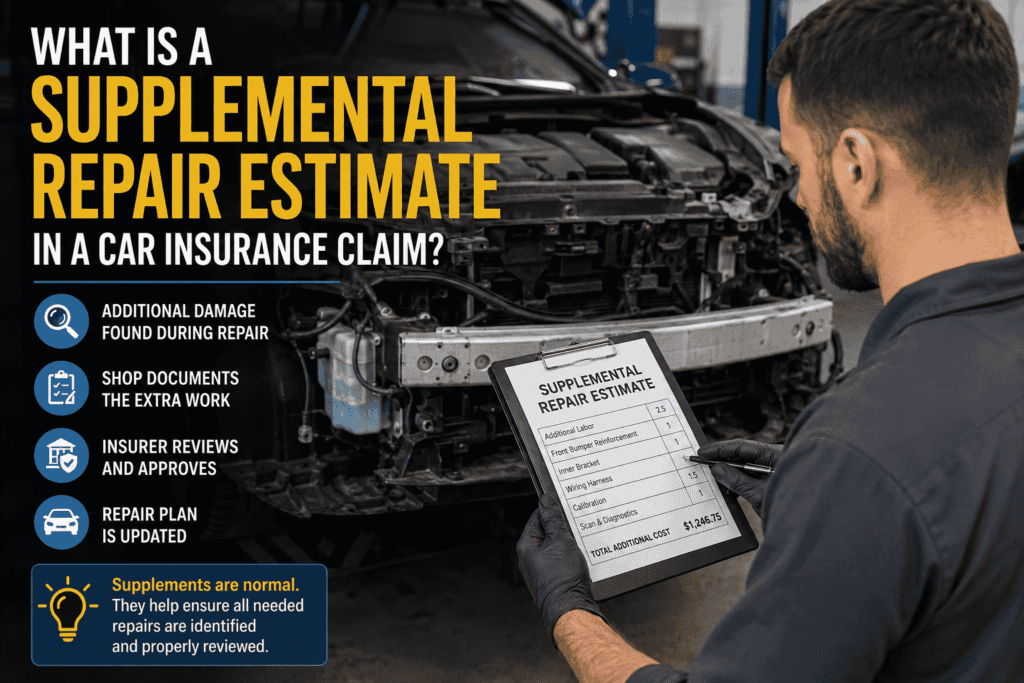
Supplemental repair estimate car insurance claims usually involve an updated estimate created after the original estimate when additional damage or required work is discovered. This often happens after the repair shop removes parts and finds hidden damage that was not visible during the first inspection.
A supplement does not automatically mean the first estimate was wrong or that something unusual happened with the claim. In many cases, it is simply another step in the car insurance claims process as the repair becomes more detailed.
Quick Summary
- A supplemental repair estimate adds repair items that were not included in the original estimate.
- Supplements often result from hidden damage discovered after parts are removed.
- The repair shop usually documents the additional work and sends it to the insurer for review.
- The insurer may approve the supplement, request more information, reinspect the vehicle, or question individual items.
- An approved supplement does not necessarily mean you personally owe the additional amount.
- Repair authorization and insurance approval are related but separate parts of the process.
What Is a Supplemental Repair Estimate in Car Insurance?
The first repair estimate is based on damage that can be identified during the initial inspection. Depending on the claim, that inspection may happen in person, at a repair facility, or through photos submitted electronically.
Once repairs begin, the shop may discover additional damaged parts, labor operations, measurements, scans, or calibrations that were not apparent before disassembly. A supplemental repair estimate documents those additional items and updates the expected repair cost.
This is closely related to a situation where the repair shop estimate is higher than the insurance estimate. The difference is that a supplement usually occurs after the repair process has already begun and new information becomes available.
Why Hidden Damage Can Appear After Repairs Begin
Modern vehicles have many components behind exterior panels. A bumper cover, for example, can hide reinforcement pieces, brackets, sensors, wiring, absorbers, and mounting points. Damage to those components may not be visible in photographs or during a basic exterior inspection.
The California Department of Insurance explains that if additional damage is found during repairs, the shop may contact the insurer about the added cost. Procedures can vary by state and insurer.
What Can Be Added to a Supplement?
The exact items depend on the vehicle and loss. A supplement might include a damaged bracket behind a bumper, additional body labor, wiring repairs, sensors, structural measurements, replacement fasteners, scans, or calibration procedures identified during the repair.
Not every requested item will automatically be covered. The insurer can review whether the additional work is related to the covered loss, supported by documentation, and consistent with the policy and claim facts. Pre-existing damage, unrelated repairs, upgrades, or other non-covered work may be handled differently.
How the Repair Shop and Insurer Handle a Supplement
The repair shop documents the added work with photos, part information, measurements, scans, labor notes, or repair procedures and sends the supplement to the insurer. The insurer may approve it, question individual items, request more documentation, or reinspect the vehicle.
If you choose your own repair shop, confirm that the supplement was submitted and ask whether any disputed item could become your responsibility.
Do You Need to Authorize Additional Repairs?
Insurance approval and customer authorization are not exactly the same thing. A repair shop may need your authorization before performing additional work even when an insurer is involved in paying the claim.
As a state-specific example, the California Bureau of Automotive Repair says that additional repairs beyond the original estimate require a revised work order describing the additional parts, labor, and revised cost, followed by customer authorization. Its guidance also explains that teardown may reveal the need for a second itemized estimate.
Other states may have different repair authorization requirements, so consumers should check the rules that apply where the repair takes place.
Does a Supplement Mean You Have to Pay More?
Not necessarily. If the added work is part of a covered loss and the insurer approves it, the supplement generally becomes part of the covered repair amount. Your deductible usually does not restart simply because a supplement is added to the same covered claim.
You could still be responsible for items outside the approved claim, such as unrelated damage, upgrades, unauthorized work, or other charges not covered by the policy. Ask the repair facility to identify any customer-pay amount before approving additional work.
The type of physical damage coverage also matters. Our guide to collision and comprehensive insurance explains which types of losses these coverages generally address.
Can a Supplement Delay the Repair?
It can. Additional damage may require new parts, another inspection, updated repair procedures, or insurer review before work continues. Parts availability and calibration scheduling can also add time.
A delay does not by itself prove improper claim handling. Ask what is pending and who needs to act next. If the shop says it is waiting for approval, confirm with the insurer that the supplement was received and ask whether additional documentation is needed. If newly discovered damage pushes the repair cost much higher, the claim can sometimes shift into a total-loss review; see what happens if your car is totaled after repairs start.
What Should You Ask During the Process?
- Was hidden damage found? Ask the shop to explain what changed after disassembly.
- Has the supplement been submitted? Confirm when it was sent to the insurer.
- Has it been approved? Ask which items are approved, pending, or disputed.
- Will I owe anything extra? Identify customer-pay items before authorizing work.
- Is another inspection required? Find out whether the insurer needs to see the vehicle again.
- Has the repair completion date changed? Ask how the supplement affects timing.
Conclusion
A supplemental repair estimate is a normal part of many car insurance repairs because the first inspection cannot always reveal damage hidden behind exterior parts. Once the vehicle is disassembled, the repair plan may need to change.
The most important points are documentation and communication. The repair shop should explain the additional work, the insurer should review what is connected to the covered loss, and you should understand any amount that may remain your responsibility before authorizing additional repairs.
Related
- Repair Shop Estimate Higher Than Insurance Estimate?
- Choose Your Own Repair Shop
- Car Insurance Claims Process
Frequently Asked Questions
Does a supplemental repair estimate mean the first estimate was wrong?
No. Some damage cannot be identified until parts are removed. A supplement can be a normal update to the repair plan as additional damage becomes visible.
Can an insurance company deny a supplement?
An insurer may question or decline individual items it believes are unrelated to the covered loss, unsupported, or otherwise not covered under the policy and claim facts.
Do I pay another deductible for a supplemental estimate?
Generally, a supplement that is part of the same covered loss does not create a new deductible. The deductible applies according to the policy and claim.
Should I approve additional repairs before the insurer reviews them?
Ask the repair shop what has been approved by the insurer and what could become customer-pay before authorizing additional work. Repair authorization requirements vary by state.