
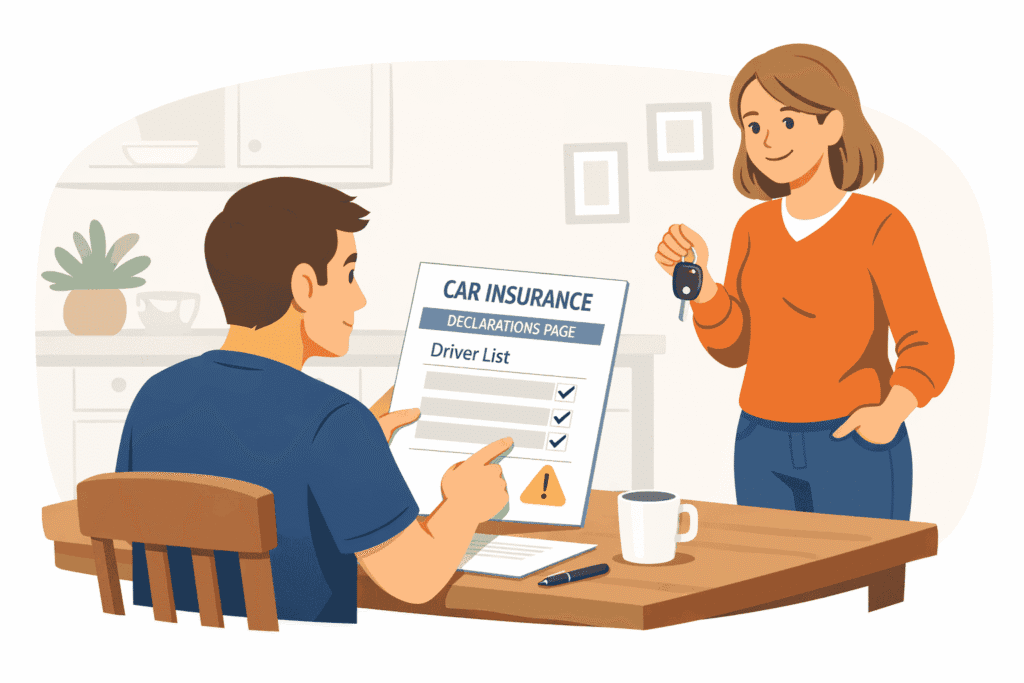
If a household driver is not listed on car insurance and regularly uses an insured vehicle, the mismatch may create questions during underwriting, renewal, or a claim. Insurers commonly ask about household residents because regular access to the vehicle can affect both risk and premium.
The outcome depends on the policy language, state rules, what information was requested, whether the driver had permission, and how frequently the vehicle was used. It also helps to understand the difference between a named insured and a listed driver.
Quick Summary
- Insurers may ask about licensed household residents and people who regularly use the vehicle.
- An unlisted regular driver can lead to additional questions during a claim or renewal.
- Occasional borrowing may be treated differently from regular household use.
- An unlisted driver is not automatically the same as a formally excluded driver.
- The declarations page, application, endorsements, and policy definitions should be reviewed before assuming coverage applies.
Why insurers ask about household drivers
Auto insurance pricing and underwriting depend partly on who is expected to operate the vehicle. A household resident’s age, driving record, license status, experience, and frequency of use may affect how the insurer evaluates the risk.
The South Carolina Department of Insurance notes that insurers commonly request the number of drivers in the household when preparing a quote. See its consumer guidance about buying automobile insurance.
An insurer may ask whether a household resident:
- has a driver’s license or learner’s permit
- regularly uses an insured vehicle
- has access to the keys
- owns another vehicle or has separate insurance
- must be listed, rated, documented, or excluded under the insurer’s rules
The exact requirement is not identical across every insurer or state. The important point is to answer application and renewal questions accurately and update the insurer when the household’s driving situation changes.
What happens if a household driver is not listed?
A missing name does not create one automatic outcome. The insurer will usually compare the driver’s residence, access, frequency of use, permission, and licensing status with the application, policy, and endorsements.
The claim may receive additional review
If the unlisted person was driving during a loss, the insurer may ask when the person moved into the home, how often the vehicle was used, who provided permission, and whether the driver was disclosed previously. That review does not itself mean the claim will be denied.
The policy or premium may be updated
If the insurer determines that the driver should have been disclosed, it may require updated information, add or rate the driver, request proof of separate insurance, or apply another action permitted by the policy and state rules.
Nebraska Department of Insurance consumer guidance warns that failing to include household drivers can result in additional premium, cancellation, or nonrenewal in some circumstances. These are possible outcomes rather than universal consequences. See its guidance on disclosing drivers to an auto insurer.
Coverage still depends on the policy
Some policies may extend protection to certain people using the vehicle with permission, but regular household use may be handled differently from occasional borrowing. Review whether car insurance follows the car or the driver before assuming every permitted driver receives the same protection.
Situations that should prompt a policy review
- A spouse, partner, or roommate moves into the home and has access to the vehicle.
- An adult child returns home and begins driving the car regularly.
- A household member receives a license or learner’s permit.
- A resident who previously had another vehicle begins using yours.
- A person described as an occasional borrower begins driving weekly or commuting in the car.
Occasional permission does not necessarily create the same issue as ongoing access. Because policies define drivers and household residents differently, the actual wording and the insurer’s questions matter.
What to check before a claim happens
Start with the car insurance declarations page and confirm which drivers and vehicles are listed. Then review:
- The driver and household information on the original application
- Definitions such as resident relative, family member, insured, and permissive user
- Any named-driver or excluded-driver endorsement
- Rules involving regular use or access to a vehicle
- Renewal questions requesting changes in household drivers
The California Department of Insurance advises policyholders to notify the insurer when there are new drivers in the household and to check whether any driver is formally excluded. See its guide to understanding an auto insurance policy.
A resident who owns a separate vehicle and maintains separate insurance may be handled differently, but that information may still need to be disclosed. Non-owner car insurance is generally intended for people who do not own a vehicle and should not be assumed to solve a household-driver issue automatically.
Conclusion
If a household driver is not listed, the central question is whether the policy accurately reflects who lives in the home and regularly uses the vehicle. An omission may lead to additional claim review, a premium or policy update, or a coverage dispute, but the result is not automatic.
Review the declarations page, application, definitions, and endorsements whenever a person moves in, becomes licensed, or begins using the vehicle regularly. Correcting the information before a loss is generally easier than explaining the mismatch during a claim.
Related
- Named Insured vs Listed Driver
- Does Car Insurance Follow the Car or the Driver?
- Excluded Driver Car Insurance
FAQ
Can a claim be denied because a household driver was not listed?
It is possible, but not automatic. The outcome depends on the policy, the information requested by the insurer, the driver’s use of the vehicle, and applicable state rules.
Does every household member need to be listed?
Not necessarily. Insurer requirements vary, but licensed residents and people with regular access to the vehicle commonly need to be disclosed even when they are insured elsewhere.
Is occasional borrowing the same as regular household use?
No. A person who uses the vehicle once may be evaluated differently from a household resident who drives it frequently or has ongoing access.