
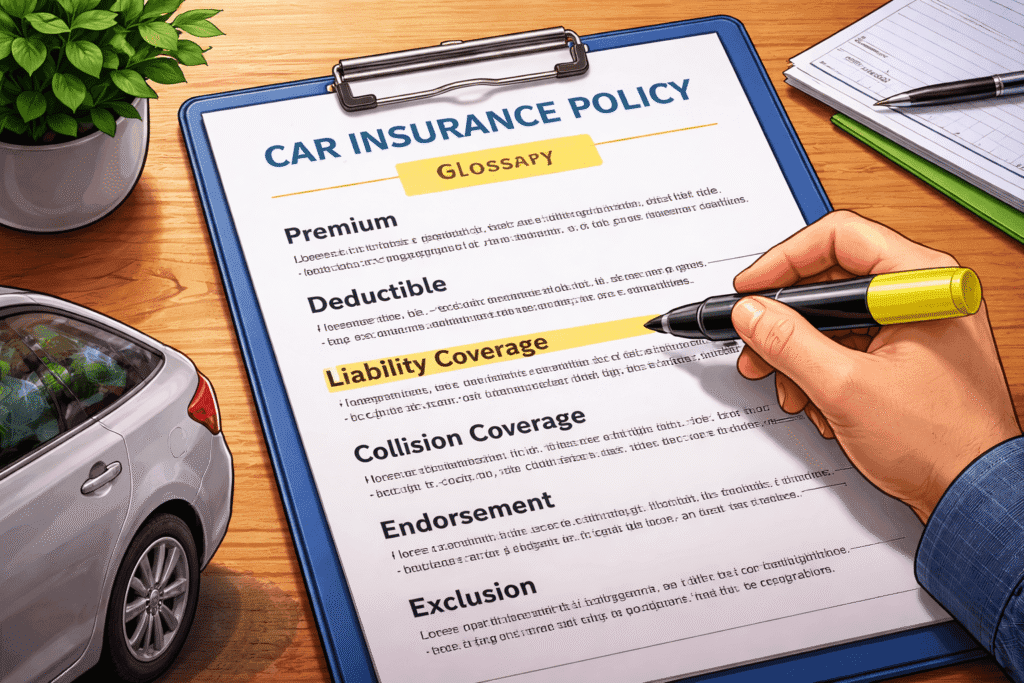
Many drivers open their policy and immediately run into unfamiliar words. Terms like deductible, endorsement, exclusion, and liability coverage can make a basic question feel harder than it should. That is why people often search for car insurance policy terms in plain language instead of trying to decode the document on their own.
For related context, see GAP insurance.
The good news is that most of these terms become much easier once you understand what each one is supposed to do. Some terms explain what the policy covers. Others explain how a claim works, what the driver may pay, or what limits apply. If you want the broader foundation first, start with how to read a car insurance policy.
This simple glossary explains common policy terms, what they usually mean, and why they matter when you read your declarations page, compare coverage, or check what happens after a loss.
Quick Summary
- Policy terms are the words that explain coverage, costs, limits, exclusions, and claim rules.
- Understanding a few core terms makes the rest of the policy much easier to read.
- The most important terms often relate to deductible, liability, limits, exclusions, endorsements, and the declarations page.
- Some terms describe coverage, while others describe drivers, documents, and policy timing.
- A simple glossary helps you spot what to review before renewal or before a claim happens.
What common car insurance policy terms mean
Not every insurer uses identical wording, and some rules vary by state or policy form. Still, many auto policies rely on the same core vocabulary. These are some of the terms drivers see most often:
- Premium: the amount you pay to keep the policy active.
- Deductible: the amount you may pay out of pocket before certain coverages help. For a deeper explanation, see how a deductible works in car insurance.
- Liability coverage: coverage that usually helps pay for damage or injuries you cause to other people.
- Collision coverage: coverage that usually applies when your car is damaged in a crash with another vehicle or object.
- Comprehensive coverage: coverage that usually applies to non-collision events such as theft, hail, vandalism, falling objects, or animal strikes.
- Policy limit: the maximum amount the policy may pay in a covered situation.
- Exclusion: a situation, person, vehicle, or type of loss the policy does not cover.
- Endorsement: a change or addition that modifies the original policy.
- Claim: a request for payment or assistance under the policy after a covered loss.
- Total loss: a situation where the insurer decides repair is not practical compared with the car’s value.
These terms matter because they shape what the policy may do, what it may not do, and what the driver may need to pay or prove in a real situation.
Policy-reading terms drivers often miss
Some important terms are not about a specific coverage. They describe who is connected to the policy or how the contract is organized. These are easy to overlook:
- Named insured: the main person or people listed on the policy contract.
- Listed driver: someone shown on the policy as a driver, but not necessarily the policyholder.
- Excluded driver: a person specifically removed from coverage when driving the insured vehicle.
- Declarations page: the summary page that usually shows drivers, vehicles, coverages, limits, and deductibles.
- Policy term: the period when the policy is active, such as six months or one year.
- Effective date: the date coverage begins.
- Expiration date: the date the current policy term ends unless it renews.
Many policy misunderstandings start here. A driver may focus only on price and never notice who is actually listed, whether someone is excluded, or when the term ends. That is one reason plain-language reading matters so much. It also connects well with what a plain language insurance policy means.
How these terms work in real life
A glossary is useful, but the real value comes from knowing how the terms connect in practice. Imagine a driver has liability, collision, and comprehensive coverage. The declarations page shows a $500 collision deductible and a $250 comprehensive deductible. If that driver backs into a pole, collision may be the relevant coverage. If hail dents the hood, comprehensive may be the relevant one.
Now imagine the same driver later adds an endorsement or has a household member listed as an excluded driver. The policy still exists, but the details have changed. That is why policy terms are not just vocabulary. They shape how the contract works after a loss, during renewal, and when comparing one policy with another.
Some terms also help explain why similar-looking policies can behave differently. For example, drivers often compare collision vs. comprehensive insurance because the names sound related, but they apply to different kinds of loss and can carry different deductibles and expectations.
What to check when reading your policy
If you want a practical review process, start with this checklist:
- Check who is listed as the named insured and which drivers appear on the policy.
- Review the coverages shown on the declarations page.
- Highlight the deductibles for each major coverage.
- Look for policy limits that affect how much protection you have.
- Read the exclusions section before assuming something is covered.
- Notice any endorsements that changed the original policy wording.
- Confirm the effective date, expiration date, and current policy term.
A neutral next step fits naturally here: before your next renewal, highlight any policy term you cannot explain in one sentence. That small habit often makes the entire document easier to understand before a claim, billing issue, or coverage question shows up.
For official context, NAIC encourages drivers to understand auto insurance coverage, California DOI explains policy coverage basics, and Texas DOI advises reviewing limits, deductibles, and exclusions.
Conclusion
Car insurance policy terms can look technical at first, but most of them become easier once you connect the word to its actual role. Some terms explain coverage, some explain cost, and others explain how the contract is structured.
The most useful next step is to review your own policy with a simple lens: who is listed, what is covered, what deductibles and limits apply, what exclusions appear, and whether endorsements changed the original contract. Once those terms feel familiar, the policy becomes much easier to read with confidence.
Related
- How to Read a Car Insurance Policy: Sections Made Simple
- What Is a Plain Language Insurance Policy?
- What Is a Deductible in Car Insurance?
FAQ
What is the most important car insurance term to understand first?
For many drivers, the most useful first terms are coverage type, deductible, and policy limit because those usually shape what the policy can do in a real loss.
Is the declarations page the full policy?
No. The declarations page is usually a summary. It shows major details, but the full policy wording explains how those details actually work.
What is an endorsement on a car insurance policy?
An endorsement is usually a change or addition that modifies the original policy. It may add, remove, or adjust how part of the coverage works.