
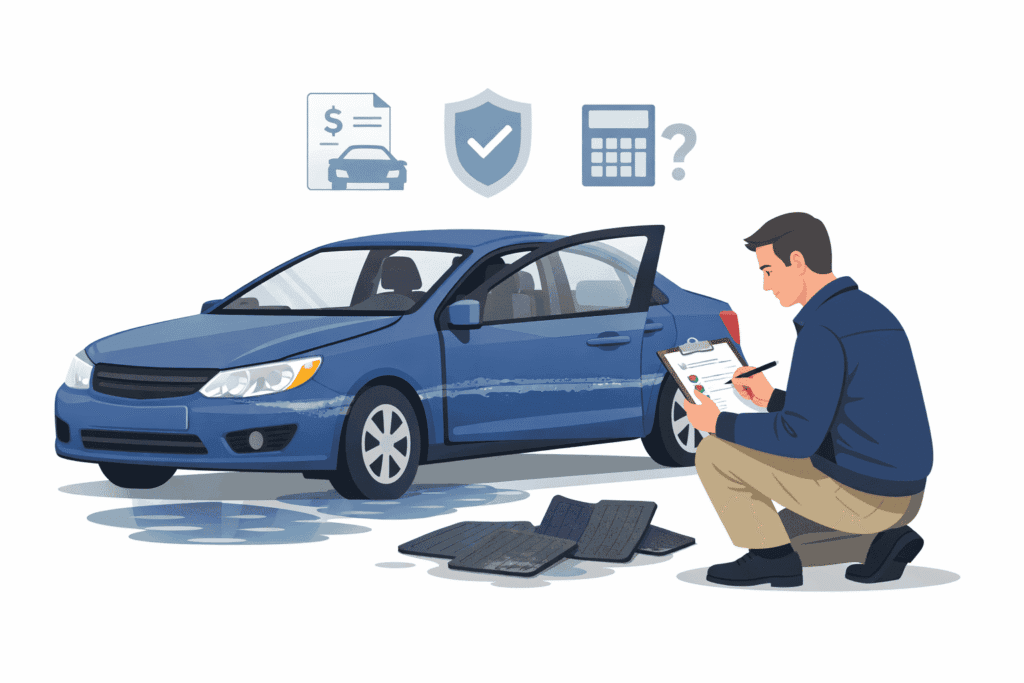
When is water damage a total loss for insurance? Usually, the question is not whether the seats are wet or the car still starts. The issue is whether repair costs, hidden damage risk, and the vehicle’s pre-loss value still make repair practical.
For official context, NAIC describes comprehensive coverage for damage to your vehicle. Texas DOI materials discuss totaled cars and actual cash value.
Water can affect electronics, wiring, safety systems, interior materials, and mechanical components long after the first visible signs. Coverage and the final decision depend on the policy, deductible, inspection, valuation, and applicable state rules.
For the broader coverage picture, start with what car insurance usually covers. This guide explains when a water-damage claim may move from repair into a total-loss review and what to check before settlement.
Quick Summary
- Water damage may become a total loss when repair costs and hidden damage risk rise too close to, or beyond, the vehicle’s value.
- Flooded electronics, wiring, safety systems, interior contamination, and corrosion risk can matter more than the first visible damage suggests.
- If you only carry liability coverage, damage to your own car from flooding is usually not covered.
- Even with comprehensive coverage, the deductible, vehicle value, and inspection results still affect the outcome.
- A car can be declared a total loss even if it still looks repairable from the outside.
- Before agreeing to repairs or settlement, review the valuation, deductible, and what part of the vehicle actually got wet.
When water damage may turn into a total loss
Water damage may move into total-loss territory when the expected repair path no longer makes practical or financial sense compared with the car’s pre-loss value. Deep flooding is not required. Expensive electrical, safety, or interior systems can push the estimate high even when the vehicle still looks repairable.
The Texas Department of Insurance explains that insurers compare a flooded car’s actual cash value with repair costs. It also notes that modern electronics can cause a vehicle to be totaled even when water did not reach the engine. State rules and policy terms still vary. See the TDI guidance on flooded cars, insurance claims, and repairs.
For the broader coverage question, review whether car insurance covers flood damage. Comprehensive coverage is generally the part of an auto policy that applies to flood damage, while liability-only coverage usually does not pay for damage to your own vehicle.
Why water damage can become more serious than it first looks
Water claims can involve damage that is difficult to judge from the outside. Wiring, control modules, cameras, sensors, seat materials, insulation, brakes, and drivetrain components may require drying, testing, calibration, repair, or replacement.
The estimate can therefore change after scanning, teardown, or deeper inspection. A car that first appears to have only a wet interior may later show electrical failures, contamination, corrosion risk, warning lights, or safety-system problems.
That is why early statements about repairability are not always final. The claim may move toward valuation when new damage appears or the repair path becomes more expensive than expected.
What insurers usually look at before calling it a total loss
The exact method can vary, but the review usually centers on a few practical questions:
- How far did the water reach inside or underneath the vehicle?
- Which systems were exposed: interior only, electronics, safety equipment, engine area, or more?
- What is the estimated cost to repair the vehicle safely?
- What was the vehicle worth right before the loss?
- How much hidden damage is still likely to appear after deeper inspection?
- Do state rules or the insurer’s total-loss formula push the vehicle toward settlement instead of repair?
That process is easier to understand if you already know how a broader total loss decision usually works. Water damage is one path into that outcome, but the decision itself still tends to follow the same core logic: value, repair cost, hidden issues, and policy handling.
What to check before assuming the car is totaled
Do not assume the car is repairable or totaled before the inspection is complete. Confirm:
- Whether comprehensive coverage is listed and which deductible applies
- How far the water reached and which systems were exposed
- Whether the estimate includes drying, scanning, calibration, interior replacement, and hidden damage
- How the repair estimate compares with the vehicle’s pre-loss value
A vehicle can still start and drive while carrying enough electrical, contamination, corrosion, or repair risk to require a total-loss review.
What to do if water damage may be heading toward a total loss
If the damage may be severe, stay organized before repairs or settlement move too far ahead. Photograph water lines, soaked materials, dashboard warnings, and the surrounding scene. Save towing, storage, cleanup, drying, and inspection receipts.
Ask which systems the insurer believes were affected and whether the file is still being handled as a repair claim or has moved into valuation. Request the estimate, valuation details, and deductible handling in writing when they are available.
For immediate steps, review what to do after flood damage to your car. For the broader timeline, see the car insurance claims process.
Common misunderstandings about water damage and total loss
“If the car still starts, it cannot be a total loss.”
No. Hidden electrical, contamination, corrosion, safety, and repair costs can still make the vehicle uneconomical to restore.
“Every flooded car is automatically totaled.”
No. The outcome depends on damage severity, repair cost, vehicle value, policy terms, and state rules.
“Drying the interior ends the problem.”
No. Moisture and affected electronics may create issues after the visible water is gone.
Conclusion
Water damage may become a total loss when repair costs and hidden risks no longer support restoring the vehicle compared with its pre-loss value. Review the coverage, deductible, inspection findings, estimate, valuation, and applicable state rules before accepting a repair path or settlement.
Related
- Does Car Insurance Cover Flood Damage?
- What to Do After Flood Damage to Your Car
- Total Loss in Car Insurance: How It’s Decided and Paid
FAQ
Does water damage automatically mean a car is totaled?
No. Some water-damaged cars are repairable. The result usually depends on the extent of the damage, the vehicle’s value, hidden damage risk, and how the total-loss review works in that case.
Is flood damage usually handled under comprehensive coverage?
Often yes, but usually only if comprehensive coverage is actually on the policy. Liability-only policies usually do not cover flood damage to your own car.
Can a car be totaled because of electronics and corrosion risk?
Yes. Water claims can become more serious because of electrical systems, sensors, contamination, and future corrosion concerns, not just the first visible damage.
What should I ask before accepting a water-damage settlement?
Ask how the damage was evaluated, whether hidden damage was considered, what deductible applies, how the vehicle was valued, and whether the file is being handled as repairable damage or a total loss.