
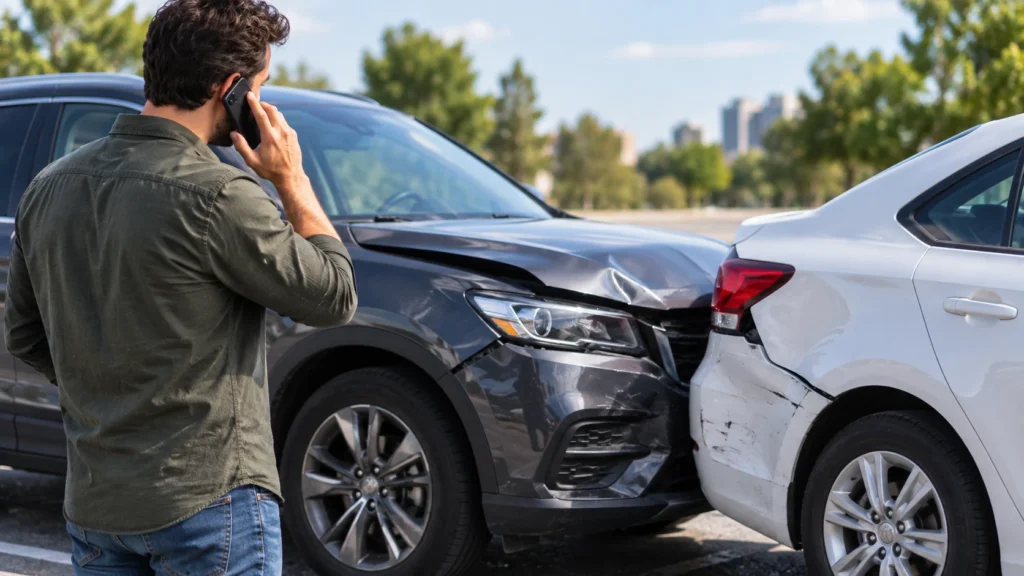
Collision vs UMPD can both help pay for damage to your car in some accidents, but they work differently. Collision generally focuses on the type of event. UMPD focuses on damage caused by an uninsured driver and may depend on fault, identification, and state rules.
Neither coverage is automatically “better.” The useful comparison starts with how collision car insurance works, whether UMPD is available where you live, and what each policy form says.
Quick Summary
- Collision may cover crash damage regardless of who caused the accident.
- UMPD generally applies when an uninsured driver is legally responsible.
- UMPD is not available or structured the same way in every state.
- Deductibles, limits, and hit-and-run rules can differ.
- The same damage is not paid twice.
Collision vs UMPD at a Glance
| Question | Collision | UMPD |
|---|---|---|
| Main trigger | Collision with a vehicle or object | Property damage caused by an uninsured driver |
| Fault | May apply regardless of fault | Usually requires the uninsured driver to be legally responsible |
| Availability | Widely offered as optional physical-damage coverage | Varies substantially by state |
| Payment cap | Policy terms and vehicle value, after deductible | UMPD limit and policy/state rules, after any deductible |
| Hit-and-run | May apply to collision damage | May require identification, contact, or a timely police report |
How Collision Coverage Works
Collision generally covers direct physical damage to a covered vehicle caused by a collision, subject to the policy, deductible, exclusions, and vehicle value. It can apply when you hit another car, a guardrail, or another object, even if you caused the crash.
Nevada’s Division of Insurance describes collision as coverage for damage to your vehicle resulting from a collision regardless of fault. It may pay for repair or compensate for the loss. The exact settlement still depends on the policy and damage evaluation.
How UMPD Coverage Works
UMPD coverage is property-damage protection tied to an uninsured motorist. It generally requires that another driver be legally responsible and uninsured, but definitions and proof requirements vary. If you are dealing with an actual crash, see what happens if an uninsured driver hits you, including what to document and which coverage paths may apply.
Some states require insurers to offer it, some make it optional, and some use different uninsured-motorist structures. A UMPD limit may be lower than the car’s value, and a separate deductible may apply. Read the declarations page and endorsement rather than assuming bodily-injury UM automatically includes vehicle damage.
CPA’s broader uninsured motorist coverage guide explains why bodily injury and property damage need to be separated.
Fault and an Identified Driver
Collision normally does not require proving that another driver was at fault before your own covered vehicle damage can be evaluated. UMPD usually turns on the other driver’s legal responsibility and uninsured status.
An unidentified driver creates a harder question. Some UMPD forms require physical contact, identification, a police report, or prompt reporting. Washington’s regulator, for example, discusses a 72-hour police-report rule for a phantom-vehicle claim. That is a Washington example, not a national deadline.
Deductibles, Limits, and Vehicle Value
Collision usually has the deductible selected on the policy. UMPD may have a different deductible or no deductible under a particular state form. UMPD also has a stated limit. Collision payments are generally constrained by policy terms and the vehicle’s actual cash value.
Ask the adjuster to identify which coverage is being considered, the applicable deductible, the maximum limit, and how a total loss would be valued. Do not assume the lower deductible shown in an online example applies to your policy.
What About a Hit-and-Run?
Collision may cover vehicle damage from contact with another car even when the driver leaves, subject to the collision deductible and policy. UMPD may or may not apply, depending on state law and the policy’s unidentified-motorist requirements.
Report the incident promptly, photograph the scene and damage, and ask which coverage paths are available. See CPA’s focused guide on whether collision covers hit-and-run damage.
Can Both Coverages Pay?
Both may be reviewed, but insurance generally does not pay twice for the same repair damage. The insurer may determine that one coverage applies, coordinate the available benefits, or change the claim path when facts about the other driver become known.
Ask for the coverage decision in writing. If the claim changes from collision to UMPD, confirm whether the deductible, limit, recovery rights, or documents also change.
A Simple Claim Example
Suppose an uninsured driver runs a red light and damages your parked vehicle. If the driver is identified and fault is supported, UMPD may be considered where that coverage exists. Collision may also be available if it is on your policy. The insurer then reviews which coverage applies under the policy and state rules.
Now change one fact: the other vehicle leaves and cannot be identified. Collision may still respond to covered collision damage, while UMPD may depend on special hit-and-run requirements. Change another fact and make the loss a single-car crash into a pole. Collision may apply, but UMPD generally would not because no uninsured driver caused the damage.
Conclusion
Collision is broad physical-damage coverage for crashes, while UMPD is narrower protection linked to an at-fault uninsured driver. Availability, proof, deductibles, and limits can make the practical result different. Review both coverage lines and ask which one the insurer is applying to the facts.
Related
FAQ
Is UMPD the same as collision?
No. Collision is physical-damage coverage for crashes; UMPD is tied to damage caused by an uninsured motorist.
Does UMPD always have a lower deductible?
No. Deductibles vary by state, policy, and coverage form.
Can UMPD cover a hit-and-run?
Sometimes, but identification, contact, reporting, and other requirements vary. Collision may provide another path.
Do I need both collision and UMPD?
They overlap in some losses but are not identical. Review availability, price, deductibles, limits, vehicle value, and your policy with a licensed professional.