
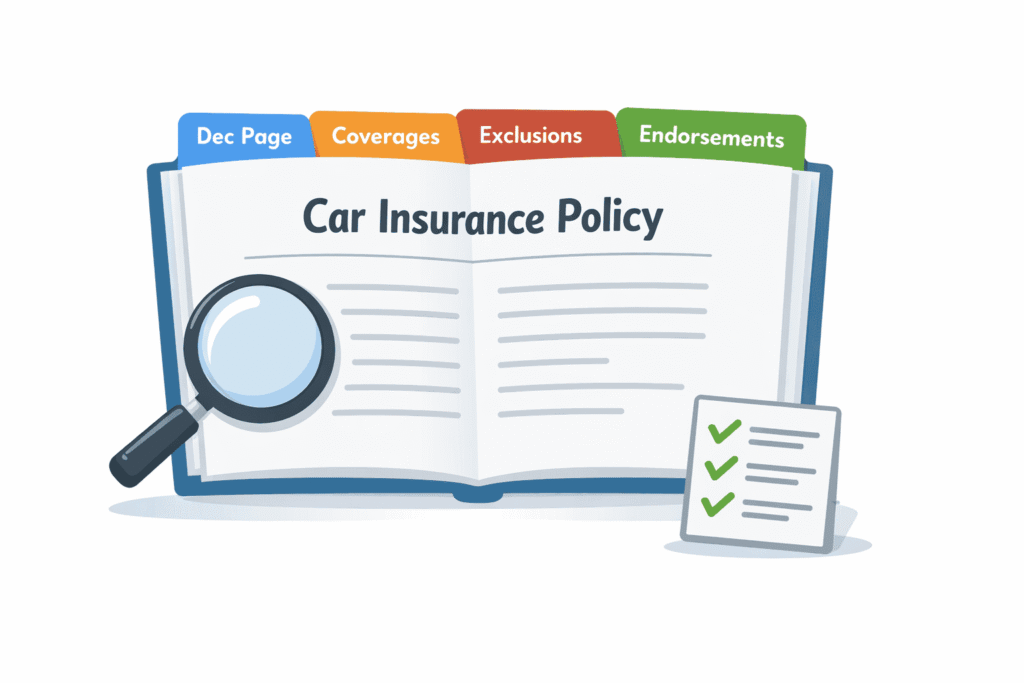
A car insurance policy can feel overwhelming. You may receive a declarations page, a long policy booklet, and extra pages called endorsements. Then you wonder: What am I actually covered for? and Where do I find the important parts?
This guide shows you how to read a car insurance policy in a simple, section-by-section way. You will learn what each major section means, where to find your limits and deductibles, and what words like “exclusion” and “endorsement” really do. You will also learn a practical method to create a one-page summary for yourself, so you can understand your coverage before you ever need to file a claim.
Definition / Core concept
A car insurance policy is a contract. It explains:
- Who is insured (people listed on the policy)
- What is insured (vehicles and coverages)
- When and where it applies (policy dates and territory)
- How much it may pay (limits and deductibles)
- What it does not cover (exclusions and restrictions)
Most policies include two key parts:
- Declarations page (Dec Page): A summary of your coverages, limits, deductibles, vehicles, and policy dates.
- Policy form booklet: The detailed rules, definitions, exclusions, and conditions that control how coverage works.
Think of the declarations page as the “table of contents.” The policy form is the “full rulebook.”
How it works in practice
Use this step-by-step approach. It helps you avoid reading 50 pages with no plan.
- Gather the full set of documents
- Declarations page
- Policy form booklet (sometimes called “Your Auto Policy”)
- Endorsements (extra pages that change the policy)
- ID cards (helpful for proof of insurance, not the full contract)
- Start with the declarations page
Look for:- Policy period: start and end dates
- Named insured: the primary person on the policy
- Drivers/vehicles listed: who and what is included
- Coverages purchased: liability, collision, comprehensive, and any add-ons
- Limits: maximum amounts the policy may pay under each coverage
- Deductibles: what you pay before certain coverages pay
- Match each coverage name to the policy booklet
The declarations page may list coverages by short names. In the policy booklet, find the section that explains each one. Common sections include:- Liability coverage
- Medical-related coverage (may vary by state)
- Uninsured/underinsured motorist coverage (if applicable)
- Physical damage coverage (collision and comprehensive)
- Duties after an accident or loss
- Find the “Definitions” section early
Policies often define common words in specific ways. A term like “you,” “family member,” “insured,” or “occupying” can have a precise meaning. Those definitions can change how coverage applies. - Check the “Exclusions” carefully
Exclusions are situations the policy does not cover. Some exclusions apply to the whole policy, and some apply to one coverage only. - Read the “Conditions” section
Conditions explain what you must do to keep coverage valid, such as:- Reporting a loss promptly
- Cooperating with the investigation
- Protecting the vehicle from further damage
- Providing documents or statements when requested
- Review endorsements last (but do review them)
Endorsements can:- Add a coverage
- Remove a coverage
- Change a definition
- Change who is insured
- Change limits or deductibles for certain situations
If an endorsement conflicts with the base policy, the endorsement often controls for that topic.
- Make your own one-page summary
Write down:- Your liability limits
- Your collision and comprehensive deductibles
- Any key add-ons (rental, towing, roadside, gap, etc.)
- Any unusual exclusions or special endorsements
- What to do after an accident (your “claims checklist”)
Main types, coverage, or variations
Car insurance policies are not identical. Here are common variations you may see.
Declarations page vs policy form vs endorsements
- Declarations page: Your specific coverages and numbers
- Policy form: General rules that apply to everyone using that form
- Endorsements: Custom changes that modify the form for your policy
Limits can be shown in different formats
Depending on the coverage, a limit may appear as:
- A single dollar amount (per person or per accident)
- A split limit (like separate amounts for different parts of a claim)
- A maximum per event (for certain add-ons)
Deductibles can differ by coverage
Collision and comprehensive often have separate deductibles. Some add-ons may also have their own limits or restrictions.
State rules can change how a policy looks
Some coverages and terms are influenced by state requirements. That is one reason the same topic can look different across states.
Personal vs commercial policies
A personal auto policy is designed for personal driving. If a vehicle is used primarily for business purposes, the policy type and wording may differ.
Costs or influencing factors (if applicable)
Reading your policy does not change your premium by itself, but it helps you understand what drives cost and risk. Common factors inside the policy include:
- The coverages you selected (liability only vs more coverages)
- Your limits (higher limits can change premium)
- Your deductibles (higher deductibles can lower premium in many cases)
- The vehicles and drivers listed on the policy
- The territory and garaging address shown on the declarations page
The goal is not to chase a “perfect” number. The goal is to understand what you are paying for and what protection you actually have.
Common questions or misunderstandings
Is the declarations page my whole policy?
No. It is a summary. The policy form and endorsements contain the detailed rules.
Where do I find exclusions?
Usually in an “Exclusions” section and sometimes inside each coverage section.
Do endorsements matter if they are only one page?
Yes. Even a short endorsement can change definitions or remove coverage in specific situations.
What’s the difference between a limit and a deductible?
A deductible is what you may pay before certain coverages pay. A limit is the maximum the policy may pay under that coverage.
If my claim is denied, does my policy explain why?
Often, yes. The decision usually ties back to definitions, exclusions, limits, and conditions in your policy. See Can an Insurance Company Deny a Claim?.
If a word is unclear, can I ignore it?
No. Instead, look for the Definitions section and read the sentence in context. Policy words often have specific meanings.
Important to Know
Car Policy Answers is an independent educational website. We do not sell insurance, provide quotes, or recommend insurance companies.
The information in this article is intended for general educational purposes only and is based on publicly available insurance guidelines and common industry practices.