
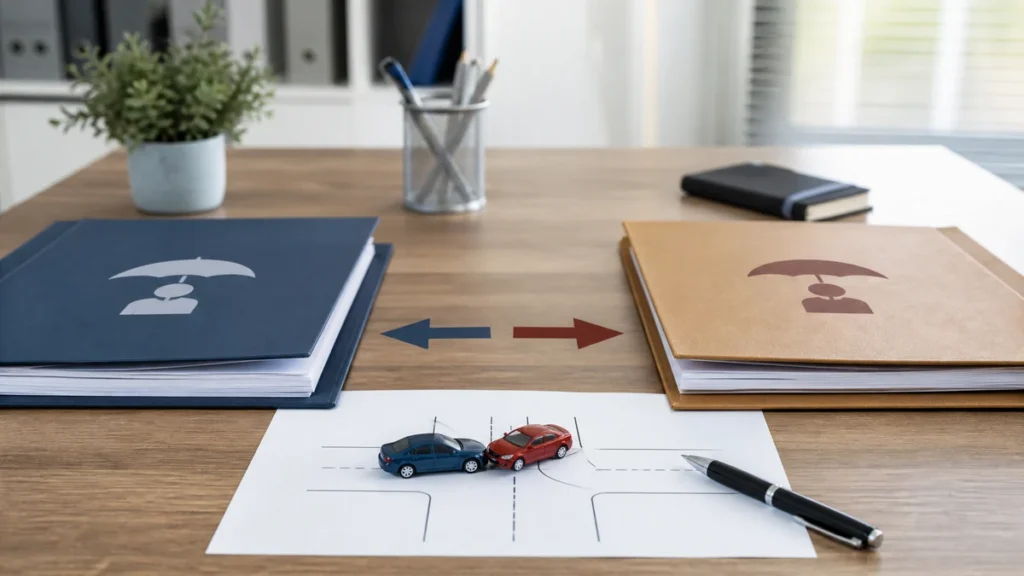
A first-party car insurance claim is a claim you make under your own policy with your own insurer. A third-party car insurance claim is a claim you make against someone else’s insurer because you believe that person caused your damage or injury.
The difference can affect deductibles, liability investigation, repair timing, subrogation, and settlement documents. For the broader workflow from reporting through payment, see our car insurance claims process.
Quick Summary
- First-party means you are making a claim under your own policy.
- Third-party means you are seeking payment from another person’s liability insurer.
- Your deductible commonly applies to first-party collision or comprehensive claims.
- A third-party property damage claim usually depends on the other insurer accepting liability.
- Your insurer may pay first and later pursue the responsible party through subrogation.
- A third-party settlement may include a release, so understand what is being settled before signing.
First-Party vs. Third-Party Claim at a Glance
| Question | First-party claim | Third-party claim |
|---|---|---|
| Which insurer? | Your own insurer | Another person’s insurer |
| Policy relationship? | You are insured under the policy | You generally are not insured under that policy |
| Deductible? | Often applies to collision or comprehensive | Your own deductible usually does not apply to direct liability payment |
| Main issue? | Your coverage and the loss facts | Liability and damages |
| Common coverage? | Collision, comprehensive, PIP, MedPay, UMPD | Property damage and bodily injury liability |
What Is a First-Party Car Insurance Claim?
A first-party claim is made under your own insurance policy. The Texas Office of Public Insurance Counsel describes first-party auto claims as claims filed with your own insurance company.
Examples can include collision after a crash, comprehensive after theft or hail, PIP or MedPay where available, and certain uninsured-motorist coverages. Because you are using your own policy, the insurer reviews coverage, exclusions, limits, duties after loss, and any deductible.
What Is a Third-Party Car Insurance Claim?
A third-party claim is made against another person’s insurance company. The OPIC third-party claims guide explains that these claims involve seeking payment from the insurer of the person believed to be responsible for the loss.
The other insurer usually investigates liability before paying you. It may review driver statements, photos, police information, witness accounts, vehicle damage, coverage status, and other evidence before accepting responsibility.
How Do Deductibles Differ?
If you use your own collision or comprehensive coverage, the deductible in that coverage generally applies even when another driver may have caused the loss. You are asking your insurer to pay under your contract first.
If the other driver’s insurer accepts responsibility and pays your property damage directly, your own collision deductible generally is not part of that third-party payment. See how the deductible works when someone hits your car for more detail.
Why Can a Third-Party Claim Take Longer?
A third-party insurer may need to confirm both coverage and liability before agreeing to pay. Even when the accident appears straightforward, it may wait for its insured’s statement or other evidence before accepting responsibility. If the other driver is not cooperating, see what can happen when the other driver is not responding to insurance. See how car insurance determines fault after an accident for the evidence insurers may consider.
With a first-party claim, your own insurer can sometimes move repairs forward sooner when coverage is clear. The tradeoff is that your deductible may apply while responsibility between the drivers is still being resolved.
How Does Subrogation Fit In?
Subrogation can connect the two claim paths. Your insurer may pay your first-party claim and then seek reimbursement from the responsible party or that party’s insurer.
The Washington Office of the Insurance Commissioner explains that an insurer may pursue the responsible party after paying its policyholder. Washington also has rules addressing recovery of the policyholder’s deductible when subrogation succeeds. Other states may handle deductible recovery differently.
Deductible recovery after subrogation depends on whether the insurer successfully recovers money and on the rules that apply to the claim. See how getting your deductible back after subrogation may work for a closer look at the recovery process.
How Common Coverages Fit
- Collision: usually first-party coverage for covered crash damage to your vehicle.
- Comprehensive: usually first-party coverage for covered non-collision losses such as theft, hail, or falling objects.
- Liability: coverage under the responsible driver’s policy that may pay another person’s covered damage or injuries.
- PIP or MedPay: first-party medical benefits where available, subject to state and policy rules.
- UMPD: coverage under your own policy for certain uninsured-driver property damage situations where available.
For uninsured-driver situations, compare UMPD coverage and uninsured vs. underinsured motorist coverage.
What About Settlement Releases?
First-party and third-party payment documents can also differ. In a first-party claim, payment is governed by your policy. In a third-party claim, the other insurer may ask you to sign a release before final settlement.
Read the document carefully. A release may settle more than the immediate repair bill, especially when injuries, rental expenses, diminished value after an accident, or other damages are involved. If you do not understand what rights the document affects, consider obtaining appropriate state-specific guidance before signing.
Which Claim Should You Use?
There is no single answer for every accident. If the other insurer accepts liability quickly, a third-party claim may allow you to avoid using your own collision coverage and deductible. If liability is disputed or repairs are urgent, your own coverage may provide a faster path when you have the necessary protection.
- Ask whether the other insurer has accepted liability.
- Confirm which deductible applies if you use your own policy.
- Ask how rental coverage or reimbursement will be handled.
- Find out whether your insurer plans to pursue subrogation.
- Review any release before accepting a final third-party settlement.
Simple Examples
Example 1: Another driver backs into your parked car but disputes responsibility. You use your own collision coverage so repairs can begin. Your deductible applies, and your insurer may later seek recovery.
Example 2: Another driver rear-ends you and their insurer accepts liability. You make a third-party property damage claim directly with that insurer, so your own collision deductible generally is not part of that payment.
Conclusion
The main difference between a first-party and third-party car insurance claim is whose policy is paying. First-party claims use your own coverage and can involve your deductible. Third-party claims depend on another person’s liability coverage and usually require that insurer to accept responsibility.
Knowing which claim path you are using helps you ask better questions about deductibles, repair timing, subrogation, rental costs, and settlement documents before you agree to payment.
Related
FAQ
Is a collision claim first-party or third-party?
A collision claim under your own policy is generally first-party. A property damage claim against another driver’s liability coverage is third-party.
Does a third-party claim have a deductible?
Your own collision deductible generally does not apply when the other insurer pays your property damage directly. Payment still depends on liability, coverage, and damages.
Can you contact both insurance companies?
Yes. You may report the accident to both insurers, but you cannot receive duplicate payment for the same loss.
Is UMPD a first-party claim?
UMPD is coverage under your own policy, so it is generally handled as first-party coverage even though an uninsured driver caused the damage.
Should you sign a release from the other insurer?
Read it carefully before signing. A release may settle claims beyond the immediate vehicle repair, depending on its wording and the circumstances.