
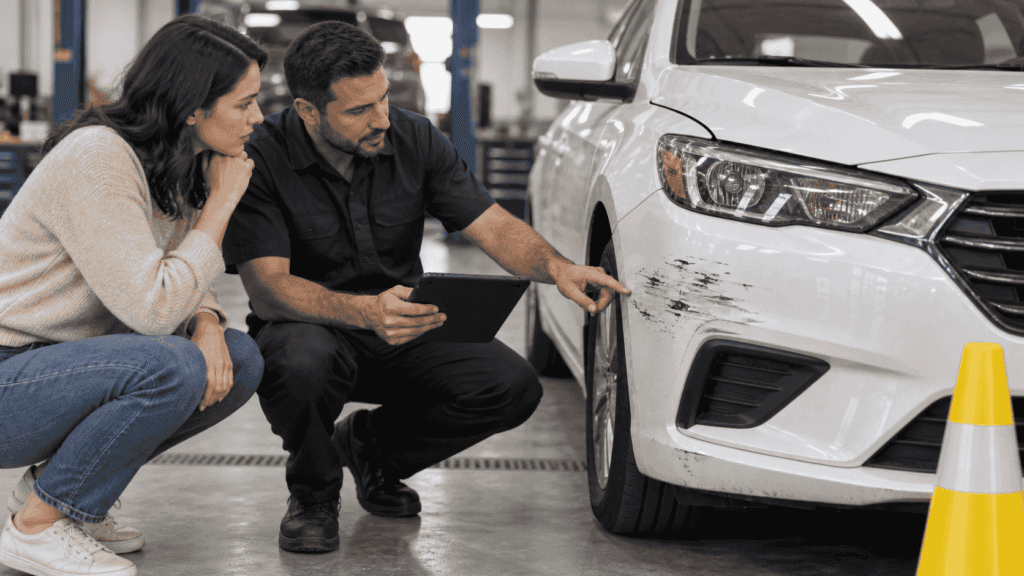
What is collision car insurance? It is optional physical damage coverage that may help pay to repair or replace your own vehicle after it collides with another vehicle, hits an object, or overturns, subject to your policy and deductible.
Collision coverage is not the same as liability insurance. Liability is mainly about damage or injuries you cause to other people. Collision is about damage to your own car after a crash-type event.
This guide explains what collision coverage usually covers, what it may not cover, how the deductible works, and how it differs from comprehensive coverage.
Quick Summary
- Collision coverage usually applies to damage to your own car after a crash with another car or object.
- It may also apply when your vehicle overturns or is damaged in a single-car crash.
- Collision is usually optional under state law, but lenders and leasing companies may require it.
- A deductible commonly applies before the insurer pays for covered repair or replacement costs.
- Collision does not usually cover theft, fire, hail, vandalism, animal strikes, injuries, or damage you cause to someone else’s property.
What Is Collision Car Insurance Designed to Cover?
Collision car insurance is part of the physical damage side of an auto policy. It may help protect your vehicle when the damage comes from impact. That could mean another vehicle, a guardrail, a fence, a pole, a wall, or another object.
The NAIC describes collision as coverage for physical damage from your auto colliding with an object, such as a tree or another car. The Idaho Department of Insurance similarly describes it as coverage that helps repair or replace your vehicle after contact with an object.
If you want the side-by-side distinction, CPA’s guide to collision and comprehensive insurance explains both coverages together. This page focuses on collision by itself.
What Collision Insurance Usually Covers
Collision coverage usually applies when your car is damaged because of an impact or overturn. Common examples include:
- You hit another vehicle.
- Another vehicle hits your car and you use your own collision coverage.
- You back into a pole, fence, wall, or garage door.
- You slide into a guardrail during bad weather.
- Your car rolls over in a single-car crash.
- You hit a pothole or road hazard in a way your policy treats as collision.
Potholes can be confusing because they do not feel like a normal crash. If that is the specific issue, CPA has a separate guide on whether insurance may cover pothole damage. Another common question is what happens when another driver hits your car and leaves; CPA’s guide to whether collision insurance covers hit-and-run damage explains that situation. If you want to compare the two property-damage paths directly, see collision vs UMPD.
What Collision Does Not Usually Cover
Collision does not usually cover every problem that happens near a car. Theft, vandalism, fire, hail, flooding, falling objects, glass-only losses, and hitting a deer are usually comprehensive-type questions, not collision questions.
Collision also does not usually pay for medical bills, legal responsibility for injuries, or damage you cause to another person’s vehicle or property. Those are liability, medical payments, PIP, or uninsured motorist questions, depending on the state and policy. CPA’s liability vs full coverage guide explains that broader difference.
How The Collision Deductible Works
Most collision claims have a deductible. The deductible is the part of the covered loss you are responsible for before the policy pays. If covered repairs cost $3,000 and your collision deductible is $500, the deductible is subtracted from the covered payment.
The Washington Office of the Insurance Commissioner notes that a deductible may apply when collision coverage is used. Your exact amount should appear on your declarations page. CPA’s guide to the car insurance deductible explains that payment step in more detail.
Repair, Replacement, And Total Loss
Collision coverage does not guarantee that the insurer will repair the car no matter what the estimate says. If the damage is too expensive compared with the vehicle’s value, the claim may be handled as a total loss instead.
The California Department of Insurance explains that a physical damage claim under a standard auto policy generally pays the lesser of the repair cost or the actual cash value of the vehicle. CPA’s guide to total loss in car insurance explains how that decision often works.
Financed And Leased Vehicles
If your vehicle is financed or leased, collision may be required by the contract even though it is not usually required by state law. The lender or lessor has a financial interest in the car and may require coverage that protects the vehicle itself.
If required collision coverage is removed or lapses, a lender may purchase coverage to protect its own interest and charge the borrower for it. The Washington Office of the Insurance Commissioner explains that lenders commonly require collision and comprehensive coverage on financed or leased vehicles. Read your financing or lease agreement before changing physical damage coverage.
Conclusion
Collision car insurance is usually the coverage that may help pay for damage to your own vehicle after it hits another vehicle or object, or after it overturns. It is separate from liability and from comprehensive coverage.
The practical next step is to check whether collision appears on your declarations page, what deductible applies, whether a lender requires it, and how the policy handles repair versus actual cash value. If you are deciding whether to keep or add the coverage, see whether collision car insurance is worth it based on vehicle value, deductible, premium, financing, and your ability to absorb a loss.
Related
FAQ
Is collision insurance required by law?
Usually no. State law typically focuses on liability insurance, but your lender or leasing company may require collision coverage.
Does collision cover my car if I caused the accident?
It may, if the policy includes collision coverage and no exclusion applies. Your deductible would usually be subtracted from the covered payment.
Does collision cover hitting a deer?
Usually no. Animal strikes are commonly handled under comprehensive coverage, but you should check your policy wording.
Does collision cover damage to the other driver’s car?
No. Collision focuses on your own vehicle. Damage you cause to someone else’s car is usually a property damage liability question.