
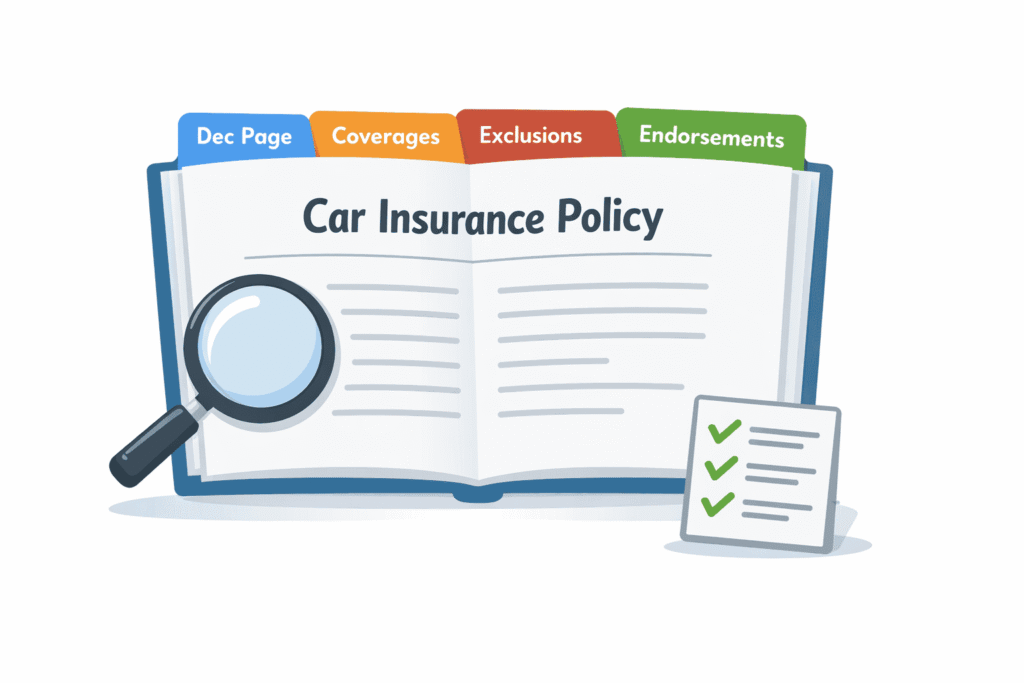
A car insurance policy can feel overwhelming at first. You may receive a declarations page, a long policy booklet, and extra pages called endorsements. Then the same questions show up fast: What am I actually covered for? Where do I find the important parts? Which page matters most if I need to file a claim?
For official context, NAIC encourages consumers to understand their auto insurance policy. Texas DOI advises reviewing coverage, limits, deductibles, and exclusions.
The good news is that you do not need to read the policy like a lawyer to understand the basics. You just need a clear order. Once you know where to look first, which sections control the main rules, and how endorsements can change the policy, the document becomes much easier to use in real life.
This guide shows you how to read a car insurance policy in a simple, section-by-section way. You will learn what each major section means, where to find your limits and deductibles, what exclusions and endorsements actually do, and how to create a simple one-page summary for yourself. If you are new to the topic overall, it also helps to start with What Is Car Insurance?.
Quick Summary
- The declarations page is the fastest place to see your active coverages, limits, deductibles, vehicles, and policy dates.
- The policy booklet contains the full rules, including defined car insurance terms, exclusions, conditions, and claim duties.
- Endorsements can change the base policy by adding, removing, or modifying coverage.
- Limits tell you the maximum the policy may pay, while deductibles tell you what you may pay first under certain coverages.
- The best way to read a policy is in order: declarations page first, then definitions, coverage sections, exclusions, conditions, and endorsements.
What a car insurance policy really is
A car insurance policy is a contract. It explains who is insured, what vehicles are insured, which coverages are active, when the policy applies, how much it may pay, and what situations are excluded or limited.
In practical terms, most policies answer five basic questions:
- Who is insured
- What is insured
- When and where coverage applies
- How much the policy may pay
- What is not covered or what conditions must be followed
Most policies come in two main parts:
- Declarations page: a summary of your specific coverages, limits, deductibles, vehicles, drivers, and policy dates.
- Policy form booklet: the full rulebook that explains how each coverage works, including exclusions, definitions, and conditions.
Then there is a third category that matters a lot:
- Endorsements: extra pages that change the standard policy form for your specific policy.
A simple way to think about it is this: the declarations page tells you what you bought, while the policy booklet and endorsements tell you how it actually works.
How to read a car insurance policy step by step
The easiest way to read a policy is to avoid starting in the middle. Use this order instead.
- Gather the full document set.
Try to have the declarations page, the full policy booklet, and any endorsements. Insurance ID cards are useful as proof of coverage, but they are not the full contract. - Start with the declarations page.
This is the best first page because it usually shows the policy period, named insured, listed drivers, vehicles, coverages purchased, deductibles, and limits. - Match the coverage names to the policy booklet.
The declarations page often uses short labels. In the booklet, find the sections that explain each coverage in full detail. - Read the definitions early.
Words like “you,” “insured,” “family member,” or “occupying” may have very specific meanings in the policy. - Check exclusions carefully.
Exclusions explain when the policy does not apply, even if the loss seems related to the vehicle. - Review conditions and duties after a loss.
These sections explain what you must do after an accident or claim, such as reporting promptly and cooperating with the investigation. - Read endorsements last, but do not skip them.
Endorsements can change definitions, coverage, deductibles, or who is insured. - Make your own one-page summary.
Write down your main limits, deductibles, endorsements, and what to do after a loss.
This method saves time because it keeps you focused on the parts that affect real-world coverage decisions first.
What to look for on the declarations page
The declarations page is usually the fastest way to understand your policy at a glance. It is not the whole contract, but it is the best starting point.
- Policy period: the effective start and end dates
- Named insured: the main person tied to the policy
- Listed drivers: who appears on the policy as a driver
- Vehicles: the cars covered by the policy
- Coverage types: liability, collision, comprehensive, medical coverages, uninsured motorist, and optional add-ons
- Limits: the maximum the policy may pay under each coverage
- Deductibles: the amount you may have to pay first under certain coverages
If you want a deeper breakdown of this page by itself, see Car Insurance Declarations Page (Dec Page).
The most important sections inside the policy booklet
Once you finish the declarations page, move into the policy booklet with a purpose. These are the sections that matter most.
Definitions
This section often looks boring, but it can change the meaning of the whole policy. Insurance contracts define certain words very precisely, and those definitions may be different from how people use the words in everyday conversation.
Coverage sections
This is where the policy explains what each coverage does. That may include liability, medical-related coverage, uninsured or underinsured motorist coverage, and physical damage coverage such as collision and comprehensive.
Exclusions
Exclusions explain what the policy does not cover. Some exclusions apply to the whole policy, while others apply only to one coverage section. This is one of the most important parts of the document because many claim disputes come down to exclusions.
Conditions
Conditions explain what the insured must do for the policy to work properly. These may include reporting the loss promptly, protecting the vehicle from further damage, providing documents, or cooperating with the claim investigation.
Duties after an accident or loss
This section matters a lot in practice because it tells you what the insurer expects after something happens. It may explain notice requirements, documentation expectations, and how to support the claim.
Why endorsements matter so much
Many drivers focus only on the declarations page and the base policy form, but endorsements can be just as important. An endorsement is a change to the standard policy. It may add coverage, remove coverage, change a definition, modify a deductible, or change who is insured.
If an endorsement conflicts with the standard form, the endorsement often controls that specific issue. Even a short extra page can affect coverage, deductibles, exclusions, drivers, or effective dates. Review what changes when you add an endorsement to a policy before relying only on the original policy booklet.
- An endorsement may add roadside assistance or rental reimbursement.
- An endorsement may change who qualifies as an insured driver.
- An endorsement may modify exclusions or deductibles for certain situations.
- An endorsement may remove or narrow a coverage you assumed was standard.
That is one reason two drivers with the same insurer can still have policies that work differently.
How to understand limits and deductibles correctly
Many people mix up these two concepts, but they answer different questions.
- Deductible: what you may have to pay first before certain coverages begin paying
- Limit: the maximum amount the policy may pay under that coverage
Collision and comprehensive often have separate deductibles. Liability and some other coverages usually focus more on limits than deductibles. If you want a fuller explanation of the numbers on the page, these guides help: Car Insurance Policy Limits and What Is a Car Insurance Deductible?.
When reading your policy, do not just ask “Do I have this coverage?” Also ask “What is the limit?” and “What deductible applies?” because those numbers can change the real outcome of a claim.
What can vary from one policy to another
Not every car insurance policy looks the same. Even when the general structure is similar, several things can vary:
- The exact coverage names used on the declarations page
- The format of limits, such as split limits or single amounts
- The deductible amounts for collision and comprehensive
- The endorsements attached to the policy
- The state-specific wording and required coverages
- Whether the policy is personal auto or commercial auto
That is why it is risky to assume someone else’s explanation matches your own paperwork exactly.
Those differences also matter when reviewing a renewal or competing quote. Use this guide to compare two car insurance policies line by line, including their limits, deductibles, exclusions, endorsements, and optional benefits.
How reading the policy helps you understand cost and protection
Reading your policy will not lower your premium by itself, but it can help you understand what you are paying for. The declarations page and related sections show the connection between your premium and the actual protection on the policy.
- The coverage types you selected
- Your liability limits
- Your collision and comprehensive deductibles
- The vehicles and drivers listed
- The garaging address and territory
If you are trying to understand why your premium looks the way it does, it also helps to review what affects car insurance cost. The goal is not just to read numbers, but to understand what protection those numbers are buying.
How to make a one-page summary for yourself
One of the easiest ways to make the policy useful is to create a personal one-page summary. That way, you do not need to reread the whole packet every time a question comes up.
- Your policy period
- Your liability limits
- Your collision deductible
- Your comprehensive deductible
- Your main optional add-ons, if any
- Any important endorsements or unusual exclusions
- A short checklist of what to do after an accident or loss
That simple summary can help a lot during renewals, claim situations, or conversations about changing coverage.
Common misunderstandings
“The declarations page is my whole policy.”
No. It is a summary, not the full contract.
“A short endorsement probably does not matter.”
It can matter a lot. Even one page can change definitions or coverage rules.
“If a word seems obvious, I do not need the definitions section.”
Not true. Policy words often have specific contract meanings.
“If a claim is denied, the policy will not explain why.”
Often it will. The explanation usually connects back to definitions, exclusions, conditions, limits, or endorsements. For more on that issue, see Can an Insurance Company Deny a Claim?.
“Reading the policy is only useful after an accident.”
No. It is more useful before a problem happens, when you still have time to understand what the policy actually says.
Conclusion
Learning how to read a car insurance policy is really about knowing where to look and in what order. Start with the declarations page, then move to the definitions, coverage sections, exclusions, conditions, and endorsements. That process makes the document much easier to understand.
The declarations page tells you what is active on your policy. The policy booklet tells you the rules. The endorsements tell you what has been changed. Once you understand those three layers, the policy stops feeling like one long confusing document and starts working like a practical guide.
If you take one useful step after reading this article, make it this: create a one-page summary of your own policy. That simple habit can save time, reduce confusion, and make claims and renewals much easier to navigate later.
Related
- What Is a Declarations Page (Dec Page) in Car Insurance?
- Car Insurance Policy Limits: What They Mean and How They Work
- Collision vs Comprehensive Insurance: 9 Key Differences
FAQ
Is the declarations page the whole policy?
No. It is a summary of the most important active details, but the full policy rules are in the booklet and endorsements.
Where do I find exclusions in a car insurance policy?
Usually in an exclusions section and sometimes within individual coverage sections. The exact layout depends on the policy form.
Why do endorsements matter?
Because they can add, remove, or modify coverage and definitions. Even a short endorsement can change how the policy works.
What is the difference between a limit and a deductible?
A deductible is what you may pay first under certain coverages, while a limit is the maximum the policy may pay under that coverage.
What should I look at first when reading my policy?
Start with the declarations page, then match those coverages to the detailed rules in the policy booklet and endorsements.